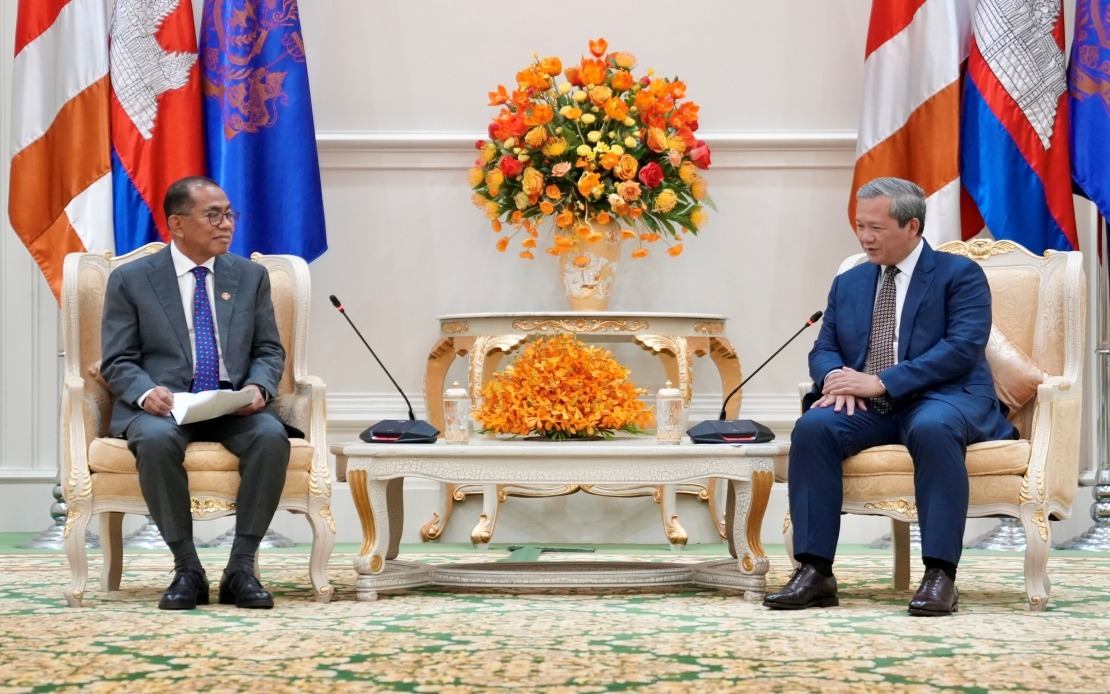
Malaysia and Cambodia are moving to significantly deepen their defence and security relationship, with Defence Minister Datuk Seri Mohamed Khaled Nordin signalling that the two nations remain committed to collaborative efforts that extend beyond bilateral concerns to encompass broader ASEAN regional resilience. During his recent visit to Phnom Penh, Nordin held substantive discussions with Cambodian Prime Minister Samdech Thipadei Hun Manet and Defence Deputy Prime Minister General Tea Seiha, underscoring the strategic importance both nations place on their military and strategic partnership as Southeast Asia navigates an increasingly complex geopolitical terrain.
Central to this renewed commitment is the impending finalisation of the Malaysia-Cambodia Defence Cooperation Memorandum of Understanding, a foundational agreement that will establish the institutional framework for expanded military collaboration between the two countries. This MoU, which is reportedly in its final negotiating stages, represents a formal codification of defence partnership that officials hope to ratify during the upcoming ASEAN Defence Ministers' Meeting in the Philippines. The completion of this agreement carries symbolic weight beyond mere bureaucratic procedure, as it demonstrates both nations' intention to transition from ad-hoc defence engagement to a structured, long-term strategic relationship that can weather political transitions and shifting diplomatic priorities.
The scope of defence cooperation outlined by Nordin reflects contemporary security challenges facing the region and signals Malaysia and Cambodia's recognition that traditional military cooperation must evolve to address emerging threats. The two countries have identified jungle warfare training, defence industry development, artificial intelligence applications, and drone technology as priority areas for joint development and knowledge sharing. These specific domains acknowledge that Southeast Asian security challenges extend beyond traditional interstate conflict to encompass transnational issues including border security, humanitarian operations, and technological domain operations—areas where Malaysian and Cambodian expertise and experience can complement one another effectively.
Regional stability, particularly concerning the Cambodia-Thailand border, featured prominently in these diplomatic discussions. Both nations emphasised the critical importance of maintaining dialogue and pursuing peaceful resolutions to persistent tensions in this traditionally volatile area. Malaysia's continued support for the ASEAN Observer Team mechanism reflects its diplomatic role as a respected regional intermediary and its commitment to employing multilateral frameworks rather than unilateral pressure to address security concerns. By positioning itself as a supporter of established ASEAN mechanisms and peaceful dialogue processes, Malaysia reinforces its image as a stabilising force rather than a provocateur in regional disputes.
The South China Sea's evolving status also featured in bilateral conversations, with both defence officials emphasising the urgency of finalising a Code of Conduct that would establish clear rules governing maritime activity in these strategically vital waters. Malaysia, as a South China Sea claimant state with significant economic interests in regional maritime commerce, maintains particular interest in ensuring that any COC framework preserves navigational freedoms and protects the rights of smaller nations to develop offshore resources. Cambodia's perspective on this issue, while differing from Malaysia's in some respects, nonetheless reflects broader ASEAN concerns about maintaining a rules-based order that prevents any single power from achieving hegemonic control over these contested waters.
Nordin's visits to both Vietnam and Cambodia during this diplomatic swing constitute part of a broader Defence White Paper implementation strategy focused on building what Malaysia terms "Credible Partnerships" under its Third Pillar of National Defence Strategy. This conceptualisation positions defence diplomacy as integral to Malaysia's overall strategic posture, recognising that military capability alone proves insufficient without robust relationships with neighbouring states and regional institutions. The inclusion of Malaysia's Chief of the Royal Malaysian Navy Admiral Tan Sri Zulhelmy Ithnain in the delegation underscores that these diplomatic engagements carry operational significance beyond symbolic gestures, with senior military officers directly involved in discussions regarding practical cooperation modalities.
The timing of these diplomatic overtures carries particular importance given Malaysia's recent conclusion of its ASEAN Chairmanship. Despite relinquishing the chair, Malaysian officials have explicitly stated that the country's commitment to regional peace and stability remains undiminished. This messaging addresses potential concerns that Malaysia might reduce its diplomatic engagement in regional affairs post-chairmanship and signals instead a sustained, institutionalised commitment to ASEAN centrality and multilateral cooperation. For Cambodia and other Southeast Asian nations, this consistency provides reassurance that Malaysia views its defence partnerships as long-term strategic commitments rather than temporary initiatives tied to rotational leadership roles.
Looking forward, both nations are evidently positioning their defence partnership with an eye toward commemorating seventy years of diplomatic relations in 2027, a milestone that provides both practical motivation and symbolic weight for advancing cooperation now. The establishment of robust defence cooperation frameworks in the present creates beneficial momentum heading into this significant anniversary, allowing both governments to point to concrete achievements in strengthening bilateral ties. This forward-looking perspective also reflects a broader Southeast Asian tendency to imbue bilateral relationships with long-term strategic significance, moving beyond transactional engagement toward genuine partnership characterised by shared institutional development and mutual capacity-building.
Malaysia's defence diplomacy across Southeast Asia more broadly demonstrates how smaller and mid-sized regional powers leverage defence partnerships to amplify their strategic influence without threatening larger powers. By engaging deeply with both Vietnam and Cambodia simultaneously, Malaysia cultivates diverse partnerships that prevent overreliance on any single power while simultaneously contributing to wider regional stability through multiple channels of communication and cooperation. This multi-directional engagement strategy reflects Malaysia's sophisticated understanding of Southeast Asian geopolitics, where maintaining equilibrium among competing interests requires constant diplomatic attention and demonstrated commitment to established mechanisms and relationships.
The emphasis on new technological domains including artificial intelligence and drone capabilities reflects recognition that modern defence challenges increasingly transcend conventional military spheres. Border security, maritime domain awareness, and regional crisis response increasingly depend on technological sophistication, data integration, and autonomous systems. Malaysia and Cambodia's willingness to collaborate in these emerging areas suggests both nations recognise that isolated technological development risks creating capability gaps and security vulnerabilities. Joint training and cooperative development in these domains can accelerate both nations' military modernisation while reducing individual investment burdens through shared research and development initiatives.
For Malaysian readers and policymakers, these developments carry implications extending beyond bilateral relations with Cambodia. The articulated defence partnership strategy reflects a coherent vision of Southeast Asian security predicated on ASEAN mechanisms, dialogue-based conflict resolution, and rules-based regional order. Malaysia's consistent advocacy for the Code of Conduct in the South China Sea, support for ASEAN Observer mechanisms, and investment in defence partnerships with multiple regional states collectively constitute a sophisticated strategy for shaping regional security architecture favourably to smaller powers' interests. As great power competition intensifies in Southeast Asia, Malaysia's approach of deepening regional partnerships and institutionalising multilateral cooperation provides a potential model for how smaller nations can maintain strategic autonomy while addressing shared security challenges.

