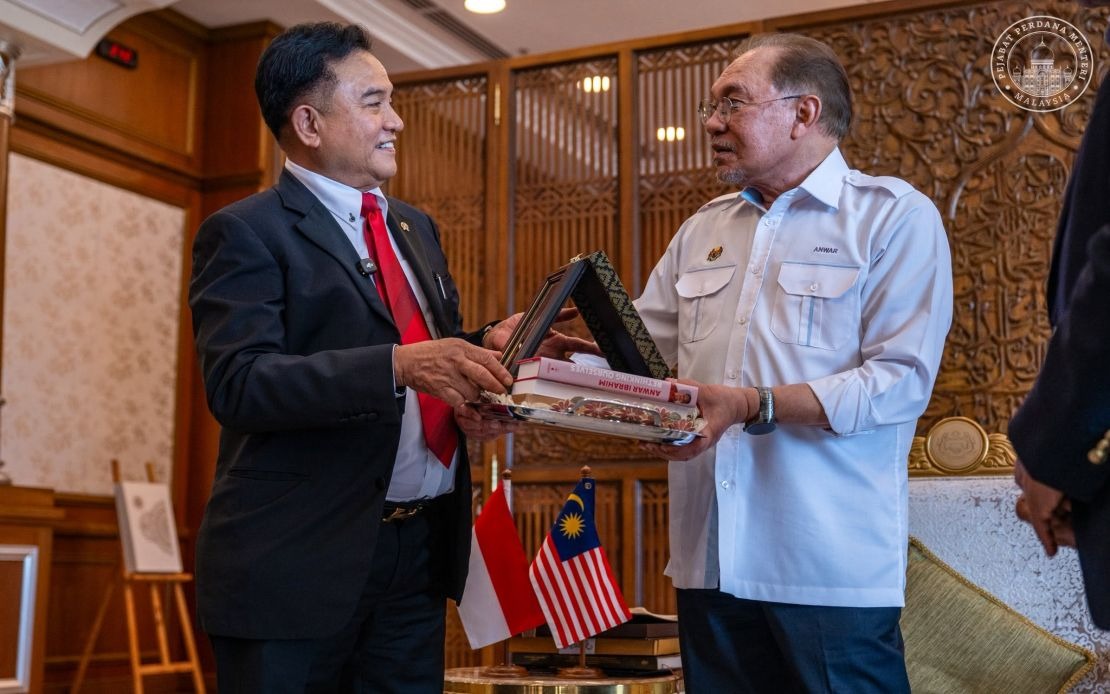
Malaysia and Indonesia are moving to fortify their partnership across legislative frameworks and administrative governance, with Prime Minister Datuk Seri Anwar Ibrahim confirming both nations' resolve to deepen engagement in these critical fields. The Malaysian leader made this declaration following a meeting at the Prime Minister's Office in Putrajaya with Indonesia's Coordinating Minister for Legal, Human Rights, Immigration and Correction, Prof Dr Yusril Ihza Mahendra, who visited as part of official bilateral consultations.
The discussion between Anwar, who concurrently holds the Finance Minister portfolio, and Prof Dr Mahendra centred on identifying concrete avenues through which the two Southeast Asian neighbours can harmonise their legislative approaches and administrative systems. Such coordination efforts hold considerable significance for the region, as Malaysia and Indonesia collectively represent a substantial portion of Southeast Asia's economic and political weight, and their alignment on governance matters can influence broader regional standards and practices.
Though specific legislative initiatives were not detailed in Anwar's account of the meeting, the focus on governance cooperation suggests attention to institutional efficiency, regulatory alignment, and procedural improvements that could facilitate smoother cross-border interactions. Both nations stand to benefit from examining successful governance models within each other's systems, particularly in areas where administrative processes directly affect citizen welfare and economic activity.
The emphasis on legal cooperation carries particular relevance given the complex transnational challenges confronting both countries. Immigration frameworks, human rights standards, and correction systems—all portfolio areas under Prof Dr Mahendra's remit—require thoughtful coordination to address issues such as labour mobility, people trafficking, and the treatment of detainees that inevitably involve both nationalities. Enhanced communication and shared best practices in these domains could strengthen protections for nationals on both sides of the border.
Anwar's characterisation of the relationship as involving "close fraternal relations" reflects the historical and cultural ties binding Malaysia and Indonesia, which extend far beyond formal diplomacy. The two nations share Malay language heritage, Islamic traditions, and interconnected trade networks that create natural synergies for cooperation. However, translating cultural affinity into concrete institutional improvements requires sustained engagement at the technical and ministerial levels, precisely the type of interaction represented by the Putrajaya meeting.
The timing of Prof Dr Mahendra's visit underscores the priority both governments assign to bilateral relations at the present moment. Indonesia, as the largest economy in Southeast Asia and a regional anchor power, maintains numerous bilateral partnerships, making the scheduling of high-level visits a signal of strategic attention. For Malaysia, deepening ties with its nearest major neighbour addresses both practical governance concerns and the broader objective of positioning the country as an integral actor within ASEAN frameworks.
Cooperation on legislative matters between Malaysia and Indonesia could yield tangible benefits across multiple sectors. Trade facilitation, for instance, might be enhanced through regulatory harmonisation that reduces compliance burdens for companies operating across both markets. Mutual recognition agreements on qualifications and certifications could improve labour mobility for skilled professionals, while coordinated approaches to emerging legal challenges—such as those posed by digital commerce and cryptocurrency regulation—could establish regional standards that reflect both nations' values and interests.
The human rights dimension of Prof Dr Mahendra's portfolio suggests that governance cooperation may extend to the normative frameworks governing individual freedoms and protections. Both Malaysia and Indonesia have faced international scrutiny regarding implementation of rights protections, and a bilateral dialogue on these matters, even conducted privately, indicates willingness to engage constructively on sensitive governance questions. Strengthening institutional mechanisms for rights protection serves both domestic legitimacy and regional credibility.
Anwar's invocation of progressing "peace, and well-being of the people" in both nations situates the bilateral agenda within a people-centred development framework rather than limiting cooperation to elite-level institutional mechanics. This framing suggests that improvements in legislative and governance cooperation are envisioned as ultimately benefiting ordinary citizens through more effective, responsive, and accountable administration in both countries. Whether measured through faster processing of cross-border applications, enhanced consumer protections, or clearer regulatory environments for business, the practical fruits of such cooperation should extend beyond government circles.
Looking forward, the breadth of cooperation envisioned—encompassing legislation, governance, and unspecified "strategic areas of mutual interest"—leaves considerable space for expanding the bilateral agenda as circumstances evolve. Regional challenges, from climate change mitigation requiring coordinated environmental governance to public health crises demanding harmonised quarantine and epidemiological protocols, create ongoing opportunities for Malaysia and Indonesia to develop joint institutional responses. The foundation laid through meetings such as that between Anwar and Prof Dr Mahendra provides the diplomatic infrastructure through which such expanded cooperation can be pursued.
For Malaysian observers and stakeholders, the strategic significance of strengthened Indonesia ties warrants attention to how legislative and governance improvements translate into practical benefits. Business communities may find new opportunities through streamlined cross-border regulations, while civil society organisations may identify prospects for collaborative advocacy on shared governance challenges. The depth to which both nations commit to translating the rhetorical commitment evident in ministerial statements into substantive institutional change will ultimately determine whether this bilateral engagement yields its full potential for mutual advancement.

