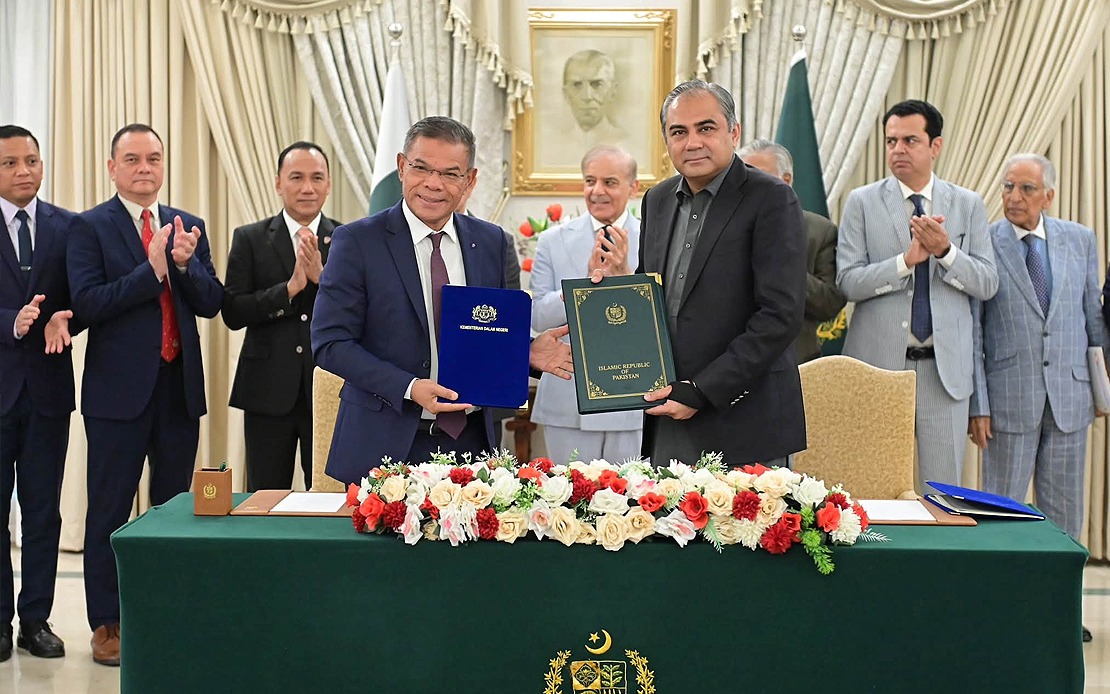
Malaysia and Pakistan have taken a significant step in their bilateral relationship by formalising the International Transfer of Prisoners (ITOP) Treaty, a legal instrument designed to streamline the movement of nationals between the two countries's prison systems. Home Minister Datuk Seri Saifuddin Nasution Ismail signed the agreement during an official visit to Islamabad, where he was received by Pakistan Interior and Narcotics Control Minister Syed Mohsin Raza Naqvi and witnessed by Prime Minister Muhammad Shehbaz Sharif at the Prime Minister's Office. The ceremonial signing underscores both nations' commitment to deepening institutional cooperation beyond traditional diplomatic channels.
The treaty represents the culmination of extensive bilateral negotiations spanning five negotiating rounds since September 2025, involving multiple Malaysian government agencies. The Home Ministry coordinated efforts alongside the Foreign Ministry, Attorney General's Chambers, Malaysian Prisons Department, and Royal Malaysia Police to craft a framework acceptable to both jurisdictions. The Malaysian Cabinet had already endorsed the agreement on 13 May, reflecting domestic consensus on the arrangement's importance and merit.
At its core, the ITOP Treaty addresses a longstanding challenge in bilateral criminal justice cooperation: the situation of nationals imprisoned abroad. Malaysian citizens currently incarcerated in Pakistani facilities will now have the option to be transferred back to Malaysia to complete their sentences, while Pakistani nationals serving time in Malaysian prisons can similarly be repatriated. This reciprocal arrangement eliminates the previous administrative and logistical barriers that may have complicated such transfers, creating a standardised legal pathway for both countries' authorities to facilitate these movements.
Beyond the mechanics of prisoner movement, the treaty emphasises humanitarian and rehabilitative dimensions that will resonate with policymakers across Southeast Asia grappling with prison reform. Officials from both countries recognise that incarcerated individuals often experience psychological and cultural hardship when separated from family and community networks in foreign detention facilities. By enabling transfer to home jurisdictions, the treaty acknowledges that rehabilitation outcomes frequently improve when inmates serve their sentences in environments culturally and linguistically familiar to them, where family visitation and community reintegration become logistically feasible.
The rehabilitation aspect carries particular weight in Malaysia's criminal justice philosophy, which has increasingly emphasised reformatory rather than purely punitive approaches. Malaysian prisons have invested substantially in vocational training, educational programmes, and psychological counselling, infrastructure that can be better leveraged when prisoners are housed domestically. Similarly, Pakistani correctional facilities can apply culturally appropriate intervention strategies when their nationals are incarcerated at home, potentially enhancing reintegration prospects for both populations upon release.
For Malaysia specifically, this treaty positions the country as a mature participant in regional security architecture. As an ASEAN member navigating complex relationships with South Asian powers, Malaysia's ability to negotiate sophisticated bilateral agreements on sensitive criminal justice matters demonstrates institutional capability and diplomatic sophistication. The agreement also addresses a practical concern: Malaysian citizens imprisoned abroad represent a constituency with domestic political implications, and enabling their repatriation fulfils a basic obligation of citizenship while reducing long-term incarceration costs borne by foreign prison systems.
The treaty's signing occurs within a broader context of Malaysia-Pakistan relations spanning decades of diplomatic, cultural, and security collaboration. Pakistan remains significant to Malaysia as a fellow Muslim-majority nation with whom Malaysia shares educational and defence partnerships, and criminal justice cooperation naturally extends this multifaceted engagement. However, the treaty also reflects contemporary realities: both countries confront transnational crime challenges including narcotics trafficking, organised crime, and terrorism-related offences that occasionally result in prosecutions in each other's jurisdictions.
From a regional perspective, Malaysia's willingness to formalise prisoner transfer arrangements with Pakistan may establish precedent for similar agreements with other bilateral partners. Southeast Asian nations have increasingly recognised that standardised mechanisms for prisoner transfers enhance overall security cooperation and reduce opportunities for criminal networks to exploit jurisdictional gaps. Thailand, Indonesia, and Singapore have pursued comparable bilateral arrangements, creating an emergent regional norm around prisoner repatriation that aligns individual countries' justice systems while respecting national sovereignty.
The timing of the agreement also reflects evolving South Asian engagement with Southeast Asia, particularly under current Pakistani leadership. Prime Minister Muhammad Shehbaz Sharif's administration has prioritised strengthening bilateral ties across multiple domains, and his personal witnessing of the treaty signing signals Pakistan's commitment to formalising what were previously informal or ad-hoc arrangements. This institutionalisation reduces transaction costs for both governments when confronted with prisoner transfer requests, replacing diplomatic negotiation with established legal procedures.
For Malaysian and Pakistani nationals currently detained in each other's countries, the treaty's entry into force will eventually enable applications for transfer based on specified criteria, though implementation details and timelines remain to be clarified through subsequent bilateral protocols. The agreement also establishes legal foundations for cooperation on other criminal justice matters, potentially including information sharing about transnational offenders, witness protection arrangements, and mutual legal assistance—areas critical to contemporary law enforcement in a globalised crime environment.
Home Minister Saifuddin Nasution characterised the treaty as emblematic of Malaysia-Pakistan relations' depth, noting that it constitutes another legal instrument strengthening the bilateral partnership's security architecture. Such characterisations reflect the Malaysian government's broader strategy of positioning criminal justice cooperation as integral to national security rather than merely administrative convenience. This framing aligns prisoner transfers with counterterrorism, organised crime prevention, and regional stability objectives, elevating their significance within government priorities.
Looking forward, the ITOP Treaty's practical impact will depend substantially on implementation mechanisms and political will on both sides. Historical patterns in bilateral prisoner transfers have sometimes encountered logistical delays or bureaucratic complications even where formal agreements existed. Malaysia and Pakistan will need to establish clear timelines for processing transfer applications, coordinate security screening procedures, and manage documentation requirements efficiently. The treaty's success will ultimately be measured not merely by its signing but by the streamlined movement of prisoners it enables and the rehabilitative outcomes it facilitates for incarcerated individuals.
The agreement represents a strategic investment in bilateral stability and humanitarian criminal justice practices. For Malaysia, it reinforces the nation's commitment to sophisticated diplomatic engagement beyond ASEAN, demonstrates capacity to negotiate complex security arrangements, and fulfils citizenship obligations to nationals abroad. For Pakistan, it strengthens ties with a strategically important Southeast Asian partner while addressing a mutual interest in prisoner management and rehabilitation. Together, the treaty exemplifies how nations with shared values can construct practical legal frameworks addressing contemporary transnational challenges.

