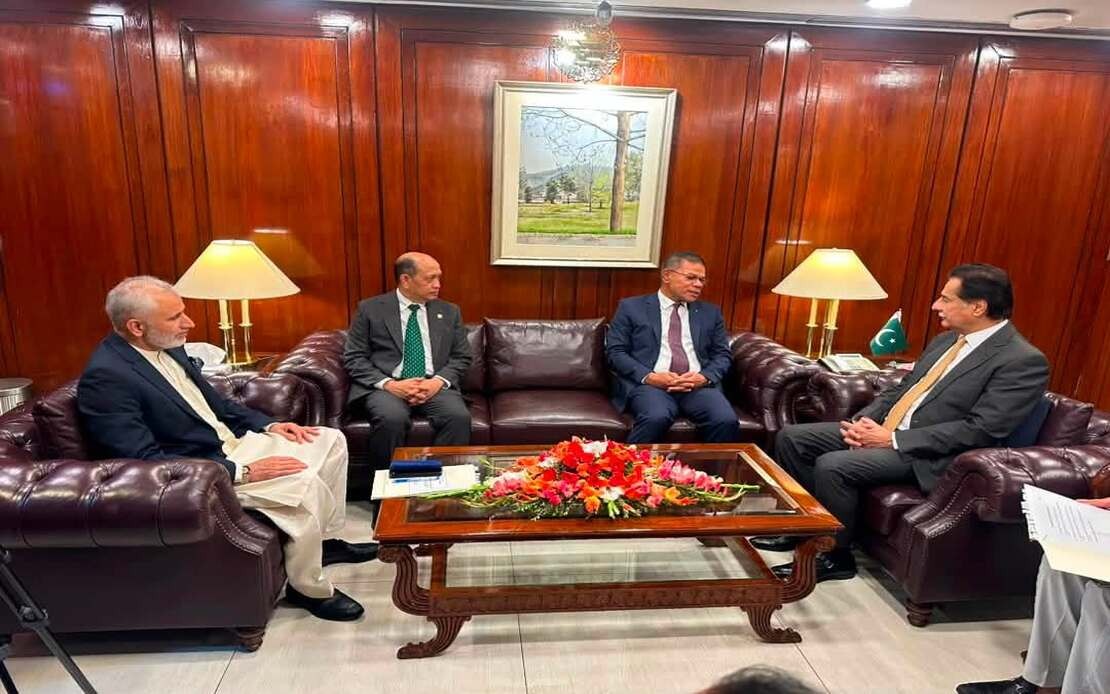
Malaysia and Pakistan have reaffirmed their commitment to resolving contemporary geopolitical tensions through dialogue and peaceful engagement, according to remarks by Home Minister Datuk Seri Saifuddin Nasution Ismail during an official visit to Islamabad. The statement comes as both nations, situated in strategically important regions of Asia, navigate an increasingly complex international security environment marked by regional disputes and emerging power rivalries. Saifuddin Nasution's emphasis on dialogue reflects a broader regional consensus that military solutions to conflict remain counterproductive, particularly in South and Southeast Asia where economic interdependence has become paramount.
During the second day of his official mission to Pakistan, Saifuddin Nasution held substantive discussions with Sardar Ayaz Sadiq, Speaker of Pakistan's National Assembly, and paid a courtesy call on Syed Yousaf Raza Gilan, chairman of Pakistan's Senate. These encounters between senior parliamentary figures represent an important channel for engagement between the two Commonwealth nations, allowing for frank exchanges on matters of mutual concern beyond the formal protocols of diplomatic channels. The meetings provided both delegations with a platform to assess bilateral relations comprehensively and identify areas where cooperation might be deepened or expanded.
The Malaysian minister highlighted his country's particular approach to maintaining regional stability, drawing on Malaysia's experience within ASEAN as a multilateral framework for resolving disputes. ASEAN's emphasis on non-interference, consensus-building, and the peaceful settlement of differences has allowed the ten-member organization to maintain cohesion despite the presence of major power competition and conflicting national interests within Southeast Asia. By sharing this experience with Pakistani counterparts, Saifuddin Nasution essentially offered a model of institutional cooperation that the South Asian region might learn from as it grapples with its own security challenges and bilateral tensions.
The bilateral relationship between Malaysia and Pakistan is anchored in shared historical experiences, including their common Islamic heritage and their joint legacy as former British colonies that transitioned to independent statehood during the mid-twentieth century. Beyond these historical foundations, the two countries maintain people-to-people connections through diaspora communities and cultural exchanges that have accumulated over decades. Trust and mutual respect form the bedrock of contemporary relations, according to official statements, though the relationship remains somewhat underutilized in terms of its economic potential and strategic coordination.
A particularly significant aspect of the meetings centred on strengthening parliamentary diplomacy and institutional exchange between the two nations. The Home Minister emphasized the importance of expanding connections between Malaysia's Parliament and Pakistan's legislative bodies, recognizing that sustained engagement at the institutional level helps insulate bilateral ties from temporary fluctuations in executive-level relations. Parliamentary diplomacy, which involves direct engagement between legislators across different countries, has proven valuable in building personal relationships and understanding between elected representatives, thereby creating informal networks that can facilitate cooperation on shared challenges.
Saifuddin Nasution's visit to Pakistan's Parliament Museum provided insights into the evolution of democratic institutions in that country, including the development of its constitutional frameworks and parliamentary traditions. Pakistan's parliamentary system, despite periodic disruptions and constitutional challenges over its seven-decade history, remains a distinctive feature of South Asian governance. The museum visit served both a symbolic and educational function, demonstrating Malaysia's interest in understanding Pakistan's institutional development and the trajectory of democratic practice within South Asia.
For Malaysia, engagement with Pakistan carries implications beyond bilateral concerns. Pakistan occupies a pivotal position in South Asian geopolitics, bridging Central Asia and the Indian Ocean region while maintaining significant security relationships with major powers including China and the United States. Malaysian policymakers recognize that Pakistan's stability and regional role influence broader Asian strategic dynamics. Additionally, Pakistan hosts substantial Malaysian business interests and serves as a transit point for Malaysian engagement with Central Asian markets, making the relationship commercially significant beyond its political dimensions.
The emphasis on dialogue and peaceful resolution reflects the shared recognition that both nations face terrorism threats, economic development challenges, and the complex reality of major power competition in their respective regions. By prioritizing constructive engagement and institutional exchange, Malaysia and Pakistan signal their commitment to avoiding zero-sum competition while pursuing their respective national interests. This approach resonates with current international trends favouring multilateralism and dialogue-based conflict prevention, though implementation remains perpetually challenging in contested geopolitical spaces.
The timing of such high-level visits and parliamentary exchanges holds particular significance given the volatile regional security environment affecting both South and Southeast Asia. China's growing assertiveness, border tensions in South Asia, and maritime disputes in Southeast Asian waters have created a complex backdrop against which bilateral and regional relationships must be managed. Malaysia and Pakistan, as relatively moderate and developmentally focused nations, have chosen to emphasize the common ground in their approaches to regional stability, positioning themselves as voices for constructive engagement rather than confrontation.
Looking ahead, the reinforcement of Malaysia-Pakistan ties through parliamentary and ministerial engagement suggests that both countries view their relationship as a stabilizing factor in their respective regions. The expansion of institutional connections between the two nations could yield practical benefits in areas including security cooperation, economic partnership, and cultural exchange. For Malaysian readers, this engagement underscores their country's broader diplomatic strategy of maintaining diverse relationships across Asia while promoting multilateral solutions to shared challenges.

