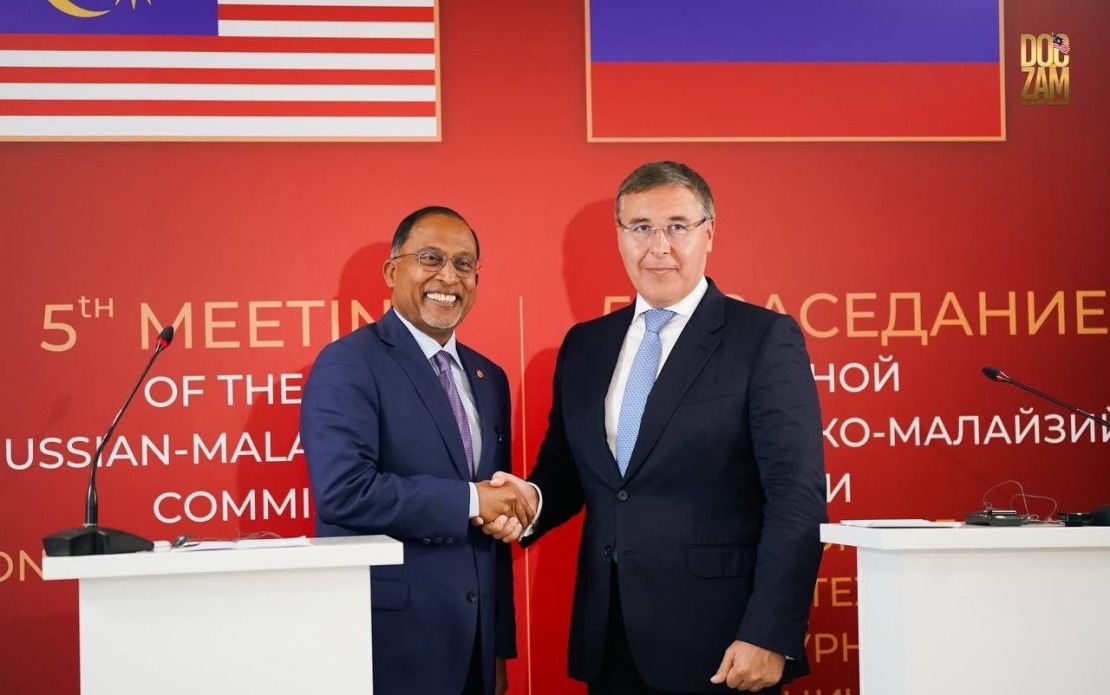
Malaysia and Russia have pledged to complete their 2027 Joint Action Plan before the year closes, signalling a shift towards more purposeful and structured engagement between the two nations. Higher Education Minister Datuk Seri Dr Zambry Abd Kadir announced the commitment following the Fifth Meeting of the Malaysia-Russia Joint Commission for Economic, Scientific, Technical and Cultural Cooperation in Vladivostok, where he represented Malaysia alongside Russian Minister of Science and Higher Education Valery Falkov.
The timing of this agreement carries significance for bilateral relations, as it builds momentum from high-level diplomatic exchanges involving His Majesty Sultan Ibrahim, King of Malaysia, Russian President Vladimir Putin, and Prime Minister Datuk Seri Anwar Ibrahim. Rather than allowing ties to remain at the ceremonial level, the latest commission meeting sought to convert these political commitments into tangible cooperative initiatives that will have measurable impact across multiple sectors.
Education represents a cornerstone of the bilateral partnership. Russia will maintain an annual commitment of 40 Government scholarships for Malaysian students, ensuring a steady pipeline of talent gaining exposure to Russian academic institutions. Beyond scholarship provision, both nations have embraced more ambitious educational ventures. A inaugural Malaysia-Russia Rectors' Forum is slated for 2027, bringing together university leaders to identify shared research priorities and institutional partnerships. The MAI-UniKL Russian Aerospace Programme expansion opens additional pathways for specialised training, particularly valuable given Malaysia's developing aerospace sector and strategic interest in technological advancement.
Youth engagement features prominently in the revised bilateral agenda. The Malaysia-Russia Youth Leadership Summer Camp represents an innovative approach to fostering people-to-people connections among the younger generation, creating networks that extend beyond governmental frameworks and potentially shape long-term regional relationships. Such initiatives acknowledge that sustained cooperation depends on building understanding and collaboration among future decision-makers and professionals across both societies.
Trade and agricultural dimensions reveal practical economic considerations driving the partnership. The two countries have committed to broadening market access and strengthening commercial ties, with particular emphasis on fertiliser cooperation including urea supply chains. This focus on agricultural inputs directly addresses Malaysia's food security concerns, recognising that Russia possesses substantial fertiliser production capacity and supply reliability beneficial to Southeast Asian agricultural systems dependent on external input sources.
Strategic sector cooperation has expanded considerably, encompassing artificial intelligence, digital technology, smart cities, and information security. These technology-focused areas reflect both nations' recognition that contemporary geopolitical and economic competition hinges on digital capabilities and innovation leadership. The inclusion of telecommunications and renewable energy cooperation positions both countries to address contemporary challenges around sustainability and digital transformation. Nuclear energy exploration, contingent on respective legal and regulatory frameworks, signals long-term thinking about energy security and technological partnership.
Financial cooperation has also deepened through institutional channels. Bank Negara Malaysia and the Bank of Russia have engaged in discussions exploring how Labuan might serve as a gateway for ASEAN-Russia financial interactions, leveraging Malaysia's existing position as a regional financial hub. Islamic finance cooperation opens another avenue, acknowledging Malaysia's expertise in Shariah-compliant financial instruments and Russia's interest in diversifying its financial partnerships. Digital assets collaboration reflects contemporary finance trends both nations recognise as increasingly relevant.
Three university cooperation agreements were formalised during the meeting, demonstrating concrete institutional commitments. Universiti Teknologi MARA partnerships with the National Research University Moscow Power Engineering Institute and the Institute of Experimental Medicine, alongside Universiti Tun Hussein Onn Malaysia's agreement with the State University of Land Use Planning, establish formal channels for academic exchange and joint research undertakings. Such institutional partnerships create lasting collaborative frameworks that persist regardless of political fluctuations.
Expanded cooperation now encompasses industrial, healthcare, transport, green technology, climate change, creative economy, and space sectors, indicating a comprehensive approach to bilateral engagement rather than narrow sectoral focus. This breadth suggests both governments view the relationship as strategically multifaceted, with potential benefits spanning economic diversification, technological advancement, and cultural exchange.
Malaysia's designation as host for the sixth Joint Commission meeting in 2027 carries particular symbolic weight, coinciding with the 60th anniversary of diplomatic relations established between the two nations. This milestone timing provides opportunity for formal recognition of the relationship's historical trajectory while cementing frameworks for the subsequent decade of cooperation. The decision to schedule the joint action plan's completion before year-end ensures implementation mechanisms are in place when this commemorative gathering occurs.
For Malaysian stakeholders, this deepening Russia engagement offers diversification benefits in several dimensions. Educational partnerships provide alternative advanced training opportunities outside Western-dominated systems, technology cooperation provides access to Russian expertise in specific domains, agricultural input security addresses food supply vulnerabilities, and financial innovation through Labuan strengthens Malaysia's regional financial role. The emphasis on mutual respect and benefit that Zambry articulated frames the partnership as reciprocal rather than hierarchical, essential framing for sustainable bilateral relations.

