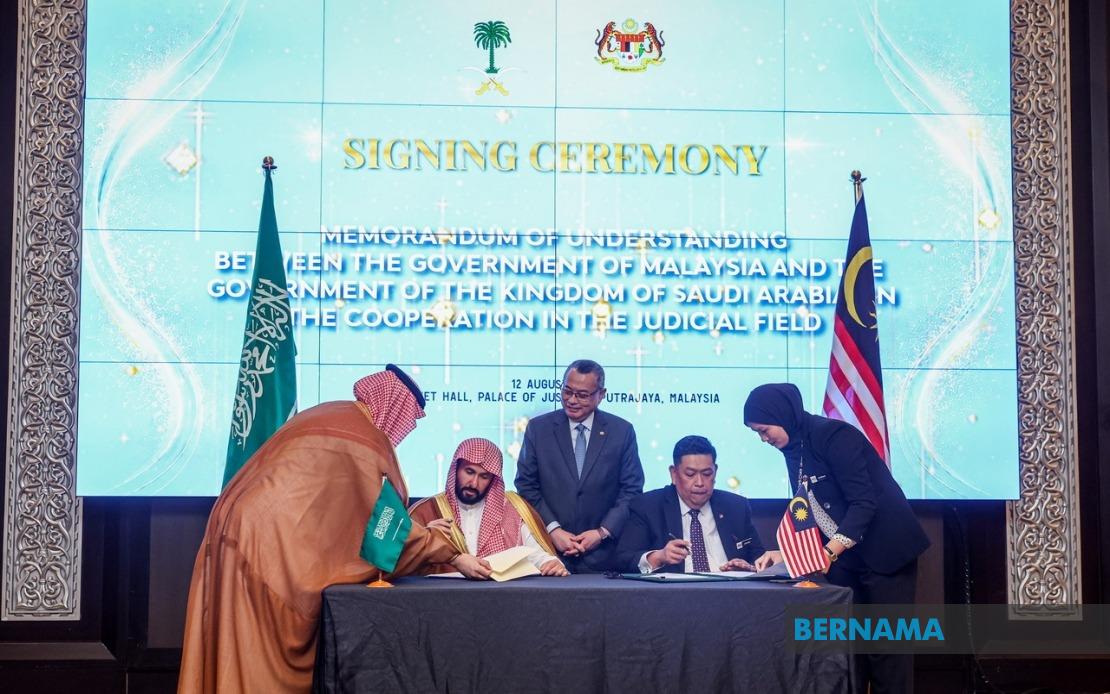
Malaysia and Saudi Arabia have formalised their commitment to stronger judicial collaboration by signing a memorandum of understanding at the Palace of Justice in Putrajaya on August 12. Chief Registrar of the Federal Court of Malaysia Azhaniz Teh Azman Teh and Saudi Arabian Minister of Justice Sheikh Dr Waleed Mohammed Alsmani executed the agreement, with Chief Justice Tun Wan Ahmad Farid Wan Salleh present as witness to underscore the significance of the initiative. The accord represents a strategic step in bilateral relations, particularly as the two nations seek to harmonise judicial practices and institutional frameworks across the region.
The memorandum establishes a structured foundation for collaboration spanning multiple dimensions of the judicial system. Civil case management techniques form a core pillar of the engagement, allowing both countries to exchange methods for streamlining litigation processes and improving case disposition rates. Equally important is the emphasis on judicial technology and digitalisation—areas where Malaysia has made substantial progress through its e-Court system, which the kingdom is keen to study and potentially adapt for its own modernisation agenda. The framework also encompasses the systematic exchange of publicly available judicial information, enabling both nations to maintain transparency while building mutual understanding of legal developments and jurisprudential trends.
Institutional visits and regular exchanges of judicial officers will form the practical backbone of this cooperation. Through direct engagement between courts and justice sector professionals, Malaysian judges and administrators can share insights about managing court operations at scale, while their Saudi counterparts bring perspectives from one of the world's largest and most complex judicial systems. The arrangement acknowledges that modern judiciaries benefit substantially from peer learning, where exposure to different approaches to common challenges—from case backlog management to technological integration—can yield innovative solutions applicable to local contexts.
A particularly noteworthy dimension of the discussions centred on Malaysia's judicial response to sexual offences against children, a topic of pressing concern across Southeast Asia and the broader Muslim world. The Malaysian Judiciary has developed specialised approaches and protocols for handling such sensitive matters, balancing procedural justice with victim protection and the dignity of those involved. By sharing this expertise, Malaysia positions itself as a knowledge leader in judicial safeguarding practices, while Saudi Arabia gains access to methodologies that have been tested and refined within a jurisdiction with similar cultural and religious reference points. This element of the MoU transcends mere technical exchange and speaks to shared values regarding child protection.
The e-Court system emerged as a flagship topic during dialogues between the delegations. Malaysia's investment in court digitalisation—encompassing case filing, document management, evidence submission, and judgement delivery through electronic platforms—represents years of incremental technological advancement. The system addresses perennial challenges facing any large judiciary: reducing physical case file storage, accelerating case progression, improving accessibility for litigants and legal professionals, and creating audit trails that enhance accountability. Saudi Arabia's interest in this model reflects a broader regional trend toward digital transformation in government services, and the willingness of the Malaysian Judiciary to facilitate knowledge transfer strengthens bilateral relations while contributing to judicial modernisation across the Islamic world.
From Malaysia's perspective, this agreement carries strategic significance in multiple registers. Diplomatically, it reinforces ties with a key Gulf nation and demonstrates Malaysia's role as a thought leader in Islamic judicial administration and institutional excellence. Economically, closer judicial cooperation can facilitate smoother dispute resolution for the growing volume of bilateral trade and investment, reducing friction in commercial relationships. For the Malaysian Judiciary itself, the partnership enhances its standing internationally and provides opportunities for judicial officers to engage with peers from a vastly different context, potentially refreshing approaches to entrenched problems.
The timing of Saudi Minister Sheikh Dr Waleed Mohammed Alsmani's official visit underscores both nations' commitment to moving beyond ceremonial engagement toward substantive institutional development. The accompanying programme, featuring judicial dialogues and courtesy calls on senior judicial leadership, reflects a deliberate tempo and seriousness in the negotiations. Such structured visits establish accountability for implementation and signal to both judiciaries that this is not a symbolic gesture but a commitment requiring sustained effort and resource allocation.
For Southeast Asia more broadly, this development illustrates how judicial cooperation agreements are becoming increasingly sophisticated and practical. Rather than limiting themselves to aspirational language about shared values, contemporary MOUs target specific operational challenges and create mechanisms for continuous engagement. This model, if successful between Malaysia and Saudi Arabia, could serve as a template for other regional judicial partnerships seeking to move beyond generic commitments to concrete collaborative projects.
The implementation phase will reveal whether the framework translates into tangible outcomes. Success will depend on whether both judiciaries allocate adequate resources to facilitate officer exchanges, whether Malaysian technical experts can effectively communicate their e-Court system knowledge to Saudi counterparts, and whether the insights gained about child protection cases yield practical improvements in either jurisdiction. The Office of the Chief Registrar's statement expressing the Malaysian Judiciary's eagerness for successful implementation suggests institutional readiness, though execution timelines and specific deliverables will likely emerge in subsequent working group meetings between the two systems.

