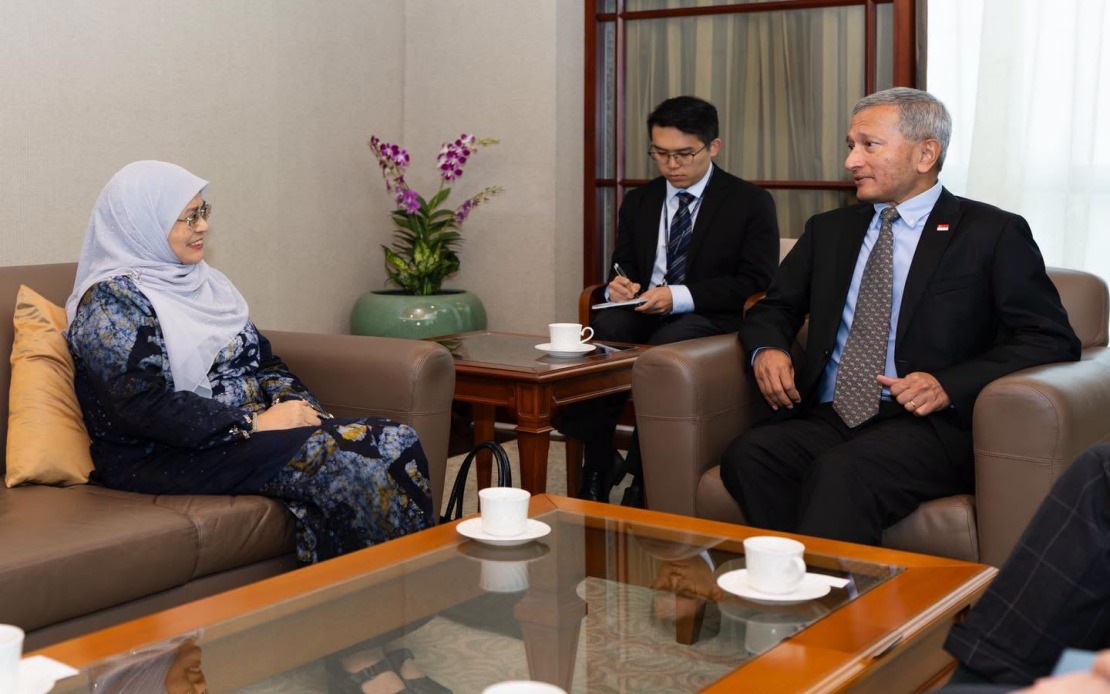
Malaysia and Singapore have reaffirmed their dedication to sustaining and expanding cooperation across multiple sectors, underscoring the strategic importance of their longstanding partnership in the region. The commitment was reinforced during a formal meeting between Singapore's Foreign Minister Dr Vivian Balakrishnan and Datin Paduka Anizan Siti Hajjar Adnin, who recently assumed office as Malaysia's High Commissioner to Singapore, according to a statement from the Malaysian High Commission.
The introductory courtesy call, which took place on Wednesday, served as an opportunity for both nations to reaffirm their shared vision for enhanced bilateral engagement. The discussion centred on maintaining the positive trajectory that has characterized Malaysia-Singapore relations, despite occasional tensions that periodically surface between the neighbouring states. The timing of such formal exchanges reflects the diplomatic protocols that underpin the relationship, signalling continuity and stability in governance at the highest levels.
During their engagement, officials from both countries explored concrete pathways to deepen cooperation while prioritizing the welfare of their respective populations. A particular focus was placed on the substantial cross-border communities—families, entrepreneurs, and workers—who maintain livelihoods and personal ties spanning both nations. For many Malaysians and Singaporeans, the border represents not a barrier but a gateway to economic opportunity, with hundreds of thousands commuting daily for employment, education, and social connection. The emphasis on improving conditions for these groups reflects recognition of the human dimension underlying state-to-state relations.
Foreign Minister Balakrishnan characterized the Malaysia-Singapore relationship as exceptionally distinctive, built upon foundations that extend beyond conventional diplomatic arrangements. He identified three pillars sustaining the partnership: shared historical experiences rooted in their joint emergence from British colonial governance, robust people-to-people connections that transcend official channels, and extensive institutional cooperation spanning defence, economics, environmental management, and cultural exchange. This multifaceted framework has enabled the two nations to navigate challenges that might otherwise destabilize smaller bilateral relationships.
Balakrishnan's endorsement of High Commissioner Anizan carries significance beyond ceremonial acknowledgment. His public statement highlighted her extensive diplomatic background and implicit confidence in her ability to advance the relationship forward. The Foreign Minister's emphasis on building upon the work of her predecessors suggests awareness of institutional continuity while signalling openness to new initiatives. High Commissioner Anizan's appointment represents Malaysia's investment in skilled representation at this critical posting, where the envoy serves as the primary architect of day-to-day diplomatic engagement.
The new High Commissioner officially commenced her role on July 2, 2026, arriving at a moment when Malaysia-Singapore ties face both opportunities and complexities. Regional economic integration, digital transformation, and climate considerations dominate the contemporary bilateral agenda. Her appointment follows an established pattern of Malaysia deploying senior diplomatic personnel to Singapore, reflecting the relationship's significance within Malaysia's broader foreign policy architecture. The position demands individuals capable of managing sensitivities while identifying collaborative possibilities across the full spectrum of governmental and societal interaction.
From a Malaysian perspective, Singapore represents the nation's closest and most economically intertwined neighbour. The city-state serves as a crucial hub for Malaysian trade, finance, and investment flows into global markets. Conversely, Singapore's strategic interests are deeply tied to stability and prosperity in its immediate regional environment, making Malaysia partnership indispensable to its own security and prosperity calculus. This mutual interdependence creates both incentives for cooperation and potential friction points requiring careful diplomatic management.
The emphasis during this courtesy call on exploring avenues to enhance citizens' lives across the border addresses practical concerns affecting millions. Cross-border workers constitute a significant portion of Singapore's workforce, particularly in construction, domestic service, and lower-skilled sectors. Meanwhile, many Malaysians depend on Singapore employment for household income and remittances. Policy coordination on labour standards, taxation, social security, and immigration procedures directly impacts these populations' welfare. Bilateral dialogue at ministerial level facilitates resolution of administrative obstacles that accumulate at lower bureaucratic levels.
Looking forward, the reaffirmation of commitment carries implications extending throughout Southeast Asia. A stable and cooperative Malaysia-Singapore relationship provides foundation for broader ASEAN cohesion and regional stability. Conversely, deterioration in their ties can reverberate throughout the organization, complicating responses to transnational challenges including maritime security, environmental degradation, and pandemic preparedness. The formal nature of this diplomatic exchange, with prominent coverage in official statements, signals both nations' intention to maintain this positive trajectory.
For Malaysian readers, the substance of this bilateral engagement merits attention for its practical implications. Malaysian businesses investing in Singapore, workers seeking employment across the causeway, students pursuing education in the city-state, and families navigating cross-border relationships all benefit from stable, cooperative governance frameworks. The commitment articulated by both nations' senior officials provides reassurance that diplomatic channels remain functional and that leadership on both sides prioritizes pragmatic partnership over inflammatory rhetoric.

