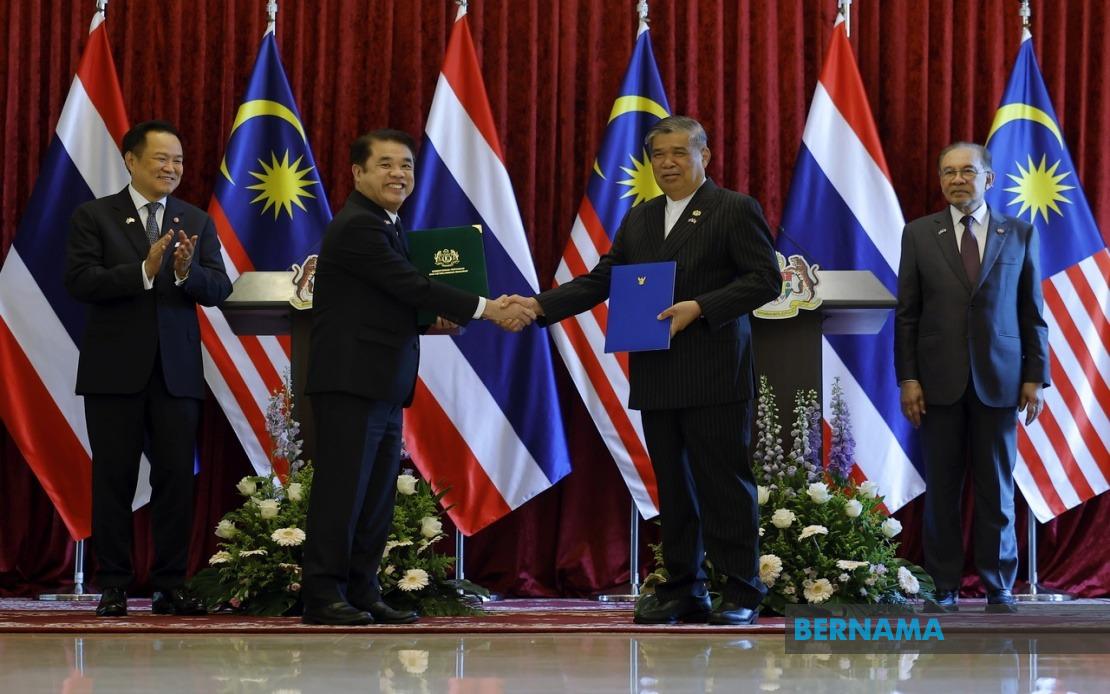
Prime Minister Datuk Seri Anwar Ibrahim and Thai counterpart Anutin Charnvirakul have inked a comprehensive memorandum of understanding aimed at broadening the agricultural partnership between Malaysia and Thailand, marking a significant step forward in regional food security and economic cooperation. The agreement, formalised during bilateral talks in Putrajaya on Thursday, encompasses collaboration across crops, livestock, fisheries, research and development, technology sharing, workforce training, and food security initiatives—a sweeping agenda that underscores both nations' commitment to leveraging their combined agricultural resources.
The resolution of longstanding market access complications involving shrimp and barramundi exports represents a particularly meaningful breakthrough for both economies. These sectors have long been sources of friction in bilateral trade negotiations, with farmers and exporters in both countries affected by tariff barriers and regulatory obstacles. By agreeing to expedite implementation of measures addressing these concerns, Malaysia and Thailand have demonstrated a willingness to move beyond protectionist instincts and embrace mutually beneficial commerce. The agriculture ministers from both countries now carry responsibility for accelerating these trade facilitation efforts, signalling that high-level political backing exists for meaningful reform.
This agricultural accord sits within a broader framework of economic ambition. The two governments have jointly recommitted to reaching US$30 billion in bilateral trade in the near term, a target that reflects confidence in their economic trajectory even as regional supply chains face volatility. The emphasis on food security cooperation—particularly relevant given climate change pressures and population growth across Southeast Asia—suggests that policymakers recognise agricultural stability as foundational to regional prosperity. By formalising technology transfer mechanisms, both countries position themselves to modernise farming practices, increase yields, and enhance competitiveness in global markets.
Thai Government Spokesperson Ratchada Thanadirek elaborated that the scope of cooperation extends beyond agriculture into trade, investment, tourism, infrastructure, and security dimensions. This holistic approach reflects the reality that economic integration requires coordination across multiple fronts. By threading together infrastructure development, supply chain resilience in energy and high-technology sectors, and tourism initiatives, the partnership creates interconnected incentives for both nations to deepen institutional ties. Such comprehensive frameworks tend to prove more durable than single-issue agreements, as each pillar reinforces the others.
The timing of Anutin's visit—his first bilateral trip to Malaysia since his reappointment in March 2026—carries symbolic weight. It demonstrates that despite Thai domestic political complexities, the government prioritises regional partnerships and bilateral relationships. For Malaysia, the visit signals an opportunity to anchor Thailand into a stronger economic orbit while also positioning itself as a regional connector across Southeast Asia. The bilateral relationship carries particular significance given shared maritime boundaries, overlapping fishing grounds, and integrated supply chains in agriculture and manufacturing.
A tangible manifestation of this commitment will unfold on Friday when both prime ministers jointly officiate the opening of a critical cross-border infrastructure link. The road connecting the Immigration, Customs, Quarantine and Security Complex in Bukit Kayu Hitam, Kedah, to the Customs, Immigration and Quarantine Complex in Sadao, Thailand, promises to substantially streamline the movement of goods, people, and services across this vital border crossing. Such infrastructure improvements reduce transaction costs, facilitate faster clearing times, and encourage legitimate trade while enhancing security oversight. The symbolic significance of two prime ministers jointly inaugurating this facility underscores political commitment to deepening integration.
For Malaysian agricultural stakeholders, the MoU creates structured pathways to access Thai markets and technology while also opening domestic markets to Thai producers. The technology transfer provisions are particularly noteworthy, offering opportunities for Malaysian farmers to adopt Thai innovations in tropical agriculture, irrigation management, and pest control—areas where Thailand has developed considerable expertise. Conversely, Malaysian strengths in certain value-added agricultural sectors and food processing can benefit Thai counterparts.
The reference to preparing for the 70th anniversary of diplomatic relations in 2027 indicates that both governments view this moment as foundational to a renewed partnership. By tasking agencies to expedite pending memoranda of understanding and implement agreed measures swiftly, Thai Prime Minister Anutin has signalled that bureaucratic delays will not impede progress. This kind of high-level directive typically accelerates implementation across both governments, creating momentum that can overcome institutional inertia.
For the broader Southeast Asian context, this agricultural cooperation between two major regional economies sets a precedent for how nations can resolve trade frictions while pursuing larger strategic objectives. As the region grapples with food security concerns exacerbated by climate uncertainty and global supply chain disruptions, bilateral and multilateral agricultural partnerships become increasingly vital. Malaysia and Thailand's approach—combining market access improvements with technology sharing and human resource development—offers a model that other ASEAN members might emulate.
The focus on supply chain cooperation in food security, energy, and high-technology sectors reflects evolving regional geopolitics. Both countries recognise that economic resilience depends on diversifying suppliers and reducing vulnerability to external shocks. By weaving agricultural cooperation into a broader tapestry of strategic partnerships, Malaysia and Thailand create dependencies that anchor their relationship while addressing genuine economic needs. This moves beyond traditional trade agreements into the realm of structural interdependence—a development that typically produces more durable political and economic benefits.

