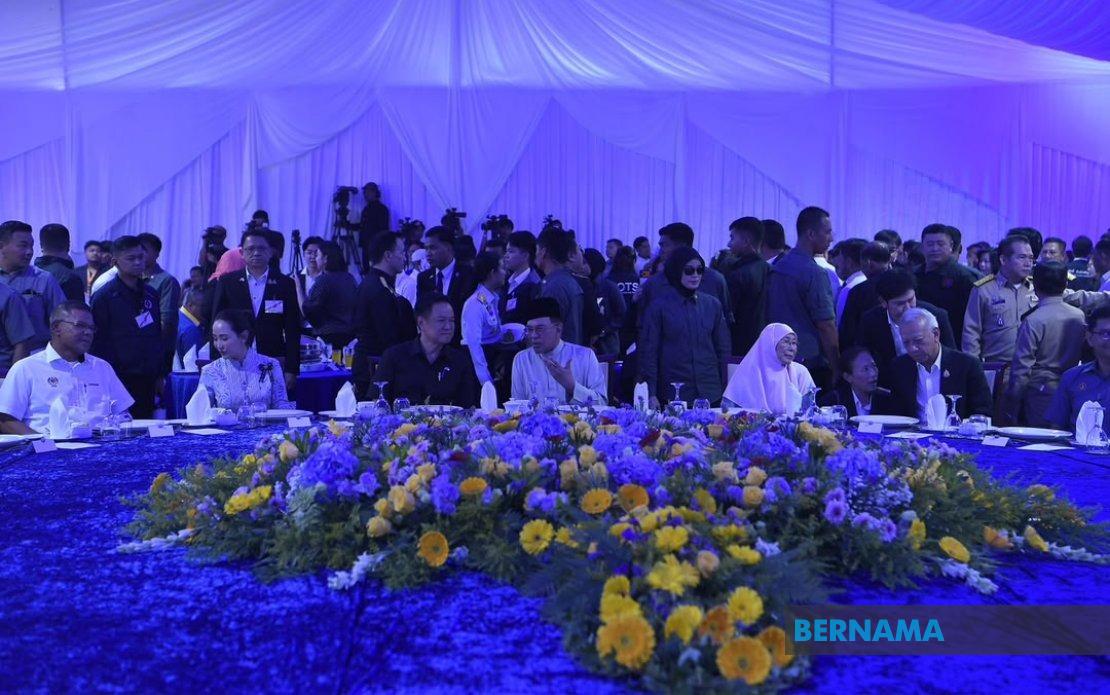
Prime Minister Datuk Seri Anwar Ibrahim and Thai Prime Minister Anutin Charnvirakul have jointly opened a significant new transport corridor on the Malaysia-Thailand border, reflecting deepening cooperation between the neighbouring nations. The modern road infrastructure links Malaysia's Bukit Kayu Hitam Immigration, Customs, Quarantine and Security (ICQS) Complex with Thailand's corresponding Sadao Customs, Immigration and Quarantine (CIQ) Complex. This ceremonial launch marks a watershed moment in cross-border relations and underscores both governments' commitment to modernising critical infrastructure that facilitates people and goods movement across one of Southeast Asia's busiest land boundaries.
The Home Ministry statement emphasised that this development represents far more than routine infrastructure upgrading. Officials characterised the road opening as a concrete manifestation of strengthened diplomatic bonds and enhanced strategic collaboration between Malaysia and Thailand. Beyond the bilateral dimension, the project aligns with broader ASEAN objectives of improving regional connectivity and creating seamless movement corridors that support economic integration throughout Southeast Asia. The initiative thereby contributes to the ASEAN Connectivity agenda, which seeks to break down physical and administrative barriers hindering intra-regional trade and people-to-people exchanges.
Operationally, the new crossing became fully functional from 6 am Malaysia time on July 11, with the longstanding Bukit Kayu Hitam-Danok border crossing permanently ceasing operations at midnight that same day. This transition represents a clean break from older infrastructure and consolidates border operations into a single, unified facility equipped with contemporary systems. The shift away from the Danok crossing, which had served both nations for decades, symbolises the region's commitment to leaving behind fragmented, legacy arrangements in favour of integrated, purpose-built border infrastructure designed for twenty-first century requirements.
Malaysia's Home Ministry highlighted the strategic dimensions of this development for both countries' immediate regions. The modern road infrastructure enables more efficient cross-border travel by streamlining movement through single, coordinated control points rather than multiple inspection stations spread across different locations. Enhanced efficiency directly benefits ordinary citizens and business operators who regularly traverse the border, reducing transit times and administrative friction. Lorry drivers, traders, and travellers will experience tangible improvements in processing speed and clarity, translating bureaucratic modernisation into practical benefits for border communities that depend on seamless cross-border movement.
The project specifically targets economic revitalisation of border zones in both nations. By facilitating smoother trade flows and reducing logistics costs associated with border crossing inefficiencies, the new road enables businesses in Thailand's Songkhla Province and Malaysia's northern states to integrate more effectively. Enhanced connectivity encourages investment in border regions, which have historically lagged economically compared to major urban centres. Improved infrastructure signals stability and efficiency to potential investors, potentially catalysing economic activity that could generate employment and prosperity for communities in these frontier areas.
Supply chain considerations featured prominently in official descriptions of the initiative's importance. Modern border infrastructure incorporating advanced integrated control systems helps reduce clearance times for consignments in transit between Malaysia and Thailand. The ASEAN North-South Economic Corridor, which the new crossing supports, facilitates movement of goods throughout the region, from Singapore northward through Malaysia and into Thailand and beyond. More efficient border processing reduces carrying costs and inventory risks for logistics operators, ultimately making Southeast Asian trade more competitive globally while enhancing intra-regional commerce that strengthens the entire bloc's economic performance.
Security considerations underpin the modern infrastructure's design and capabilities. The new ICQS-CIQ complex incorporates contemporary enforcement and surveillance technologies enabling Malaysian and Thai authorities to enhance border security while improving operational transparency. Integrated control systems allow for better information-sharing between agencies and coordinated responses to security threats, organised crime activities, and illicit trafficking. This represents a significant upgrade from the fragmented security arrangements that previously characterised the Danok crossing, where different agencies operated with less integrated technology and coordination mechanisms.
The initiative directly aligns with Malaysia MADANI, the government's overarching development framework emphasising modernisation, inclusivity, and prosperity. The Home Ministry's commitment to continuing infrastructure upgrades, technology adoption, and strategic international cooperation reflects these foundational principles. Border management represents a critical government function affecting national security and economic performance simultaneously, making this project exemplary of Malaysia MADANI principles in practice. By investing in modern infrastructure and transparent operations, the government demonstrates its commitment to safeguarding citizens while enabling the cross-border commerce essential for regional prosperity.
Thailand's participation in this joint initiative underscores mutual recognition of shared interests in regional stability and economic development. Both nations derive substantial benefits from efficient cross-border movement, making infrastructure investment rational from both security and prosperity perspectives. The bilateral ceremony itself, featuring top-level political participation, signals to regional and international audiences that Malaysia and Thailand prioritise border relations and view cooperation as central to national interests. This public commitment helps build business confidence and encourages private-sector investment in border-dependent activities.
For Malaysian businesses and citizens, the new crossing offers immediate practical advantages while suggesting broader policy directions favouring greater regional integration. Companies involved in Thailand trade can expect marginal cost reductions from faster border clearances, potentially improving competitiveness. Tourism operators benefit from smoother tourist flows, while private citizens crossing the border for family, business, or leisure purposes will experience simpler procedures and shorter waiting times. These incremental improvements accumulate meaningfully for frequent border crossers and commercial operators.
The permanent closure of the Danok crossing represents a deliberate policy choice reflecting confidence in the new facility's capacity and design. Rather than maintaining dual crossings to provide redundancy, both governments centralised operations into a single modern complex. This consolidation reduces administrative overhead, simplifies coordination, and allows both countries to manage border operations more efficiently. It also signals unambiguous policy direction, eliminating confusion about which facility should be used and preventing residual traffic from fragmenting newly integrated systems.
Looking forward, the new crossing establishes foundations for potential future collaborations between Malaysia and Thailand. Success with this project may encourage both governments to consider additional joint infrastructure initiatives addressing other connectivity challenges or facilitating specific sectors like tourism or agricultural trade. The mechanisms and relationships developed through this project create institutional frameworks supporting continued bilateral cooperation beyond infrastructure. Regional analysts will likely monitor whether this milestone generates momentum for broader ASEAN infrastructure initiatives and whether Thailand's experience with Malaysia influences its approach to border management with Laos, Myanmar, and Cambodia.

