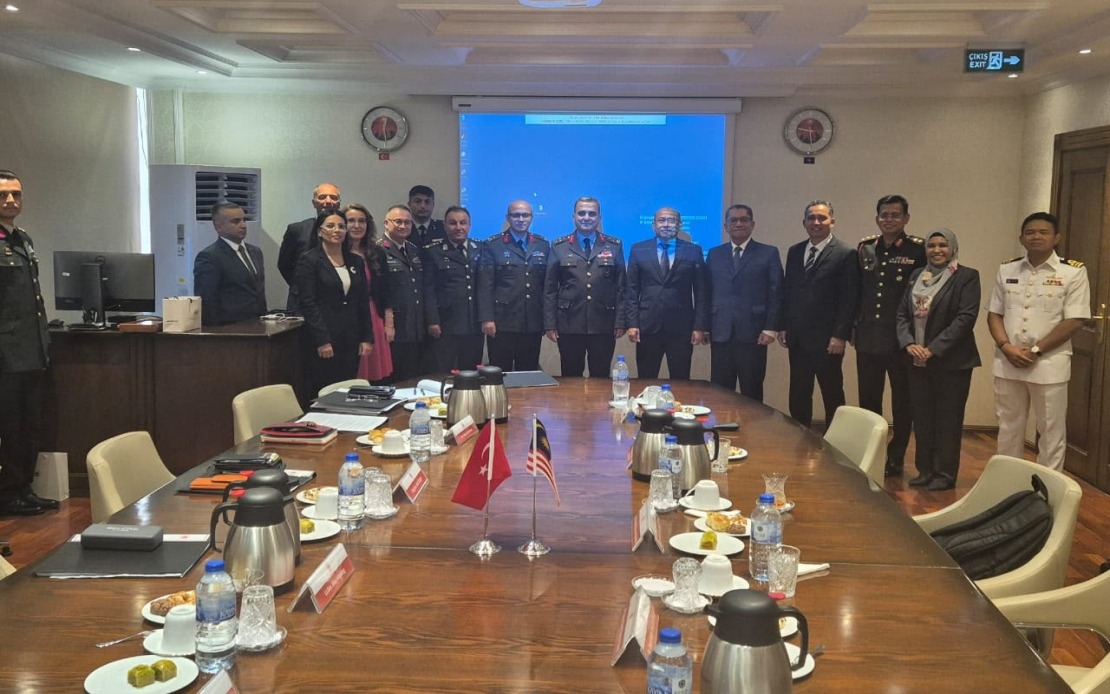
Malaysia and Turkiye have taken a significant step toward deepening their defence relationship by holding their inaugural Policy Talk at Turkiye's Ministry of National Defence headquarters in Ankara on Monday. The meeting represents a formal institutionalisation of military-to-military engagement between the two nations, moving beyond ad-hoc consultations toward a sustained, structured dialogue framework. Led on the Turkish side by Lt Gen Ilkay Altindag, director-general of defence and security at the MoND, and by Datuk Yani Daud, deputy secretary-general of policy at Malaysia's Ministry of Defence, the talks underscored both nations' commitment to elevating their strategic partnership in an increasingly complex geopolitical environment.
The substantive agenda examined during the meeting encompassed a broad spectrum of security concerns affecting both countries and the broader Asia-Pacific region. Discussions centered on defence policy formulation, military strategy, and the geopolitical security challenges that shape security thinking in both capitals. By creating a platform for senior defence officials to exchange perspectives and share intelligence assessments, the policy talk establishes a mechanism for developing mutual understanding on regional developments and emerging threats. This collaborative approach reflects a recognition that in an era of transnational security challenges, bilateral coordination enhances the strategic autonomy of both nations.
A particular emphasis emerged on the importance of sustaining peace and stability across the Indo-Pacific and Middle Eastern regions. Malaysia seized the opportunity to acknowledge Turkiye's diplomatic initiatives aimed at conflict resolution, specifically commending Ankara's role in facilitating the Makkah Pact, a significant agreement aimed at de-escalating tensions in West Asia. This recognition signals Malaysia's appreciation for Turkiye's constructive engagement in regional conflict prevention, particularly given Malaysia's own interests in maritime security and stability in critical sea lanes through which its trade flows.
The establishment of Terms of Reference for the Policy Talk constitutes the institutional scaffolding that will govern future interaction between the two defence establishments. By codifying the framework within which cooperation instruments will be negotiated and potential defence programmes will be developed, both nations have created a predictable structure that reduces transaction costs and facilitates the progressive expansion of military ties. This approach mirrors best practices observed in other successful bilateral defence relationships, where formal mechanisms provide continuity regardless of political transitions or personnel changes.
Looking ahead, Malaysia has formally extended an invitation for Turkiye to attend the second iteration of the Policy Talk in Kuala Lumpur during 2025. This reciprocal commitment demonstrates that the dialogue is intended as a genuine, ongoing engagement rather than a one-off diplomatic event. The rotation of venues also carries symbolic significance, with Malaysia's capital hosting the follow-up conversation, reinforcing the principle of equal partnership and shared responsibility for nurturing the relationship. This geographical alternation mirrors diplomatic protocol observed in established defence partnerships and signals the seriousness with which both nations regard their emerging security cooperation.
From Malaysia's strategic perspective, deepening ties with Turkiye aligns with broader foreign policy objectives articulated in the Mid-Term Review of the Defence White Paper. Malaysia seeks to diversify its security partnerships and reduce over-reliance on any single power or alliance structure. Turkiye, positioned at the intersection of Europe, Asia, and the Middle East, brings distinctive capabilities and perspectives that can enrich Malaysia's strategic options. Furthermore, Turkiye's military modernisation programmes and defence technological advancement present potential opportunities for knowledge transfer and cooperative procurement initiatives.
For Southeast Asia more broadly, this development reflects a growing recognition that regional security cannot be understood in isolation from global power dynamics and Middle Eastern developments. Malaysia's engagement with Turkiye demonstrates the region's willingness to cultivate partnerships with non-traditional allies who share commitment to principles of sovereignty, non-interference, and peaceful resolution of disputes. In this context, the Malaysia-Turkiye dialogue contributes to a more multipolar regional architecture, where Southeast Asian nations actively construct security partnerships across multiple continents rather than remaining passive recipients of external strategic competition.
Turkiye's perspective on this partnership warrants consideration as well. As Ankara seeks to expand its influence in Asia-Pacific, engagement with Malaysia—a respected voice in ASEAN and a significant maritime power—offers credibility and reach. Turkiye has maintained a decades-long tradition of military engagement in Southeast Asia, and formalising cooperation frameworks with major regional players enhances its strategic positioning. The defence dialogue also provides an avenue through which Turkiye can promote its interests in regional stability and conflict resolution, particularly regarding Middle Eastern affairs where Malaysia wields soft power.
The timing of this initiative carries particular relevance given contemporary geopolitical turbulence. Regional flashpoints including the South China Sea disputes, tensions in the Strait of Hormuz, and broader Sino-American strategic competition create an environment where medium powers seek to strengthen cooperative frameworks. Malaysia, as a non-aligned nation with significant maritime interests and participation in multiple regional organisations, benefits from cultivating relationships with powers like Turkiye that maintain strategic independence while contributing constructively to global governance.
Concretely, the policy talk mechanism could facilitate cooperation across multiple domains including military education exchanges, joint training exercises, defence technology partnerships, and intelligence sharing protocols. These practical dimensions will gradually build operational familiarity and interoperability between Malaysian and Turkish armed forces, transforming political intent into tangible military cooperation. The framework also creates space for discussing challenges such as terrorism, maritime piracy, and cyber threats that concern both nations.
The formalisation of Malaysia-Turkiye defence relations also reflects evolving patterns within the Non-Aligned Movement and among developing nations generally. Rather than accepting constraints imposed by existing power structures, nations like Malaysia and Turkiye are proactively constructing bespoke partnerships that serve their particular interests. This approach enhances their agency in an international system often dominated by great power competition, allowing them to shape regional outcomes rather than merely respond to external pressures.
Looking forward, observers should monitor whether this inaugural dialogue generates concrete defence initiatives or remains primarily a consultation forum. The true measure of success will be whether the policy talk catalyses expanded military engagement, including potential joint exercises, technology collaborations, or capacity-building programmes. For Malaysia's defence establishment, the partnership offers opportunities to learn from Turkiye's experience navigating complex security environments spanning multiple regions, while Turkiye gains deeper insights into Southeast Asian security dynamics through sustained dialogue with a key regional player.

