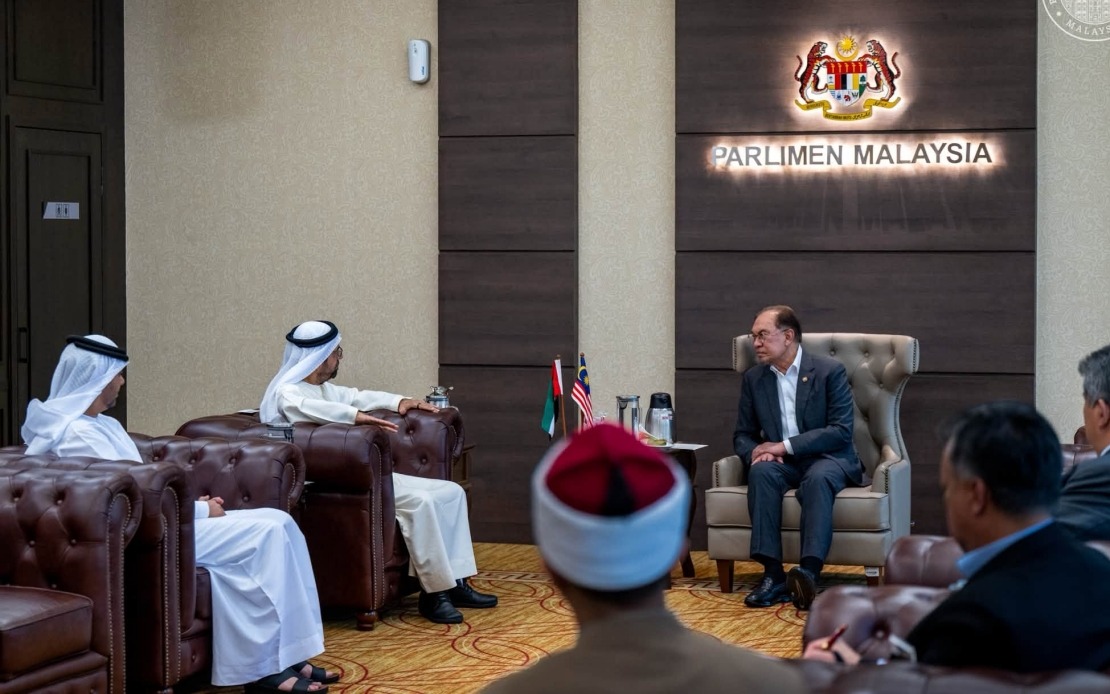
Malaysia and the United Arab Emirates are moving to deepen their bilateral engagement through expanded strategic cooperation frameworks that address emerging regional challenges and technological advancement, according to Prime Minister Datuk Seri Anwar Ibrahim. The commitment was reinforced during discussions with Dr Ali Rashid Al Nuaimi, chairman of the Defence, Interior and Foreign Affairs Committee of the UAE's Federal National Council, at the Prime Minister's office in the Parliament building in Kuala Lumpur on July 8.
The meeting represents a continuation of existing diplomatic channels between the two nations, which have maintained strong economic and political ties over decades. However, the focus on contemporary security concerns and technological innovation signals an evolution in how both governments conceptualise their partnership in the 21st century. For Malaysia, engagement with the UAE carries particular significance given Abu Dhabi's strategic position in the Gulf region and its increasingly influential role in Middle Eastern affairs.
During the bilateral discussions, both delegations examined the implications of regional geopolitical developments, particularly tensions involving the United States and Iran. This focus reflects Malaysia's pragmatic approach to maintaining balanced relationships with major powers while safeguarding its own national interests and those of the broader Southeast Asian region. The Persian Gulf remains a critical maritime corridor through which Malaysian trade flows; instability there carries direct economic and security consequences for the country. By engaging the UAE on these matters, Malaysia seeks to understand regional dynamics from the perspective of a Gulf state with considerable diplomatic leverage.
A particularly notable emphasis in the meeting centred on artificial intelligence and its applications in government administration and defence capabilities. Anwar specifically highlighted the UAE's pioneering approach of mandating AI training for ministers and senior officials, positioning technological literacy as essential preparation for contemporary governance challenges. This acknowledgment reflects Malaysia's recognition that AI proficiency is rapidly becoming a cornerstone of competitive advantage in both economic and security domains.
The UAE has positioned itself as a technology leader within the Middle East, investing heavily in AI infrastructure and establishing innovation hubs that attract international expertise. For Malaysia, which aspires to develop its own technological ecosystem and smart governance frameworks, the UAE's experience offers valuable lessons. The Malaysian government has been pursuing digital transformation initiatives across various agencies, and formal knowledge transfer arrangements with UAE counterparts could accelerate these efforts.
In the defence sector, Malaysia faces evolving security challenges including maritime security concerns in the South China Sea, cybersecurity threats, and transnational security issues. The UAE's military modernisation programmes and defence procurement experience could inform Malaysian strategic thinking. Both nations face similar security architecture challenges in their respective regions and may benefit from sharing intelligence assessments and operational methodologies, though such cooperation typically remains confidential.
Anwar's reiteration of Malaysia's commitment to deepening UAE cooperation explicitly linked bilateral strengthening to contributions toward regional peace, stability, and prosperity. This framing positions the relationship not as a parochial arrangement between two governments but as a force contributing to wider regional wellbeing. Given Malaysia's ASEAN membership and the bloc's policy of strategic autonomy, this language also signals that Southeast Asian nations view engagement with Gulf states as compatible with their existing commitments to non-alignment and balanced relationships.
The timing of this high-level engagement also reflects broader patterns in Malaysian foreign policy. Under Anwar's leadership, the government has pursued a more active engagement strategy with major trading partners and regional powers. The UAE ranks among Malaysia's significant trading partners, particularly in sectors such as real estate, energy, and finance. Strengthening the political and strategic relationship can facilitate smoother commercial dealings and create conditions for expanded economic cooperation.
From a Southeast Asian perspective, Malaysia's cultivation of ties with Gulf states contributes to regional diplomatic diversification. As other ASEAN members similarly expand their Gulf engagement, the region collectively gains leverage in international forums and access to alternative partnerships beyond traditional Western alignments. The UAE, meanwhile, benefits from Myanmar's growing footprint in Southeast Asian affairs, making countries like Malaysia valuable partners for understanding regional dynamics.
The discussion of AI governance also touches on broader questions about how developing economies adopt emerging technologies responsibly. Both Malaysia and the UAE grapple with balancing innovation with security concerns, data privacy, and equitable access to AI benefits across society. By exchanging experiences, both nations can avoid pitfalls and optimise their technological transitions. This knowledge-sharing dimension may prove as valuable as any formal security arrangement.
Looking forward, the outcomes of this meeting may translate into concrete cooperation frameworks, though announcements are typically staged over time rather than released immediately. Malaysia and the UAE may establish joint committees on AI governance, exchange training programmes for officials, or coordinate positions in international forums addressing technological standards and security governance. Such arrangements typically take months or years to fully operationalise but represent important foundations for sustained collaboration.
The broader significance of this engagement lies in how it reflects Malaysia's positioning within an interconnected global system where bilateral relationships serve multiple strategic purposes simultaneously. Enhanced ties with the UAE strengthen Malaysia's voice in international affairs, provide access to technological expertise, contribute to regional security architecture, and create conditions for commercial advantage. For a middle-power nation pursuing strategic autonomy, such multifaceted engagement represents prudent statecraft.

