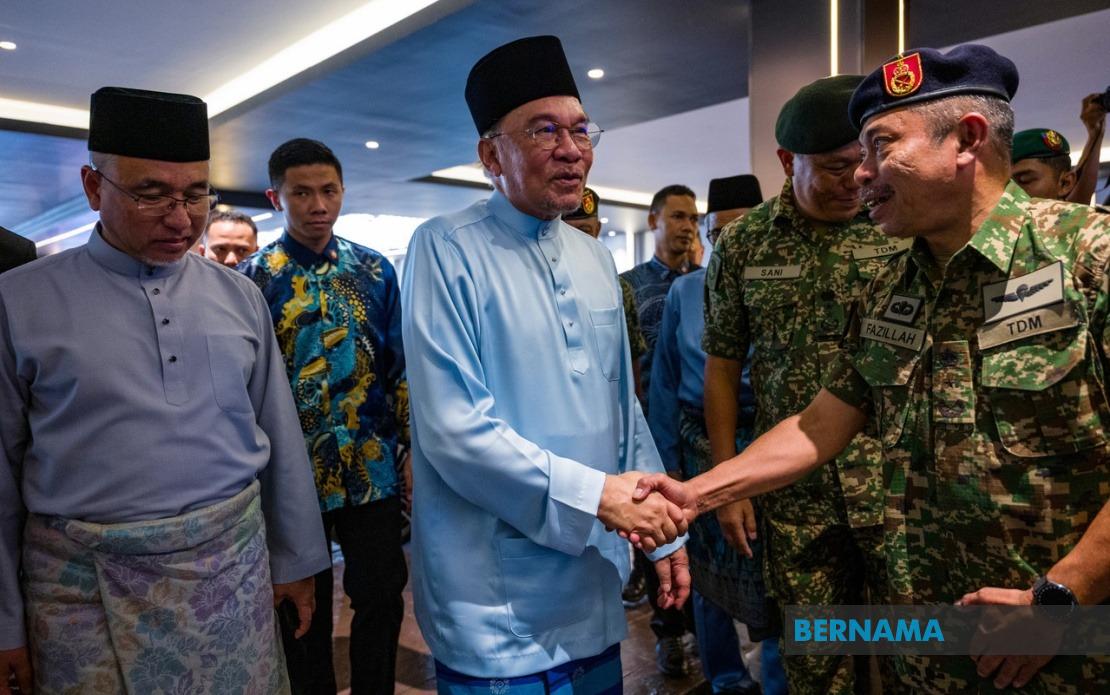
Prime Minister Datuk Seri Anwar Ibrahim has signalled the government's intention to expand defence expenditure in the upcoming 2027 budget, a decision that underscores Putrajaya's determination to strengthen the operational capabilities of the Malaysian Armed Forces. The announcement, made during the Semarak Kenegaraan Programme at Terendak Camp in Melaka, represents a significant policy commitment at a time when regional security dynamics across Southeast Asia continue to evolve and regional military capabilities are advancing.
Chief of Defence Force General Tan Sri Malek Razak Sulaiman welcomed the budgetary initiative, framing it as validation of the government's broader strategic vision for the MAF. The defence chief emphasised that increased financial resources would enable the military to pursue its transformation roadmap comprehensively, addressing not only hardware requirements but also human capital development and institutional readiness. His remarks reflect the military establishment's confidence in the government's willingness to translate security priorities into concrete fiscal commitments.
The additional defence allocation will directly support implementation of the MAF's Future Force strategic development plan, a comprehensive initiative designed to modernise ageing equipment and systems while building operational capacity to address contemporary security challenges. This approach acknowledges that military effectiveness depends equally on technological advancement and personnel capability, requiring balanced investment across both domains. For a nation managing maritime security responsibilities across considerable sea lanes and territorial waters, such modernisation carries particular significance.
Personnel welfare represents a central pillar of the proposed budget increase, reflecting recognition that military readiness stems partly from servicemembers' living standards and morale. Anwar highlighted specific improvements including enhanced housing facilities, construction of a new military hospital, and maintenance of essential utilities including water supply infrastructure. These quality-of-life enhancements address longstanding concerns within the armed forces about accommodation standards and medical facilities, issues that directly affect recruitment and retention of skilled personnel.
The government has additionally committed to streamlining promotion pathways for both MAF and Royal Malaysia Police officers, aligning these mechanisms with broader public service advancement schemes. This administrative reform aims to create more transparent, expedited career progression, potentially improving job satisfaction and retaining experienced personnel who might otherwise consider alternative opportunities. Such structural changes, though less visible than capital expenditure, can significantly influence institutional morale and effectiveness.
General Malek Razak characterised the budgetary commitment as emblematic of governmental determination to establish the MAF as a formidable, integrated deterrent capable of defending national interests. This language suggests military planners view the defence investment not merely as maintenance spending but as a strategic signal regarding Malaysia's defence posture within a competitive regional environment. Southeast Asian nations, including Malaysia's neighbours, have undertaken substantial military modernisation programmes in recent years, creating pressure for Malaysian defence capabilities to remain credible and contemporary.
The timing of this announcement carries significance beyond its immediate fiscal implications. Regional developments—including evolving security architectures, technological advancement in military capabilities, and shifting geopolitical alignments—have placed renewed emphasis on national defence readiness throughout Southeast Asia. Malaysia's defence spending, historically moderate relative to some regional counterparts, reflects both budgetary constraints and security priorities focused on internal stability and territorial protection rather than power projection.
Equipment modernisation financed through increased allocations will likely address legacy systems requiring replacement or substantial upgrading, particularly within naval and air defence components. Malaysia's strategic location along major maritime trade routes and its extensive exclusive economic zone create defence requirements centred on maritime domain awareness and coastal security, areas where technological advancement offers significant operational advantages. Budget increases should theoretically enable acquisition of more sophisticated surveillance and response capabilities.
The welfare dimension of the defence budget increase holds particular relevance for military recruitment and retention in Malaysia's increasingly competitive labour market. Military service, while honourable and purposeful, requires candidates to accept lower remuneration than private sector alternatives. Improvements to housing, healthcare, and career advancement prospects help counterbalance financial disparities, making military careers more attractive to qualified personnel. This becomes increasingly important as Malaysia transitions toward more technologically sophisticated defence requirements demanding higher educational standards from recruits.
For Malaysian defence planners, the budget commitment represents validation of long-standing proposals for increased investment, though actual allocation levels will become clear only upon Budget 2027's presentation. The defence sector has repeatedly advocated for higher spending to address modernisation backlogs accumulated over years of constrained budgets. This announcement suggests those arguments have gained traction within the highest levels of government, though competing budgetary priorities—healthcare, education, infrastructure—continue to compete for finite resources.
Regionally, Malaysia's defence investment decisions influence broader Southeast Asian security dynamics. Nations track neighbours' military expenditures and capability developments as indicators of strategic intent and regional balance. Malaysia's commitment to modernisation, even if modest by some regional standards, contributes to overall regional defence posture and signalling effects regarding Malaysia's determination to maintain capable armed forces. This matters particularly given Malaysia's non-aligned foreign policy orientation and emphasis on peaceful dispute resolution.
The successful implementation of increased defence budgets will ultimately depend on execution quality—ensuring resources translate into genuine capability improvements rather than being consumed by inefficiencies or misalignment with operational requirements. Defence modernisation programmes, whether in Malaysia or elsewhere, frequently encounter delays, cost overruns, and technical challenges. The government's commitment to increased spending thus carries implicit responsibilities for effective project management and accountability in defence procurement and implementation.
Looking forward, the defence budget initiative represents part of Malaysia's broader effort to maintain a credible security posture while managing competing national priorities. As regional security environments continue evolving and defence technologies advance, periodic increases in military spending appear likely to become necessary features of Malaysian budgetary planning, making this current commitment potentially the beginning of a sustained modernisation phase rather than a one-time adjustment.

