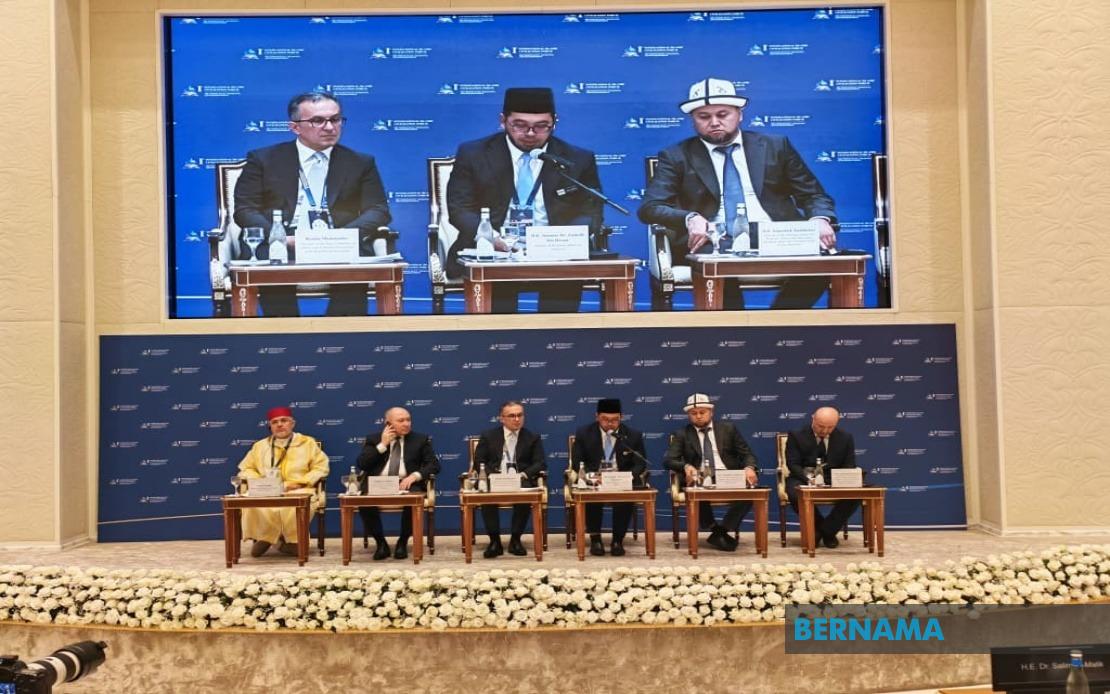
Malaysia has called upon the Islamic world to respond constructively to the humanitarian catastrophe in Gaza by reasserting timeless principles of justice, compassion, and human dignity. Speaking at the International Islamic Civilisation Forum in Tashkent, Uzbekistan, Datuk Dr Zulkifli Hasan, Minister in the Prime Minister's Department (Religious Affairs), framed the Gaza crisis not merely as a humanitarian emergency but as a defining moment for the Muslim world to demonstrate its capacity for principled global leadership. His intervention at the forum's plenary session represents a deliberate pivot away from defensive positioning, instead positioning Islamic civilisation as a constructive force capable of shaping humanity's trajectory in an era of unprecedented technological and geopolitical change.
The Gaza tragedy, Zulkifli argued, has punctured the international conscience and exposed the inconsistent application of global legal standards and justice mechanisms. Rather than retreating into grievance or nihilism, he contended that Muslim societies must seize this moment to catalyse a deeper renewal of Islamic civilisation itself. This renewal must transcend the temptation to define Muslim identity purely in reactive terms, perpetually responding to external pressures and circumstances. For Malaysian audiences familiar with regional sectarian tensions and competing ideological narratives, this framing offers a particularly relevant proposition: that strategic advantage accrues not to those who react most vociferously, but to those who articulate compelling visions of positive contribution.
Zulkifli's core argument challenges a persistent assumption within contemporary Islamic discourse: the notion that Islamic greatness lies primarily in the past. While acknowledging Islam's extraordinary historical achievements in science, architecture, philosophy, and governance, he reoriented the conversation toward future agency. The pertinent question facing the Muslim world today is not whether Islamic civilisation once attained unparalleled heights—historical record settles that matter conclusively—but rather what distinctive role Islamic thought and Islamic societies should play in architecting the future. This reframing carries particular resonance for Malaysia, which positions itself as a bridge between the Muslim majority world and global modernity, navigating the complex terrain where religious identity and contemporary governance intersect.
The minister contended that contemporary humanity yearns for more than technological prowess and economic expansion. Modern societies increasingly hunger for moral clarity, principled leadership grounded in enduring values, and ethical frameworks capable of constraining the destructive potential of unchecked innovation. Islamic civilisation, Zulkifli suggested, possesses distinctive resources to fulfil these hunger. Historically, Islamic societies distinguished themselves not merely through monumental architectural achievements or groundbreaking scientific contributions, though both were formidable, but through their capacity to construct just political systems, nurture leaders of moral integrity, and systematically honour the inherent dignity of every individual. Knowledge within Islamic tradition was cultivated as an act of service—both to the divine and to humanity—creating intellectual traditions with built-in ethical orientations.
Realising this vision demands more than nostalgic appeals to Islamic glory, Zulkifli emphasised. Genuine civilisational renewal requires three interconnected dimensions: intellectual revitalisation that generates original thought applicable to contemporary conditions; moral conviction that provides visceral commitment to ethical principles; and collective responsibility structured around enduring Islamic values. The renaissance the Muslim world must pursue must restore ethics as the foundation of governance, wisdom as the companion to technical knowledge, and purposefulness as the animating principle of development. These elements must cohere around core Islamic principles, creating an internally coherent vision rather than an eclectic borrowing from multiple traditions.
Historically, Islamic civilisation distinguished itself through openness and intellectual cosmopolitanism. Muslim scholars during the classical and medieval periods systematically absorbed and synthesised knowledge from Greek, Persian, Indian, and Chinese sources, integrating foreign wisdom within Islamic frameworks while maintaining intellectual and spiritual coherence. Zulkifli advocated for contemporary Muslim societies to revive this pluralistic intellectual tradition by becoming active architects of ethical governance frameworks for emerging technologies. As artificial intelligence, biotechnology, and quantum computing reshape human capability, Muslim thinkers and institutions should actively shape the moral and ethical parameters governing these transformative technologies. Rather than passively accepting technological trajectories determined by non-Muslim societies, Muslim contributions could ensure innovation remains fundamentally aligned with human dignity and welfare.
Environmental stewardship emerged as another crucial dimension of civilisational renewal. Zulkifli highlighted Islamic teachings regarding humanity's role as custodians of creation, emphasising that environmental degradation represents both an ecological crisis and a spiritual failing. This resonates powerfully with Southeast Asian audiences confronting deforestation, pollution, and climate impacts. Islam's sophisticated ecological theology, properly understood and applied, offers resources for compelling environmental ethics rooted in spiritual conviction rather than mere pragmatic calculation. Muslim-majority nations across Southeast Asia and beyond could pioneer distinctive models of sustainable development grounded in Islamic environmental principles, demonstrating that ecological responsibility flows naturally from Islamic teaching.
Crucially, Zulkifli rejected zero-sum framing of Islamic civilisation's renewal. Rather than envisioning this process as rivalry between competing civilisations, he positioned it as an opportunity for the Muslim world to contribute distinctively to humanity's common project. Islamic civilisation's flourishing need not emerge at the expense of other traditions; indeed, genuine renewal would manifest through dialogue, partnership, and mutual respect among civilisations. This represents a sophisticated diplomatic positioning particularly relevant for Malaysia, which has invested decades cultivating multifaith coexistence and inter-civilisational dialogue while maintaining strong Islamic identity. Malaysia's approach demonstrates that Islamic authenticity and cosmopolitan engagement are not contradictory imperatives but complementary aspects of enlightened statecraft.
Malaysia's own commitment to building coalitions with Muslim nations does not preclude constructive engagement with partners from diverse civilisational backgrounds, Zulkifli stressed. The nation pursues strategic alliances within the Muslim world while simultaneously collaborating across religious and cultural boundaries to address shared global challenges. This balanced posture reflects the reality that contemporary problems—climate change, technological disruption, pandemic disease, geopolitical instability—transcend civilisational boundaries and demand broad coalitional responses. For Southeast Asian policymakers wrestling with similar tensions between religious identity and regional integration, Malaysia's model offers practical demonstration that these need not constitute mutually exclusive commitments.
Zulkifli also highlighted potential for deepened bilateral cooperation between Malaysia and Uzbekistan, two nations with complementary strengths in Islamic affairs. Uzbekistan's extraordinary legacy in classical Islamic scholarship, encompassing legendary madrasas and theological traditions, combines naturally with Malaysia's contemporary experience in Islamic governance, Islamic finance systems, and multicultural democratic coexistence. Both nations could function as bridges connecting Central Asia and Southeast Asia, facilitating knowledge exchange, ethical innovation, and sustainable development benefiting the wider Muslim world. This partnership model suggests how regional cooperation among Muslim-majority nations can generate practical benefits while advancing shared civilisational objectives.
The broader implications of Zulkifli's intervention extend well beyond diplomatic pleasantries. His articulation represents a deliberate effort to steer Muslim discourse away from purely defensive or reactionary postures toward proactive articulation of civilisational vision. For Malaysia, embedded within Southeast Asian dynamics of religious pluralism and geopolitical complexity, this messaging reaffirms the nation's role as an intellectual and moral leader within the Muslim world. By framing Islamic civilisation's renewal as a contribution to humanity rather than a challenge to Western hegemony, Zulkifli positions the Muslim world as source of solutions rather than source of problems. Whether Muslim societies can genuinely mobilise around this ambitious vision remains an open question, but the attempt to reorient Islamic discourse toward positive agency and ethical leadership marks a significant rhetorical and intellectual shift worth sustained attention.

