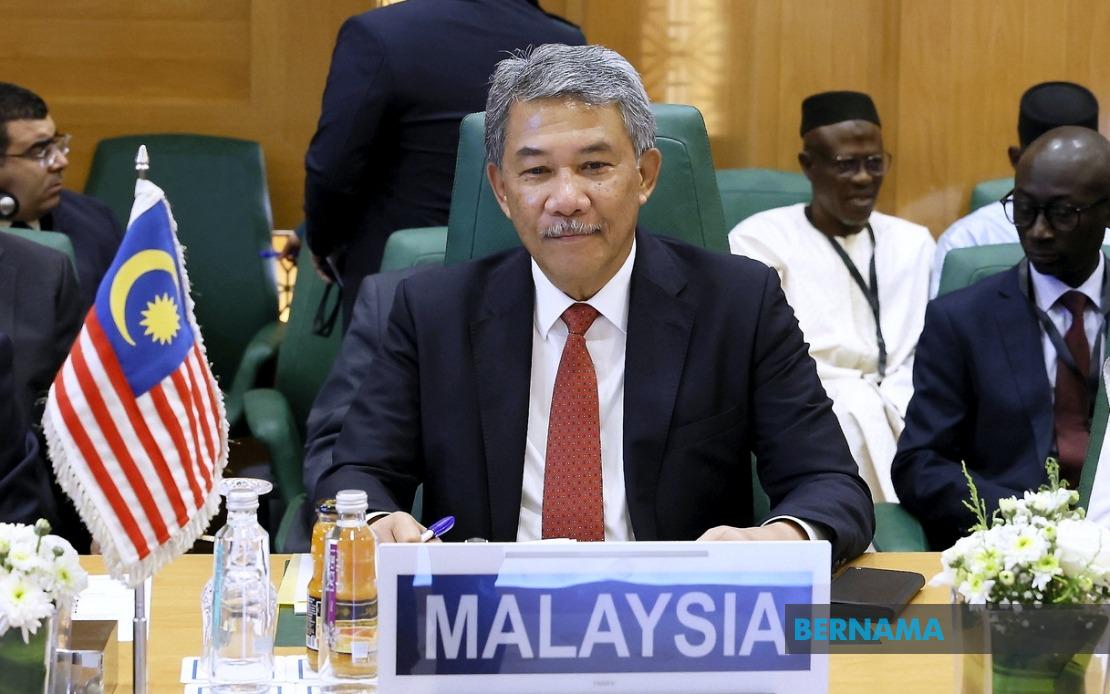
Malaysia has intensified diplomatic pressure within the Organisation of Islamic Cooperation, calling for a united stance against Israel's expansion of settlements across the occupied Palestinian territories. Foreign Minister Datuk Seri Mohamad Hasan delivered a forceful address at an Extraordinary Meeting of the OIC Council of Foreign Ministers in Jeddah on August 27, demanding that member states act decisively to uphold international law and reject what he termed an illegitimate colonisation project worth US$2.3 billion.
The Malaysian government is anchoring its position on the International Court of Justice's Advisory Opinion issued on July 19, 2024, which carried significant weight in Malaysia's diplomatic messaging. Hasan argued that OIC nations must translate this legal pronouncement into concrete policy action, moving beyond rhetorical support to active non-cooperation with Israeli settlement initiatives. This represents an attempt to mobilise the 57-member bloc around enforceable commitments rather than aspirational declarations.
At the heart of Malaysia's concern lies the E1 settlement plan, a particularly contentious development scheme that, if implemented, would physically fragment Palestinian territorial control and render the establishment of a contiguous Palestinian state virtually impossible. By connecting existing settlements in the West Bank to East Jerusalem, the E1 project effectively creates an irreversible fait accompli that undermines any future peace negotiations premised on territorial viability. Malaysia's emphasis on this specific scheme reflects sophisticated understanding of how settlement geography directly determines the feasibility of Palestinian statehood.
The humanitarian dimensions of this settlement expansion cannot be separated from its political implications. Hasan drew explicit connections between settlement growth and the displacement of Palestinian communities, citing systematic evictions from East Jerusalem and ongoing settler violence in the West Bank. These actions, Malaysia contends, represent deliberate attempts to alter the demographic and political character of contested territories, amounting to a form of ethnic engineering that violates international humanitarian law.
Malaysia's broader concern extends to Jerusalem itself, where the Foreign Minister emphasised the need to preserve both the city's Islamic and Christian heritage. The government called for strengthened support for Jordan's historical Hashemite Custodianship over the holy sites, recognising that religious and political dimensions of the Jerusalem question are inseparable. This framing appeals to both Muslim and Christian-majority nations within the OIC framework, broadening the coalition against settlement expansion.
The timing of Hasan's statement followed a particularly inflammatory incident on July 23, when Israeli settlers and far-right political figures entered the Al-Aqsa Mosque compound—a development Malaysia characterised as intolerable provocation. These incursions, whether understood as religious trespass or political theatre, serve to inflame communal tensions and signal to Palestinians that their religious sites remain vulnerable to violation. Malaysia's condemnation reflects how settlement expansion operates not merely as territorial acquisition but as a broader assertion of control over Palestinian lives and sacred spaces.
Gaza's catastrophic humanitarian situation featured prominently in the Malaysian statement, with Hasan noting that over 70,000 lives have been lost in the ongoing conflict. He emphasised that nearly three years of international calls for ceasefire, humanitarian access, and civilian protection have gone unheeded, presenting the impasse as a fundamental failure of the rules-based international order. For Malaysia and other OIC members, this stalemate demonstrates that diplomatic pressure alone requires reinforcement through tangible consequences for violations.
Malaysia's call for permanent ceasefire and unhindered humanitarian access reflects growing frustration with the inadequacy of provisional agreements and temporary relief measures. The Malaysian position demands structural change: permanent cessation of hostilities rather than renewed cycles of conflict, and systematic reconstruction of Palestinian institutions as prerequisites for genuine statehood. This signals that Malaysia views humanitarian relief not as an endpoint but as a foundation for political reconstruction.
Underlying Malaysia's diplomatic offensive is a reaffirmation of the two-state solution as the only viable framework for durable peace. Yet this traditional formulation faces practical challenges precisely because settlement expansion systematically erodes the territorial basis upon which two-state viability depends. Malaysia's insistence that Palestinian independence must rest on 1967 borders with East Jerusalem as capital reflects unwillingness to accept redefined parameters that would further disadvantage Palestinian negotiating positions.
The Malaysian government has positioned itself as champion of accountability, calling upon the United Nations Security Council to enforce international law and ensure Israel faces consequences for specific violations. This includes protection of UNRWA's mandate following Israel's seizure of the Kalandia Training Centre and concerns regarding Palestinian legislative initiatives. Malaysia's emphasis on institutional protection recognises that Palestinian statehood requires not merely territorial space but functional administrative capacity.
For Southeast Asian readers, Malaysia's activism within the OIC carries both regional and global significance. As a Muslim-majority democracy with established diplomatic channels, Malaysia functions as a bridge between Islamic nations and the broader international community. The country's persistent advocacy for Palestinian rights reflects both genuine conviction and strategic positioning within the Islamic world, where solidarity with Palestine remains a touchstone of legitimacy.
Malaysia's call for a rules-based international order represents an implicit critique of selective enforcement of international law. The government contends that unless Israeli settlement expansion faces genuine consequences, the entire architecture of international legal norms loses credibility. This argument resonates across developing nations that fear their own sovereignty could similarly be undermined through selective application of international principles.
Looking forward, Malaysia's diplomatic gambit within the OIC faces substantial obstacles. Disagreements among member states about appropriate responses, variations in bilateral relationships with Israel, and differing assessments of what concrete actions remain feasible will likely complicate efforts to forge unified OIC positions. Nevertheless, Malaysia's persistent articulation of a principled stance contributes to shaping the parameters of acceptable discourse within international forums and signals that some nations remain unwilling to normalise settlement expansion as a fait accompli.

