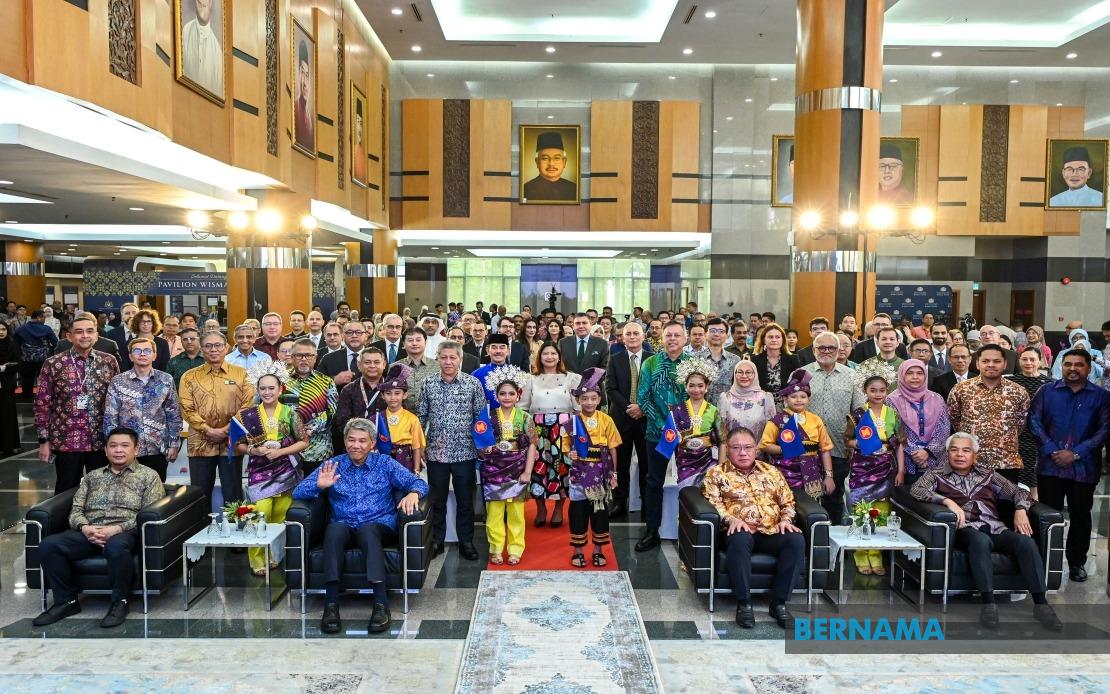
Malaysia has reaffirmed its unwavering commitment to ASEAN as the nation joined the regional grouping in commemorating nearly six decades of collective partnership and endeavour. The milestone celebration, held on Monday at the Foreign Ministry in Putrajaya, brought together approximately 300 guests including government officials, diplomats, and representatives from international bodies to recognise the significance of ASEAN's journey since its founding in 1967.
The ceremony, organised under the banner "59 Years of Navigating Together", underscored the enduring bonds that unite the ten Southeast Asian nations and East Timor in pursuit of shared prosperity and regional stability. The theme itself carries deeper meaning—it acknowledges the complex challenges the bloc has navigated over the decades while emphasising the collaborative approach that has enabled ASEAN to remain relevant and influential despite shifting geopolitical dynamics across the Indo-Pacific.
Foreign Minister Datuk Seri Mohamad Hasan presided over the event, accompanied by Tourism, Arts and Culture Minister Datuk Seri Tiong King Sing and Deputy Foreign Minister Datuk Lukanisman Awang Sauni. The presence of senior officials from Malaysia's government apparatus demonstrated the institutional importance placed on ASEAN partnerships within the national administration. The gathering also included envoys accredited to Malaysia and officials from regional and international organisations, reflecting the multilateral significance of ASEAN's role in contemporary Southeast Asian affairs.
The celebration featured a specially produced video montage titled "ASEAN Journey: Navigating Our Future, Together - 59 Years of Malaysia in ASEAN", which traced the nation's trajectory within the regional community since its inception. This documentary-style presentation served to educate attendees and remind participants of Malaysia's pivotal contributions to ASEAN's institutional development, policy formulation, and economic integration efforts. A ceremonial cake-cutting officiated by Foreign Minister Mohamad marked the conclusion of the formal proceedings.
ASEAN itself was formally established on August 8, 1967, when the foreign ministers of Indonesia, Malaysia, the Philippines, Singapore and Thailand signed the Bangkok Declaration, a foundational agreement that established the framework for regional cooperation and mutual respect among member states. This charter has remained the philosophical bedrock of ASEAN for nearly six decades, emphasising non-interference in internal affairs and consensus-based decision-making processes that have generally served the grouping well.
The regional bloc has undergone substantial expansion since those early years, growing from its original five founding members to an 11-nation community that spans diverse economic, political, and cultural landscapes. Brunei Darussalam joined in 1984, followed by Vietnam's accession in 1995 as Southeast Asia moved toward post-Cold War reconciliation. The admission of Laos and Myanmar in 1997 extended ASEAN's reach further into mainland Southeast Asia, while Cambodia's entry in 1999 completed the gradual expansion across the region's key nations.
The most recent addition to the bloc came with Timor-Leste's membership, formalised during the 47th ASEAN Summit in October of the preceding year. The admission of Southeast Asia's youngest nation represented a symbolic completion of ASEAN's geographical scope across the broader region and acknowledged the country's strategic importance in an era of intensified great power competition in the Indo-Pacific. This expansion has required the grouping to continually adapt its decision-making mechanisms and operational frameworks to accommodate greater diversity of interests and development levels among member states.
The Foreign Ministry's statement emphasised that ASEAN continues to demonstrate exceptional strength, solidarity, and resilience as a community, attributes grounded in three interconnected pillars of cooperation. The political-security dimension encompasses dialogue mechanisms, confidence-building measures, and conflict prevention strategies essential for maintaining stability across a region with complex historical legacies and ongoing maritime boundary considerations. The economic pillar, underpinned by frameworks like the ASEAN Free Trade Area and the Regional Comprehensive Economic Partnership, drives intra-regional commerce and investment flows that benefit all members.
The socio-cultural pillar, meanwhile, promotes people-to-people connectivity, educational exchanges, and cultural understanding that cultivate deeper bonds among Southeast Asian societies. These three dimensions work synergistically to reinforce ASEAN's position as one of the world's most significant regional groupings, capable of exerting influence disproportionate to the individual economic sizes of its member states. For Malaysia specifically, ASEAN membership has provided a platform to amplify its diplomatic voice, enhance its economic opportunities through preferential trading arrangements, and strengthen security cooperation with neighbouring nations.
The 59th anniversary celebration arrives at a juncture when ASEAN faces evolving external pressures and internal cohesion challenges. The regional grouping continues navigating complex geopolitical realities, from the competition between major powers seeking influence in Southeast Asia to developmental disparities among member states that occasionally complicate consensus-building. Yet the ceremony itself affirmed that despite these headwinds, member states remain committed to the fundamental ASEAN principles that have enabled coexistence and cooperation among nations with vastly different political systems, economic models, and strategic alignments.
For Malaysia, ASEAN remains central to national foreign policy calculations and regional identity. As a founding member and a nation geographically central to the grouping, Malaysia has invested considerably in ASEAN's institutional infrastructure and has regularly assumed leadership roles in advancing the bloc's agenda. The anniversary commemoration thus served not merely as a retrospective acknowledgement of past contributions but as a reaffirmation of Malaysia's continued dedication to strengthening ASEAN's relevance and effectiveness in addressing contemporary regional challenges ranging from maritime security to pandemic preparedness and climate adaptation.
Looking forward, the regional bloc will need to balance deepening integration among member states while respecting the diversity of interests and development priorities that characterise the 11-nation community. Malaysia's sustained commitment, as demonstrated through high-level official participation in anniversary celebrations, signals the nation's intent to remain an active advocate for ASEAN cohesion and effectiveness in an increasingly complex regional environment where Southeast Asian unity represents a valuable collective asset.

