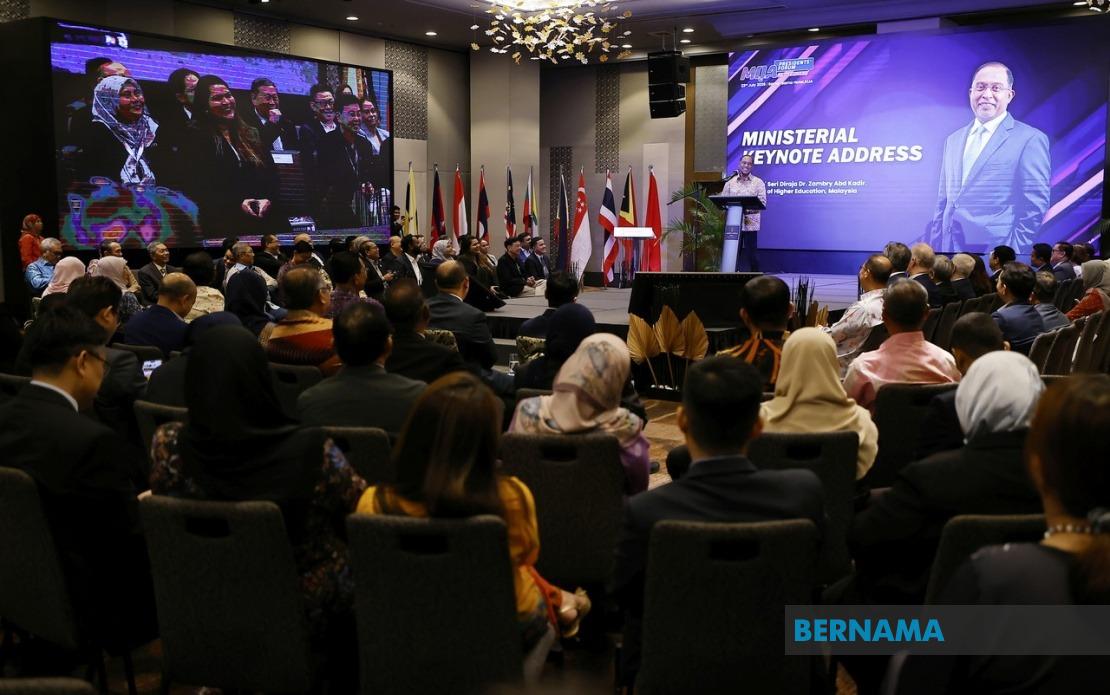
The Malaysian government remains firmly committed to preserving academic freedom and cultivating environments where ideas flourish through open debate, Higher Education Minister Datuk Seri Dr Zambry Abd Kadir declared at a public forum in Putrajaya on July 23. Speaking at a lecture delivered by Columbia University professor Dr Joseph A. Massad on Muslim identity in a globalised world, Zambry outlined the administration's vision for universities as genuine centres of learning where thinkers across disciplines can examine complex issues without fear of suppression.
Zambry's remarks underscore a government stance that positions Malaysia's universities as platforms for substantive intellectual engagement. Rather than treating academic freedom as an absolute without boundaries, the minister framed it within a broader concept of institutional responsibility. This approach suggests the government recognises that universities serve both immediate academic communities and wider society, requiring scholars to conduct themselves with awareness of potential societal implications. The distinction between unfettered expression and responsible discourse has become increasingly significant as universities worldwide navigate tensions between protecting free inquiry and managing institutional reputations in polarised times.
The minister emphasised that Malaysian higher education institutions will continue functioning as spaces where competing perspectives can coexist and be rigorously examined. By inviting prominent international scholars like Massad to engage with local audiences, the government signals openness to diverse intellectual traditions and frameworks. This practice strengthens Malaysia's position as a regional hub for advanced learning and helps Malaysian academics and students access cutting-edge scholarship from global leaders in their fields. The exchange of ideas across institutional and geographical boundaries has long been foundational to academic progress, allowing scholars to test theories against alternative viewpoints and methodologies.
Zambry articulated that intellectual responsibility must accompany academic freedom—a principle particularly relevant in contemporary Malaysia. Universities should encourage vigorous debate underpinned by evidence, logical reasoning and mutual respect for opposing conclusions. This formulation addresses legitimate concerns about misinformation and irresponsible rhetoric while preserving space for genuine scholarly disagreement. The emphasis on civility and evidence-based discourse reflects recognition that academic communities function most productively when participants engage substantively rather than dismissively with competing arguments. Without such standards, debate risks deteriorating into posturing or ideological entrenchment that advances neither knowledge nor understanding.
Malaysia's plural society provides compelling rationale for robust yet respectful intellectual engagement. With diverse religious, ethnic and cultural communities coexisting within the nation, universities have particular significance as spaces where citizens can learn to understand perspectives fundamentally different from their own. Scholarly dialogue conducted with integrity and openness models the kind of civil engagement that multicultural democracies require. When universities function well, they demonstrate that profound disagreement need not preclude mutual respect or productive collaboration, lessons with applications far beyond academic walls.
The minister acknowledged that disagreement is inevitable, especially as digital platforms and artificial intelligence reshape how information circulates and ideas spread. Rather than treating disagreement as aberrant, Zambry characterised it as normal within pluralistic societies. The Malaysian principle of agreeing to disagree—respecting others' rights to hold different views while maintaining one's own position—provides a cultural foundation for managing such inevitable differences. This approach requires maturity from all parties; it demands that those holding minority views tolerate criticism while those in majority positions refrain from weaponising their numbers against dissent.
The government's continued recruitment of visiting scholars and international academic figures serves multiple purposes within Malaysia's higher education strategy. Such engagements expose local students and academics to world-class instruction, broaden intellectual horizons beyond regional perspectives, and position Malaysian universities competitively within global academic rankings that reward research output and international collaboration. For Malaysian researchers, interaction with distinguished foreign scholars creates networking opportunities that can facilitate future collaborations, joint publications and knowledge transfer. These connections increasingly matter as academic disciplines become more internationalised and research questions transcend national boundaries.
Zambry's remarks also reflect broader Southeast Asian dynamics concerning academic freedom. Across the region, universities face pressure from various quarters—government authorities concerned about stability, nationalist movements emphasising cultural particularity, and commercial interests treating education primarily as credentialing. Malaysia's articulation of a middle path, protecting freedom while emphasising responsibility, offers a model relevant to peer nations navigating similar tensions. The approach acknowledges legitimate state interests in social stability while resisting the temptation to subordinate universities entirely to government agendas or ideological conformity.
The emphasis on informed dialogue through scholarly engagement addresses concrete challenges Malaysian policymakers confront. In polarised environments where misinformation spreads rapidly, universities can serve as institutions that model and teach critical thinking, evidence evaluation and constructive disagreement. By fostering these capacities among students and contributing to public discourse through research and expert commentary, universities strengthen democratic functioning and social resilience. This role requires protecting academics' ability to pursue unpopular lines of inquiry without automatic censure, while still maintaining standards of evidence and logical coherence.
Looking forward, the sustainability of Malaysia's commitment to academic freedom will likely depend on consistent implementation across institutions and disciplines. Protecting freedom is simplest when scholars discuss abstract theoretical questions; challenges multiply when research addresses sensitive social, religious or political matters. The test of genuine commitment comes when universities defend researchers whose findings prove inconvenient to authorities or majority opinion. Zambry's articulation of principle thus requires institutional reinforcement through policies, hiring decisions, and institutional defence of academic independence when pressures emerge.
The government's positioning also responds to international perceptions about academic freedom in Malaysia. Global university rankings and international scholars' decisions about where to work and collaborate incorporate assessments of intellectual openness and freedom from political interference. By actively promoting academic freedom discourse and welcoming distinguished international figures, Malaysia signals to the global academic community that it welcomes rigorous scholarship regardless of conclusions. This positioning supports Malaysia's aspirations to develop world-class research institutions and attract top talent—both increasingly essential as regional competition for academic excellence intensifies.
Ultimately, Zambry's defence of academic freedom within frameworks of responsibility reflects recognition that universities serve multiple constituencies with sometimes competing interests. Students deserve genuine education that develops critical thinking rather than mere indoctrination. Scholars require freedom to pursue knowledge without fear of arbitrary punishment. Societies depend on universities' capacity to generate reliable knowledge and thoughtful analysis of significant challenges. The minister's framing attempts to honour these multiple obligations simultaneously, acknowledging that academic freedom cannot be absolute while resisting the notion that it should be sacrificed to narrow political interests or ideological conformity.

