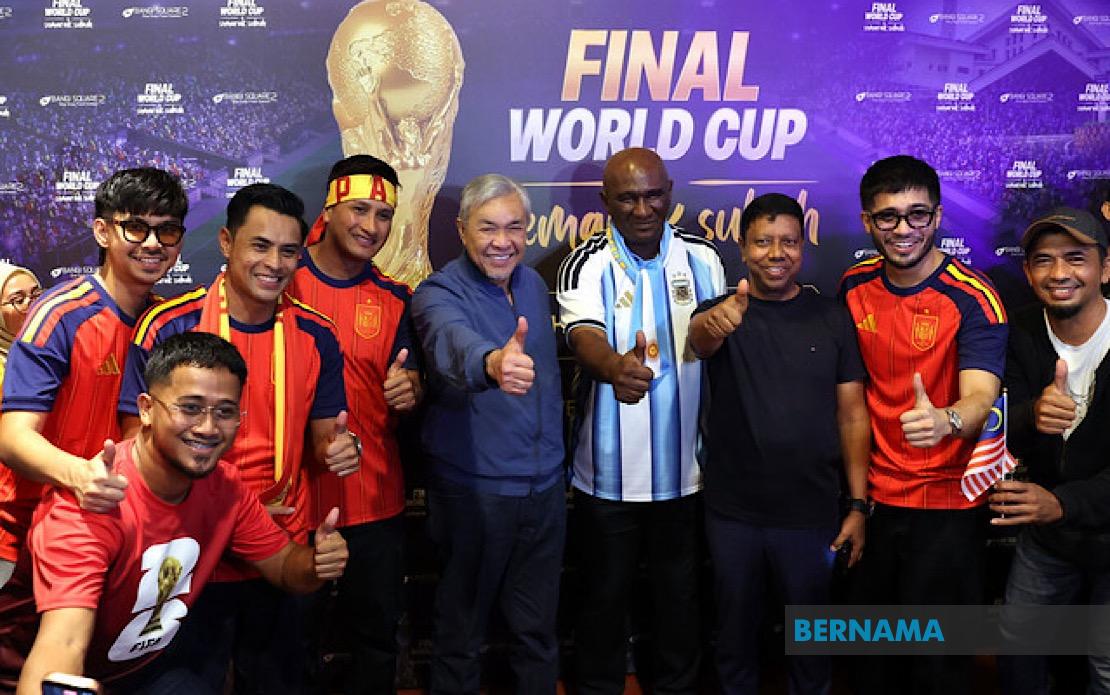
Deputy Prime Minister Datuk Seri Dr Ahmad Zahid Hamidi has declared Malaysia's ambition to one day host football's premier global championship, the FIFA World Cup. Speaking at a community event in Bangi on July 20, Ahmad Zahid, who also holds the Rural and Regional Development portfolio, framed the aspiration within a broader vision for regional prominence in international sport. The sentiment reflects growing confidence in Malaysia's institutional capacity and footballing infrastructure, even as the nation remains outside the ranks of traditional World Cup hosts in the Asian region.
Ahmad Zahid's remarks carried a dual dimension: the hosting ambition paired with an equally significant hope that Malaysia's national squad, the Harimau Malaya, would itself qualify and participate in such a tournament as Southeast Asia's representative. This two-pronged objective addresses both the structural challenge of venue preparation and the sporting challenge of competitive achievement. For a region that has historically struggled to produce World Cup-qualifying nations, the articulation of such aspirations from high-level government carries symbolic weight, signalling political will and potential resource allocation toward football development.
The timing of Ahmad Zahid's comments coincided with a major international football event: the viewing of the World Cup final between Argentina and Spain at Bangi Square 2. Hundreds of football enthusiasts gathered to witness the match, creating a festive atmosphere that underscored the deep emotional connection Malaysian audiences maintain with global football. The Deputy Prime Minister's attendance at this public viewing, rather than in a closed setting, underscored the government's intent to position itself alongside ordinary fans in celebrating the sport's grandest stage.
Concurrent with the final screening, organisers arranged a session titled "Borak Bola" that brought together legendary figures from Malaysia's footballing past. Datuk Zainal Abidin Hassan, Mohd Farizal Marlias, and Mohamad Zaquan Adha Abdul Radzak participated in discussions moderated by Hafizal Hamad, offering insights into the nation's football heritage. Such gatherings serve an important function in Malaysian sports culture, bridging generational gaps and reminding contemporary audiences of earlier triumphs and the institutional knowledge embedded within the sport's elder statesmen.
Malaysia's current FIFA ranking reflects incremental progress. The Harimau Malaya have climbed to 136th position globally, accumulating 1,086.22 points and improving by two places from the previous ranking of 138th. While these rankings place Malaysia firmly in the lower-middle tier of international football, the upward trajectory suggests that targeted investment and strategic coaching decisions may be yielding measurable results. The ranking matters operationally for tournament qualification pathways and continental competition seeding, making even modest improvements noteworthy from a technical standpoint.
Hosting a World Cup requires far more than political will or sporting ambition. The infrastructure demands are formidable: multiple stadiums meeting FIFA specifications, training facilities, accommodation for teams and officials, transportation networks, and security arrangements all represent substantial capital investments. For Southeast Asia, only Thailand has previously submitted a formal bid to host the tournament, reflecting both the financial burden and the competitive international landscape. Malaysia would need to demonstrate not merely the desire but the comprehensive capacity to execute such an undertaking, likely requiring partnerships with regional neighbours and international sponsors.
The Harimau Malaya's participation in a World Cup would require overcoming qualification hurdles that have historically proven challenging. Southeast Asia has contributed only one nation to the World Cup in modern history: Indonesia qualified in 1938 under Dutch administration, before independence. Vietnam came closest in recent decades, reaching the 2022 World Cup qualification final rounds. Malaysia's path to qualification would demand sustained improvement in squad quality, coaching excellence, and tactical innovation within a competitive Asian confederation that includes established powerhouses like Japan, South Korea, and Iran.
Ahmad Zahid's articulation of these twin ambitions occurs within a broader context of Malaysian sporting nationalism and infrastructure development. The country has successfully hosted major sporting events in recent decades, including the 1998 Commonwealth Games and various badminton and football tournaments. This accumulated experience in event management provides a foundation, though World Cup hosting operates at an exponentially higher scale and complexity. International experience suggests that successful bids typically require 10 to 15 years of preparation from formal announcement to tournament execution.
The Deputy Prime Minister's remarks also reflect awareness of Southeast Asia's growing economic dynamism and regional aspiration to assert greater presence on global stages. Hosting the World Cup would position the region as a destination for international sports tourism and investment, with lasting impacts on infrastructure and urban development. For Malaysia specifically, such an event could catalyse stadium upgrades, transport improvements, and hospitality sector expansion with benefits extending well beyond football.
Government endorsement of World Cup hosting ambitions signals potential policy directions regarding football funding, stadium development, and talent identification programmes. The Harimau Malaya's recent ranking improvements suggest that systematic approaches may be taking effect, though sustained progress requires consistent investment and strategic patience. The gap between aspiration and achievement remains substantial, yet Ahmad Zahid's public commitment provides a framework for mobilising stakeholder support, from domestic football federation officials to corporate sponsors and international partners.
Looking forward, Malaysia's pursuit of these objectives will likely unfold across multiple timescales. Immediate priorities centre on improving the national team's competitiveness through stronger regional confederation performance and attracting quality coaching expertise. Medium-term efforts would involve formal World Cup hosting bid preparation, should FIFA open bidding windows. Long-term success requires embedding football excellence within Malaysian sporting culture, developing youth academies, and creating pathways that transform occasional bright prospects into consistently competitive teams.
The intersection of Ahmad Zahid's remarks with the World Cup final viewing illustrates how sporting aspirations and political messaging intertwine in contemporary Malaysia. While the hosting ambition may require decades to realise, if at all, the expression of such goals reflects confidence in national capacity and commitment to football's development. For Malaysian fans watching Argentina face Spain, these statements offered a vision of a future where the Harimau Malaya might themselves grace World Cup stages, whether as hosts or qualifiers representing Southeast Asian pride.

