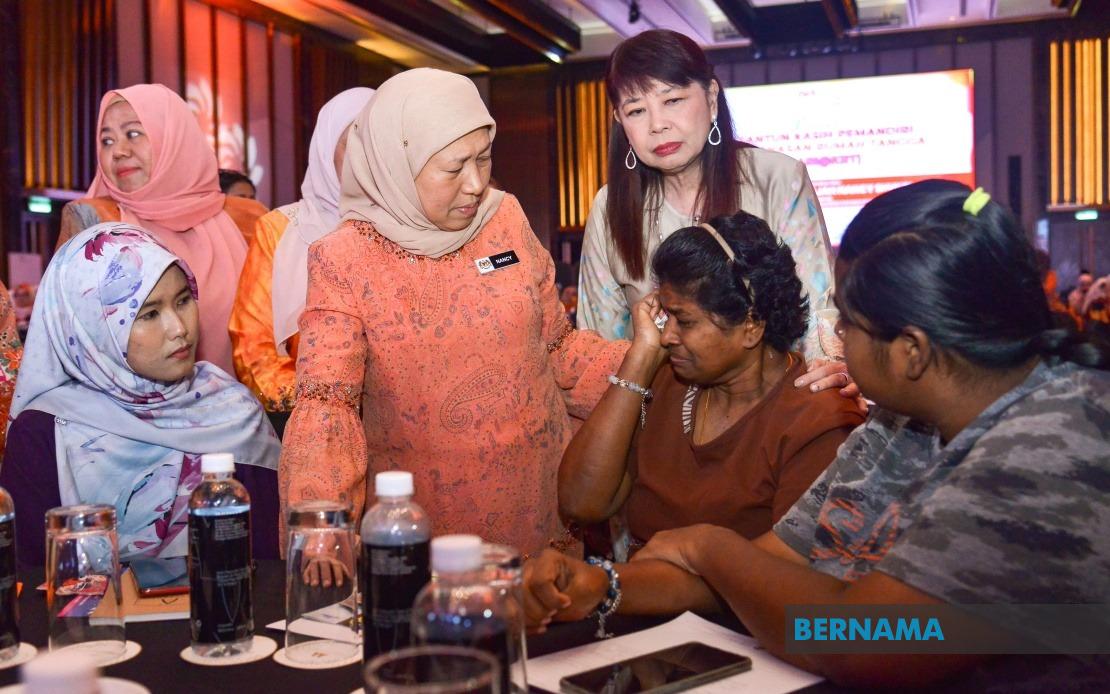
Malaysia has launched a comprehensive support initiative aimed at helping 1,400 survivors of domestic violence rebuild their lives through coordinated psychological, legal and economic assistance. The SARI@KRT: Road to Eliminate Violence Against Women (EVAW) 2026 programme, unveiled by the Ministry of Women, Family and Community Development (KPWKM), represents a significant expansion of the government's response to family violence affecting thousands of Malaysian households annually.
Minister Datuk Seri Nancy Shukri outlined an ambitious rollout strategy that will establish a baseline of at least 100 participants in every state across the federation. The approach moves beyond conventional awareness campaigns to address the deeper psychological wounds inflicted by violence. Rather than simply publicising the dangers of domestic abuse, the programme seeks to rebuild confidence among affected individuals and demonstrate that pathways to safety and independence exist within Malaysia's institutional framework.
The programme architecture emphasises three interconnected pillars. First, it delivers intensive psychosocial support to help survivors process trauma and develop coping mechanisms. Second, it provides dedicated legal assistance to navigate complex family law matters, particularly child maintenance disputes where financial obligations remain contested. Third, it incorporates economic empowerment components designed to reduce financial dependency, a recognised vulnerability factor that often traps victims in abusive relationships. This multi-dimensional approach reflects international best practice, recognising that addressing domestic violence requires simultaneous intervention across emotional, judicial and economic domains.
Recent police statistics underscore the scale of the challenge facing Malaysia's family unit. Between January and June 2024, the Royal Malaysia Police recorded 4,014 cases of domestic violence, representing a nine per cent increase from 3,678 incidents during the same window in 2023. Johor emerged as the epicentre with 721 reported cases, trailed by Selangor with 614 and Perak with 405. These figures concentrate heavily in Malaysia's most urbanised states, suggesting that metropolitan pressures and economic strain intensify family conflict in these regions.
Analysis of the underlying triggers reveals that communication breakdowns and misunderstandings account for the plurality of incidents, representing 1,967 cases during the first six months of 2024. Substance abuse follows distantly with 444 cases, whilst financial stress contributed to 378 incidents. These patterns indicate that many domestic violence episodes stem from conflicts rooted in everyday household management and interpersonal inadequacy rather than pathological criminality. The prevalence of communication-related triggers suggests that early intervention through counselling and conflict resolution training could prevent escalation to physical violence.
Financial abuse emerged as a particularly insidious concern warranting enhanced government attention. Nancy highlighted situations where one spouse possesses adequate income but refuses to contribute to household necessities, effectively weaponising economic power to subordinate the other partner. This form of control operates below the radar of traditional criminal law, yet it creates profound vulnerability and restricts the victim's autonomy and dignity. She emphasised that family financial responsibility constitutes a mutual obligation binding both spouses, and that failure to discharge this duty represents a recognisable abuse category requiring intervention.
The programme incorporates practical mechanisms to reduce barriers facing survivors navigating the court system. KPWKM will distribute special allowances enabling participants to attend judicial proceedings related to child maintenance claims. This innovation removes a significant obstacle that frequently forces impoverished victims to abandon legal remedies, as court attendance often clashes with employment obligations and childcare responsibilities. By offsetting these costs, the government enables survivors to pursue financial security through formal mechanisms.
Minister Nancy contextualised the statistical increase as partly reflecting improved public awareness and heightened willingness among victims to report incidents to authorities. This interpretive frame carries important implications, suggesting that rising case numbers do not necessarily indicate deteriorating social conditions but rather greater transparency and reduced stigma surrounding domestic violence disclosure. The willingness of victims to come forward represents progress in cultural attitudes, though it simultaneously demands expanded support infrastructure.
The programme's launch occurs within the broader Southeast Asian context of elevated gender-based violence, as pandemic lockdowns and economic disruption globally triggered documented surges in family violence. Malaysia's expansion of institutional support responds to this regional pattern while drawing on lessons from neighbouring nations' experience managing domestic violence during periods of heightened social stress. The programme positions Malaysia as a regional leader in systematic, multi-agency responses to this persistent social problem.
Implementation challenges remain substantial. Reaching 1,400 survivors across diverse Malaysian communities requires culturally sensitive service delivery, particularly in rural and indigenous communities where family violence carries deep-rooted social stigma and where institutional trust remains fragile. The programme must also contend with evidence that many domestic violence victims, particularly those from lower-income backgrounds, remain unaware of available support mechanisms or fear immigration consequences if they engage with government services. Sustained resource commitment and community engagement will determine whether the initiative achieves its transformational ambitions.
The government's stated commitment emphasises transition from mere awareness to actionable empowerment. Nancy articulated a vision in which survivors do not remain isolated with their trauma but instead access structured support pathways leading toward self-reliance and secure futures. This philosophical reorientation positions survivors as agents capable of reconstruction rather than passive victims requiring perpetual assistance. By combining psychological restoration, legal advocacy and economic opportunity, the SARI@KRT programme attempts to address the structural conditions enabling domestic violence to persist across Malaysian society.

