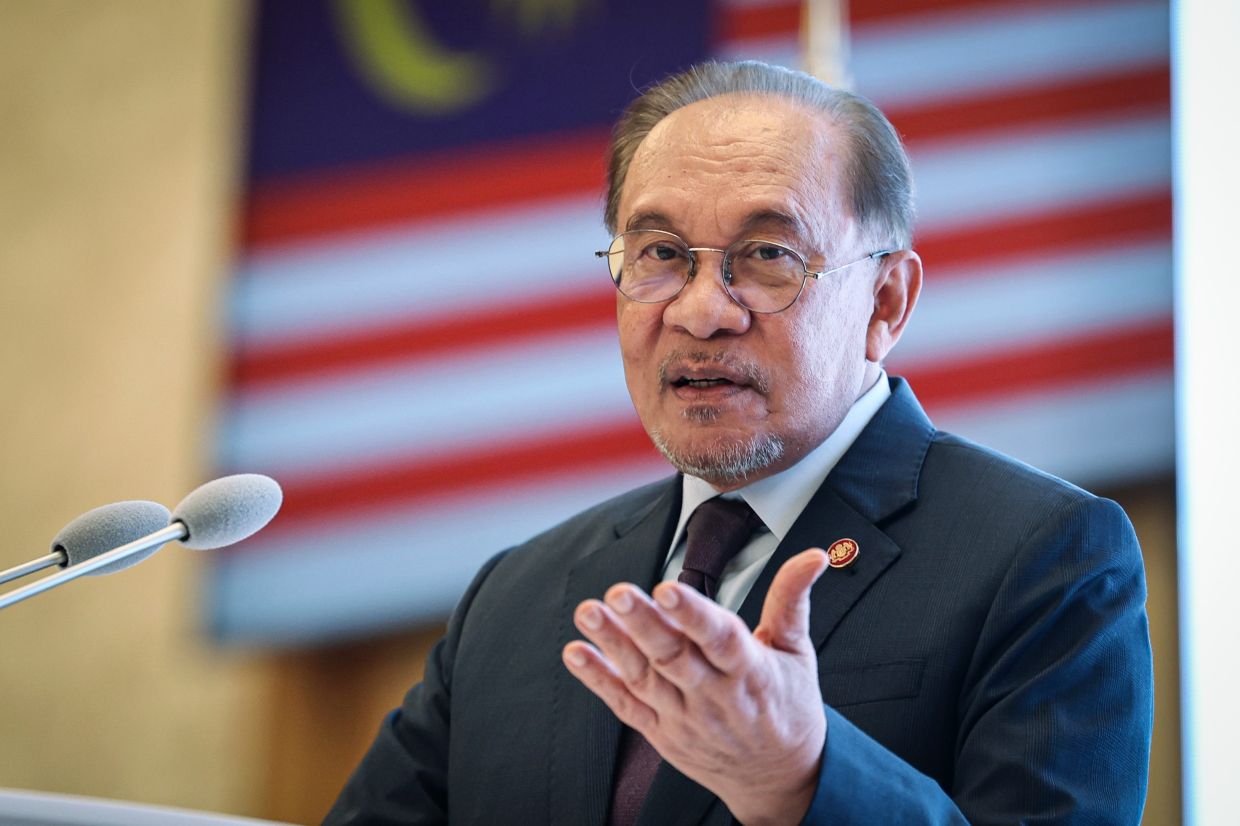
Prime Minister Datuk Seri Anwar Ibrahim has underscored Malaysia's strategic importance as a trading nation positioned along critical global supply chains, describing this geographical and economic advantage as central to the country's diplomatic framework. Speaking at the 39th Asia-Pacific Roundtable, held from June 30 to July 2 and organized by the Institute of Strategic and International Studies (ISIS) Malaysia, Anwar articulated how Malaysia's trading credentials have become inseparable from its broader foreign policy agenda.
The government's approach to economic diplomacy, according to Anwar who also serves as Finance Minister, has consistently focused on reinforcing bonds with long-standing commercial and investment partners. Over successive administrations, this commitment has translated into concrete efforts to foster deeper economic integration across multiple frameworks and agreements designed to facilitate smoother trade flows and capital movement throughout the region and beyond.
Malaysia has positioned itself prominently in negotiations and implementation of major multilateral trade agreements that fundamentally reshape regional commerce. The ASEAN Free Trade Area, the Regional Comprehensive Economic Partnership (RCEP), and the Comprehensive and Progressive Agreement for Trans-Pacific Partnership (CPTPP) represent the backbone of this engagement strategy. Through these mechanisms, Malaysia has actively championed tariff harmonization, expanded market access opportunities, and promoted investment flows that benefit all participating economies while maintaining competitive fairness.
Anwar stressed that ASEAN centrality remains non-negotiable in Malaysia's foreign policy calculus, notwithstanding contemporary geopolitical complexities and occasional member disagreements. He articulated that the bloc's collective strength serves not merely as a platform for advancing Malaysian interests but fundamentally as an instrument for maintaining regional peace, ensuring shared prosperity, and guaranteeing stability in Southeast Asia. This positioning reflects Malaysia's conviction that its own development trajectory remains intrinsically bound to ASEAN's cohesion and success.
Beyond established trading partners within Southeast Asia, Malaysia is deliberately pursuing economic engagement with emerging markets and less-developed regions that present untapped potential. This strategic expansion encompasses West Asia, Central Asia, Latin America, and Africa—territories that historically received limited Malaysian commercial attention but now feature prominently in diversification initiatives. Rather than viewing this as purely economic opportunism, the Prime Minister framed it as a convergence of economic necessity and geopolitical positioning that enhances Malaysia's influence across multiple continents.
The Malaysian government's collaboration model emphasizes genuine partnership built around complementary sectoral strengths. Priority areas for joint development include the halal industry, where Malaysia possesses established expertise and certification frameworks; the digital economy, reflecting the nation's technological advancement; agricultural production and trade; and green technology adoption. This sector-focused approach acknowledges that sustainable economic relationships extend beyond simple commodity exchanges to encompass knowledge transfer, capacity building, and mutually beneficial technological advancement.
Energy cooperation represents a particularly strategic dimension of Malaysia's economic diplomacy, with Petronas—the national oil and gas corporation—serving as a primary vehicle for engagement. During Anwar's recent official visit to Turkmenistan, Petronas executed agreements with Turkmen state entities targeting the exploration and development of two substantial gas fields. This expanded hydrocarbon cooperation reflects Malaysia's understanding that energy security and resources remain foundational to regional economic development and geopolitical influence throughout Central and West Asia.
Complementing these commercial arrangements, Malaysia and Turkmenistan established a comprehensive long-term framework governing hydrocarbon development cooperation. This accord extends beyond immediate extraction and sales activities to encompass human capital development and technical expertise sharing, acknowledging that sustainable resource partnerships require institutional strengthening and workforce training across both nations. Such arrangements position Malaysia as a technology provider and development partner rather than merely a resource importer.
The Prime Minister's articulation of diversification as national necessity—rather than optional economic preference—reflects Malaysia's assessment of contemporary global volatility and uncertainty. Geopolitical tensions, supply chain disruptions, and shifting great power competition create genuine vulnerabilities for nations dependent on narrow trading relationships or concentrated market access. By deliberately broadening its economic footprint across geographically dispersed and politically diverse partners, Malaysia seeks to insulate its economy from localized shocks while maintaining flexibility in adapting to emerging opportunities and threats.
Malaysia's overarching objective, according to Anwar, centers on fortifying existing partnerships while systematically cultivating relationships with new trading counterparts. This dual-track approach acknowledges that traditional allies and established markets provide stability and predictability essential for long-term planning, while emerging partnerships offer growth dynamism and insurance against dependence on any single economy or region. The government aims to construct an economic architecture that simultaneously maximizes immediate commercial gains and protects against future vulnerabilities.
The emphasis on maintaining broad-based, resilient, and forward-looking economic ties reflects sophisticated understanding that Malaysia's prosperity depends not on dominating any single market but on remaining indispensable across multiple value chains. This philosophy represents a significant strategic reorientation that positions Malaysia not as a passive participant in global commerce but as an active architect of regional economic architecture. By leveraging its geographic centrality, institutional capacity, and sectoral expertise, Malaysia seeks to shape the frameworks within which regional trade and investment occur while capturing disproportionate benefits from its intermediary position.

