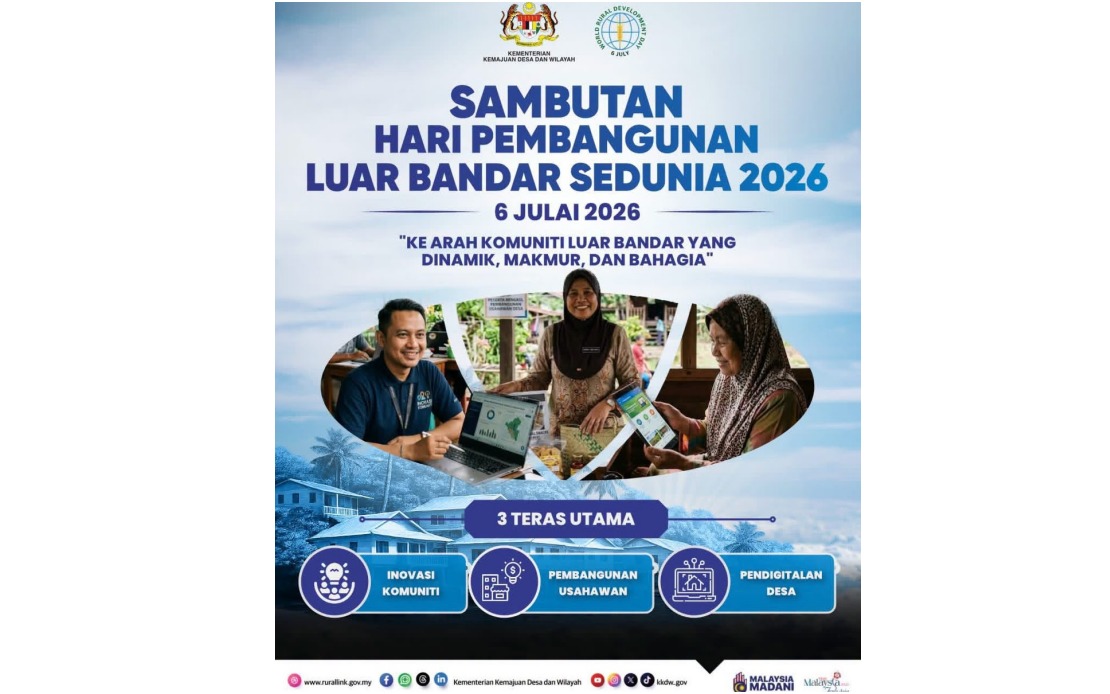
Malaysia will make history tomorrow by hosting its inaugural celebration of World Rural Development Day at Tun Abdul Razak Stadium in Jengka, near Maran. The milestone event underscores the nation's renewed policy emphasis on rural communities, which constitute a vital yet often-overlooked segment of the population driving grassroots economic activity and social cohesion across Peninsular Malaysia and beyond.
Deputy Prime Minister and Minister of Rural and Regional Development Datuk Seri Dr Ahmad Zahid Hamidi will officiate the celebration, lending high-level government endorsement to an initiative that resonates with Malaysia's broader development agenda. The chosen theme—"Toward Vibrant, Prosperous and Happy Rural Communities"—encapsulates a modernised vision for rural Malaysia that extends well beyond traditional agricultural narratives, positioning countryside development as integral to national progress and the achievement of the United Nations Sustainable Development Goals.
The Ministry of Rural and Regional Development has anchored the celebration around three interconnected pillars that reflect contemporary challenges facing rural Malaysia. Community innovation represents a shift away from top-down development models, empowering rural populations to identify and implement homegrown solutions to local challenges. This acknowledges the creativity and entrepreneurial spirit already flourishing in many rural areas but constrained by limited access to formal networks and resources.
Rural digitization constitutes the second pillar, addressing a persistent infrastructure gap that has historically disadvantaged countryside communities in accessing e-commerce opportunities, digital services, and information technology. By prioritising digital connectivity and literacy, the government aims to collapse the spatial barriers that have limited rural entrepreneurs' market reach and excluded rural residents from the expanding digital economy dominating urban centres. This thrust carries particular relevance for Malaysia's aspirations as a middle-income country seeking to leverage technology for inclusive growth.
Rural entrepreneur development forms the third pillar, directly targeting economic opportunity creation beyond subsistence agriculture. This focus recognises that sustainable prosperity in rural areas requires diverse income-generating activities, from agribusiness and cottage industries to tourism and value-added product manufacturing. The initiative provides institutional support and mentorship frameworks that help emerging rural business operators navigate licensing, financing, and market access challenges that often prove insurmountable without assistance.
The celebration will feature several substantive awards and announcements that extend beyond ceremonial significance. The Rural Aspiration Award MADANI and Felda Plan Excellence Award will recognise outstanding contributions within rural development and land settlement schemes, incentivising continued excellence and community engagement. The launch of My Rural Insight Journal provides a platform for documenting and disseminating rural development experiences, creating an institutional memory and knowledge repository for future policy refinement.
Another highlight involves the announcement of Felcra Bhd Interim Distributable Profit Distribution for the 2026 cycle, directly benefiting members of the Federal Land Consolidation and Rehabilitation Authority cooperative schemes. Such distributions underscore the government's commitment to ensuring that development gains translate into tangible improvements in rural household incomes and living standards. The timing of this announcement during the celebration reinforces the message that rural development translates into immediate, measurable economic benefits.
The United Nations General Assembly formally declared World Rural Development Day on September 6, 2024, designating July 6 as the annual global observance date. This timing commemorates the establishment of the Centre on Integrated Development for Asia and the Pacific (CIRDAP), which reflects international recognition of rural development's critical importance in achieving sustainable development outcomes. The global celebration commenced on July 6, 2025, with Malaysia now joining member countries implementing official national observances beginning in 2026.
Malaysia's participation in this newly-established global initiative positions the country alongside international peers in addressing rural development challenges that transcend borders. Agricultural communities across Southeast Asia face similar pressures from urbanisation, demographic shifts, and climate variability. By institutionalising World Rural Development Day, Malaysia signals commitment to learning from regional experiences and contributing expertise to collective efforts addressing rural prosperity.
The government's invitation for public attendance reflects confidence in the celebration's relevance to ordinary Malaysians. The exhibition booths hosted by the Ministry and partner agencies will showcase concrete programmes, technological solutions, and success stories from existing rural development initiatives. This grassroots engagement differs from purely bureaucratic announcements, creating space for rural residents, aspiring entrepreneurs, and development stakeholders to interact directly with government officials and access information about available programmes and support mechanisms.
For Malaysian policymakers, this inaugural celebration represents an opportunity to assess progress and recalibrate strategies in light of evolving rural realities. Rural Malaysia encompasses tremendous diversity—from advanced horticultural regions to subsistence-dependent areas, from villages within reach of metropolitan expansion to remote communities in Peninsular Malaysia's interior and East Malaysian states. A one-size-fits-all approach risks ineffectiveness, making the emphasis on community innovation particularly significant as communities themselves help design locally-appropriate solutions.
The celebration's emphasis on digitization carries strategic importance for Malaysia's Vision 2050 aspirations and the broader digital economy transition. Rural broadband infrastructure remains uneven, and digital skills gaps persist in many communities. Addressing these deficiencies unlocks potential for remote work, digital agriculture, and online commerce, fundamentally transforming economic prospects for rural areas that might otherwise face continued marginalisation in an increasingly digital national economy.
Looking forward, the institutionalisation of World Rural Development Day potentially catalyses sustained policy attention and resource allocation to countryside development. Regular celebrations create accountability mechanisms and focal points for reviewing progress against rural development targets. For Malaysian readers invested in equitable, inclusive growth that benefits communities beyond major urban concentres, tomorrow's celebration represents a notable commitment to reimagining rural Malaysia's role in the nation's future prosperity.

