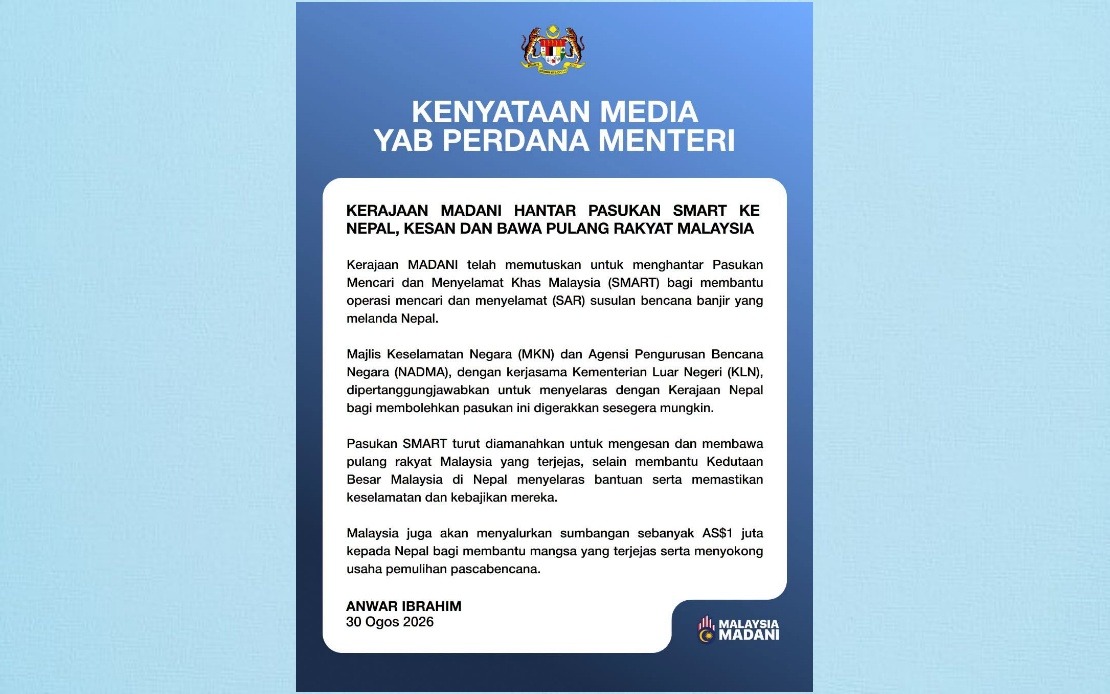
Malaysia has activated its international disaster response mechanism in the wake of devastating floods that swept through Nepal's Rasuwa district on August 26, with Prime Minister Datuk Seri Anwar Ibrahim announcing the deployment of the Special Malaysian Disaster Assistance and Rescue Team (SMART) to bolster search and rescue operations in the heavily affected region. The decision underscores Malaysia's commitment to regional humanitarian cooperation and reflects growing concerns about the welfare of Malaysian nationals caught in what has become one of the most serious natural disasters to strike the country in recent months.
According to the Foreign Ministry's latest update, 55 Malaysians have not been reachable since the flash floods and catastrophic landslides devastated the mountainous district. This substantial number of missing nationals has prompted the coordinated response involving multiple Malaysian government agencies, with the National Security Council and the National Disaster Management Agency working closely alongside the Foreign Ministry to mount an effective international operation. The urgency of locating and ensuring the safety of these citizens reflects Malaysia's broader responsibility to its diaspora and nationals abroad during crises.
The SMART team, Malaysia's premier disaster relief unit, will undertake a dual mandate encompassing both humanitarian rescue operations and the specific mission of identifying and repatriating Malaysians affected by the calamity. Beyond direct rescue efforts, the deployment will serve to strengthen coordination with the Malaysian Embassy in Nepal, which has been stretched managing the crisis response and tracking down missing nationals scattered across the affected zones. This integrated approach ensures that Malaysian citizens receive priority attention while simultaneously contributing meaningful international assistance to the broader relief effort.
Prime Minister Anwar Ibrahim outlined that the National Security Council and National Disaster Management Agency have been tasked with liaising directly with the Nepalese government to expedite all necessary approvals and logistical arrangements for the SMART team's swift deployment. Such coordination is essential in international disaster response, where bureaucratic delays can prove costly in terms of lives saved and effectiveness of operations. The government's emphasis on facilitating deployment "as soon as possible" signals the administrative priority being assigned to the mission at the highest levels of Malaysian governance.
Beyond the deployment of specialised personnel, Malaysia is extending financial assistance to help Nepal navigate the immediate humanitarian catastrophe and subsequent recovery phase. The government has committed to contributing US$1 million to support affected populations and fund post-disaster rehabilitation initiatives. This financial injection represents tangible Malaysian solidarity with a neighbouring Asian nation facing overwhelming challenges, and positions Malaysia as a responsible regional power willing to back humanitarian declarations with concrete resources. The contribution will support everything from emergency medical care and shelter to longer-term infrastructure reconstruction efforts.
The August 26 flash floods and landslides struck Rasuwa district with remarkable ferocity, transforming the landscape and destroying communities with minimal warning. The combination of heavy rainfall, steep mountainous terrain, and vulnerable infrastructure created catastrophic conditions that overwhelmed local response capacities. For Malaysians caught in such remote areas, the challenges of locating survivors and establishing communication lines have been compounded by difficult geography and the scale of physical destruction. The presence of a professional Malaysian rescue team equipped with specialist training and equipment could prove instrumental in locating survivors among debris fields and collapsed structures.
The SMART team's involvement extends to welfare coordination and safety assurance for identified Malaysians, working alongside embassy personnel to arrange appropriate care, temporary accommodation, and eventual repatriation where necessary. This holistic approach recognises that disaster response encompasses not merely rescue operations but also the protection and support infrastructure required to ensure affected nationals receive dignified treatment and proper assistance during the most vulnerable period following a catastrophe.
This Malaysian response reflects established protocols for handling overseas disasters affecting citizens, but the scale of the Rasuwa floods has necessitated mobilising one of the country's most capable and experienced rescue units. The SMART team brings decades of operational experience from previous international deployments and domestic disaster responses, knowledge that will prove invaluable in navigating the complex terrain and environmental conditions characteristic of post-flood Nepal. Their presence will also amplify Malaysia's voice in international coordination mechanisms, ensuring Malaysian interests and citizen welfare receive adequate consideration within broader relief frameworks.
For Southeast Asia more broadly, the deployment demonstrates the region's growing capacity and willingness to mount mutual aid operations across borders during major disasters. As climate change intensifies extreme weather patterns and increases the frequency of catastrophic flooding events throughout the region, such international cooperation mechanisms become increasingly vital. Malaysia's swift response serves as a model of regional responsibility and illustrates how diplomatic, humanitarian, and security agencies can coordinate effectively to manage transnational crises affecting diaspora populations.

