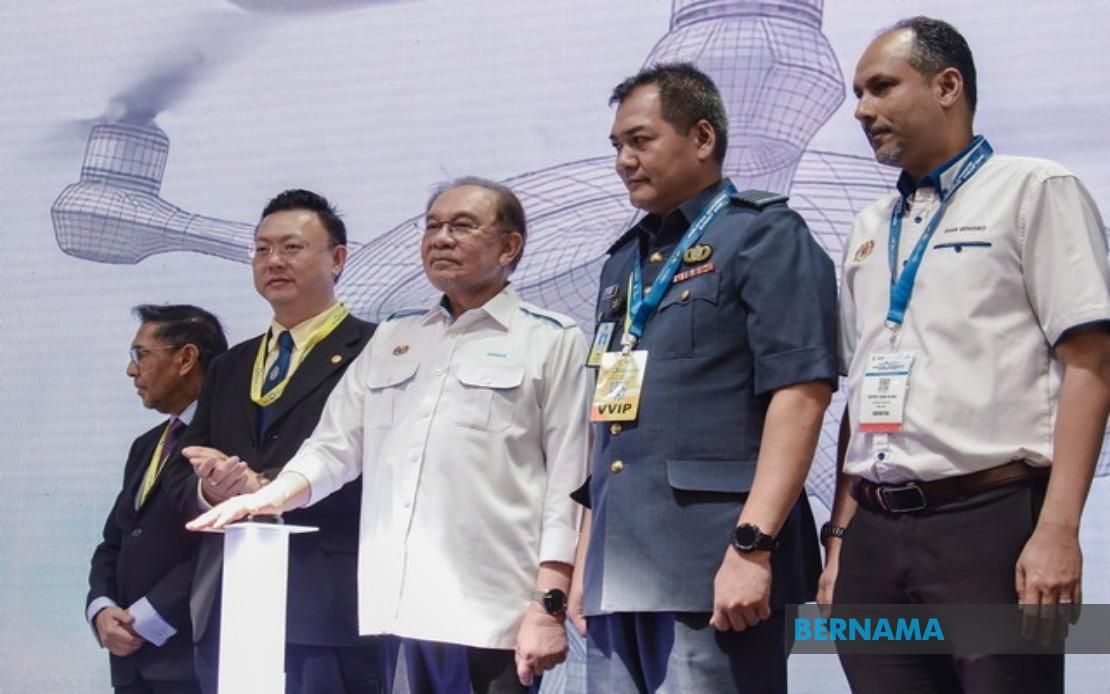
Prime Minister Datuk Seri Anwar Ibrahim has issued a stark call for Malaysia to prioritise the development of unmanned aerial vehicle technologies, positioning the burgeoning drone sector as essential to the nation's long-term economic competitiveness and technological advancement. Speaking at the closing ceremony of MyDrone Expo 2026 in Sepang, Anwar underscored the urgency of moving swiftly in emerging technology fields, with drones serving as a critical intersection between artificial intelligence, digital transformation, and practical economic application. The message was clear: Malaysia risks falling behind in a strategically important industry unless policymakers and industry stakeholders act decisively to build the necessary infrastructure and expertise.
The drone industry represents far more than a niche technological pursuit. According to projections cited by the Prime Minister, the global UAV market is anticipated to surpass USD55 billion by 2030, signalling enormous wealth-creation potential for nations that position themselves as leaders in this space. This figure underscores why governments worldwide are treating drone development with increasing seriousness, viewing it as a cornerstone of future economic resilience. For Malaysia, a nation seeking to transition away from lower-value manufacturing and commodity dependence, capturing a meaningful share of this expanding market could generate high-skilled employment, attract foreign investment, and establish new revenue streams across multiple sectors.
What distinguishes Anwar's intervention is his explicit linkage between drone technology and the broader digital economy. Rather than treating UAVs as standalone equipment, he articulated a vision of drones as deeply embedded within the wider ecosystem of artificial intelligence and digital transformation reshaping global commerce. This perspective matters because it suggests that Malaysian competitiveness in drones cannot be achieved in isolation. Instead, developing world-class drone capabilities requires simultaneous investments in AI research, digital infrastructure, cybersecurity frameworks, and skilled human capital. The synergies between these fields mean that success in one domain amplifies advantages in others, creating a virtuous cycle of innovation and economic benefit.
The MyDrone Expo 2026, co-organised by the World UAV Federation Malaysia Chapter and the Malaysia UAV Development Association, demonstrated tangible momentum within the domestic industry. The three-day event attracted over 100 exhibition booths and drew thousands of visitors and industry representatives from 46 countries, indicating that Malaysia already hosts a community of drone entrepreneurs, manufacturers, and enthusiasts capable of competing on the global stage. This existing base provides a foundation upon which government support and policy reform can build, rather than starting from zero. The international participation suggests that foreign companies and investors view Malaysia as a potentially attractive location for drone-related ventures, contingent upon receiving appropriate regulatory clarity and support.
Recognising that government intervention alone cannot drive industry success, Anwar directed Cabinet ministers, policymakers, research institutions, and relevant agencies to extend comprehensive regulatory and ecosystem support to the drone sector. This represents a significant political commitment, signalling to both domestic and international investors that drone development is a government priority rather than a peripheral concern. The directive touches on several critical areas: regulatory frameworks must evolve to permit innovation while maintaining safety and security; funding for research must increase; testing and certification processes must be streamlined; and policy must explicitly encourage both defence and civil applications, from agricultural productivity improvements to plantation management and beyond.
The scope of potential drone applications in Malaysia's context is particularly significant given the nation's substantial agricultural and plantation sectors. Drones equipped with sensors and imaging technology can monitor crop health, optimise pesticide and fertiliser application, assess soil conditions, and dramatically improve yields while reducing environmental impact. For a country with extensive rubber and palm oil plantations, widespread drone adoption could substantially enhance productivity and profitability. Similarly, infrastructure inspection, disaster response, logistics optimisation, and environmental monitoring represent additional high-value use cases where Malaysian companies could establish competitive advantages. The government's emphasis on supporting civil applications suggests awareness of these economic multiplier effects beyond the defence and aerospace sectors.
Building a talent pipeline emerges as equally vital as regulatory reform and funding. Anwar specifically urged collaboration between private industry, government research institutions, and universities to develop the skilled workforce that drone innovation and deployment require. His invocation of existing artificial intelligence and quantum computing faculties indicates that Malaysia possesses some foundation in advanced technology education that can be leveraged and expanded for drone-related fields. However, creating a comprehensive talent ecosystem demands more than ad-hoc university programmes; it requires coordinated curriculum development, industry partnerships that place graduates in meaningful roles, competitive compensation to retain talent, and a culture that rewards entrepreneurship and technological excellence. Singapore and South Korea have demonstrated how such coordinated approaches can rapidly establish regional technology leadership.
The timing of this push carries geopolitical and strategic significance for Southeast Asia. As regional powers compete for technological leadership and economic dominance in emerging sectors, Malaysia's ability to develop capabilities in drones and allied technologies will influence its broader technological standing and negotiating power. Nations that lead in transformative technologies typically enjoy spillover benefits across related industries and attract talented professionals from across the region. By moving decisively on drones, Malaysia can position itself as a Southeast Asian hub for unmanned systems innovation, potentially attracting companies, researchers, and capital flows from throughout the region and beyond.
However, realising this vision requires more than rhetorical support from political leadership. Successful technology sector development typically hinges on sustained funding, regulatory predictability, intellectual property protections, access to venture capital, and a willingness to tolerate some failure as part of the innovation process. Malaysia's track record in developing high-tech industries offers both encouraging examples and cautionary tales. The semiconductor manufacturing sector demonstrates the nation's capacity to attract and retain world-class technology investment, yet other technology initiatives have foundered due to inconsistent support, regulatory uncertainty, or lack of integration with international value chains.
The global context adds both urgency and opportunity. China has emerged as a dominant force in commercial drone manufacturing, while the United States maintains leadership in high-end defence applications. However, opportunities exist in specialised segments, custom applications, regional market leadership, and niche innovations where smaller nations can compete effectively. Malaysia's geographic position in one of the world's most economically dynamic regions, combined with its existing manufacturing expertise and growing technology capabilities, positions it well to capture market share in Southeast Asian and regional Asian markets where demand for affordable, locally-relevant drone solutions is surging.
For Malaysian businesses and investors, the Prime Minister's remarks signal that the regulatory and political environment for drone ventures is shifting positively. Entrepreneurs contemplating drone-related startups, manufacturers considering facility expansions, and established companies exploring drone applications now have clearer assurance that government will facilitate rather than obstruct their efforts. This confidence is invaluable in technology sectors where regulatory uncertainty can paralyse investment decisions and deter talent. The explicit government commitment also enhances Malaysia's attractiveness to international drone companies evaluating regional expansion sites, potentially catalysing technology transfer, job creation, and capability development.
Looking forward, the implementation phase will prove critical. Policy directives issued from the highest political levels must translate into concrete regulatory changes, budget allocations, and institutional arrangements at operational levels. Success requires sustained focus beyond the initial announcement phase, particularly given the long development cycles typical of technology sectors. Malaysia's trajectory in drone development will serve as a bellwether for whether the nation can execute on its stated ambitions to become a regional technology leader. The sector's intersection with AI, digital transformation, and multiple economic applications means that success here could catalyse broader advances across Malaysia's technology landscape, strengthening the nation's competitiveness in an increasingly digital global economy.

