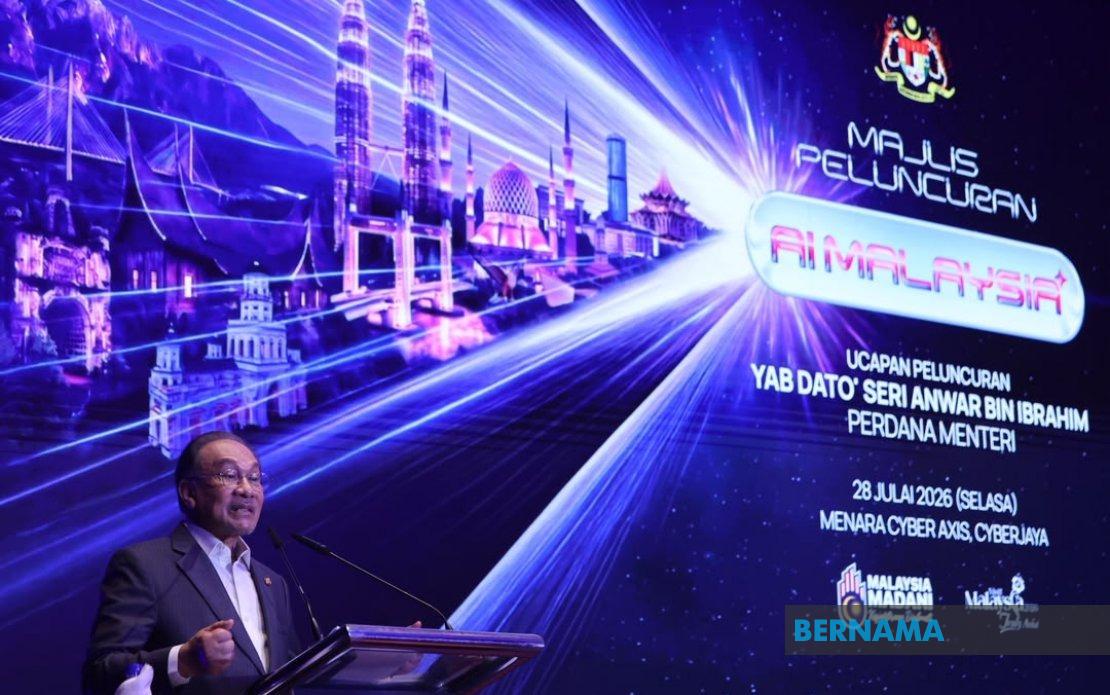
Prime Minister Datuk Seri Anwar Ibrahim has sounded a cautionary note on Malaysia's embrace of artificial intelligence and advanced technology, warning that rapid digital transformation risks eroding the moral and cultural foundations that anchor Malaysian society. Speaking at the launch of AI Malaysia, a new national artificial intelligence entity operating under the Digital Ministry in Cyberjaya, Anwar articulated a vision where technological mastery and human values coexist rather than compete, framing this balance as essential to building a MADANI nation.
Anwar's remarks come as Malaysia accelerates its digital transformation agenda, positioning itself as a regional leader in AI adoption and technological innovation. While acknowledging that mastery of artificial intelligence is vital for Malaysia to maintain global competitiveness, the Prime Minister stressed that technological advancement must be pursued within a framework that protects the country's distinct identity. His statement reflects growing international concerns about the potential social and cultural costs of unchecked technological change, particularly in diverse societies where shared values serve as social glue.
The challenge, as Anwar framed it, is deceptively simple yet profoundly complex: Malaysia must aspire to the technological heights achieved by developed nations while remaining anchored to its foundational principles of faith, ethics and cultural heritage. This approach requires rejecting a false binary between modernisation and tradition, instead seeking synergies where technological progress serves to strengthen rather than undermine social cohesion. For a multiracial, multireligious nation, this balance assumes heightened importance, as the erosion of shared moral values could exacerbate existing social fragmentation.
Education has emerged as the cornerstone of Malaysia's AI strategy according to Anwar's vision. The Prime Minister indicated that the Ministry of Education has been tasked with integrating artificial intelligence exposure into school curricula while simultaneously strengthening Science, Technology, Engineering and Mathematics education alongside Technical and Vocational Education and Training programmes. This dual emphasis acknowledges that technological competency alone is insufficient; Malaysian graduates must possess both technical skills and robust ethical grounding. The integration of AI literacy at foundational education levels reflects a strategic decision to build human capital capable of both developing and responsibly deploying advanced technologies.
Higher education institutions face equally significant responsibilities in this framework. Anwar called on Malaysian universities to strengthen their artificial intelligence faculties, research centres and departmental capacity to ensure graduates meet the demanding skill requirements of global technology industries. Feedback from major international technology firms including Nvidia, Google, Microsoft, Huawei and Ericsson suggests Malaysian graduates currently lag peers from more technologically advanced nations in specialised AI competencies. However, Anwar cautioned against allowing universities to pursue industry alignment at the expense of ethical education, emphasising that graduates must combine technical excellence with strong moral compass and humanistic values.
The concept of shifting from "made in" Malaysia to "made by" Malaysia represents a significant recalibration of the country's approach to technology development. Rather than remaining a consumer or assembler of foreign technologies, Anwar advocated for empowering local universities, educational institutions and private sector enterprises to develop home-grown artificial intelligence solutions tailored to Malaysian and Southeast Asian contexts. This strategy offers potential economic benefits through reduced technology dependency and creation of intellectual property assets, while also ensuring that AI systems reflect local values and address regionally specific challenges rather than simply importing solutions designed elsewhere.
Anwar's emphasis on preserving human dignity and values carries particular resonance for Malaysia as a multiracial, multireligious society. He explicitly warned that for such nations, erosion of religious and moral values poses existential risks to social stability and national cohesion, potentially undermining the shared frameworks that enable diverse communities to coexist peacefully. This perspective diverges from technological determinism that treats digital transformation as a neutral, inevitable process to which societies must simply adapt. Instead, Anwar articulated an active, deliberate approach where Malaysian society consciously shapes how technology integrates into its cultural and social fabric.
The launch of AI Malaysia itself signals institutional commitment to coordinating artificial intelligence development across government. The Digital Ministry, represented at the event by Minister Gobind Singh Deo, will spearhead efforts to accelerate AI adoption within government ministries, departments and agencies, suggesting that technology deployment will extend across public administration and service delivery. This institutional coordination addresses a challenge many Southeast Asian nations face: fragmented technology strategies that lack coherence and create inefficiencies.
Anwar's dual role as both Prime Minister and Finance Minister positions him to influence both policy direction and resource allocation toward artificial intelligence initiatives. The presence of Communications Minister Datuk Seri Fahmi Fadzil and Chief Secretary to the Government Tan Sri Shamsul Azri Abu Bakar at the AI Malaysia launch underscores the cross-government nature of this technological transition. Such high-level coordination suggests Malaysia's leadership views artificial intelligence not merely as a technology sector concern but as a comprehensive national development agenda requiring integrated policy responses.
The broader context for these remarks involves Malaysia's positioning within the global artificial intelligence competition. As developed economies and China invest heavily in AI research and deployment, Southeast Asian nations risk falling behind without deliberate acceleration strategies. Yet Anwar's framing suggests Malaysia aims to chart a distinctive path, one that learns from both the technological achievements and societal challenges experienced by more advanced AI-adopting nations. This approach recognises that societies adopting technologies after observing their impacts elsewhere can potentially capture benefits while avoiding certain pitfalls, though the challenge of applying such lessons remains substantial.
Looking forward, the success of Malaysia's artificial intelligence ambitions will substantially depend on how effectively the education system, industry and government coordinate efforts while maintaining focus on preserving core values. The balance Anwar advocated—technological progress paired with moral grounding—represents an aspirational vision that requires sustained commitment, adequate resource allocation and consistent messaging across all institutional levels. For other Southeast Asian nations facing similar tensions between modernisation and cultural preservation, Malaysia's approach may offer instructive lessons in attempting to navigate this increasingly critical challenge.

