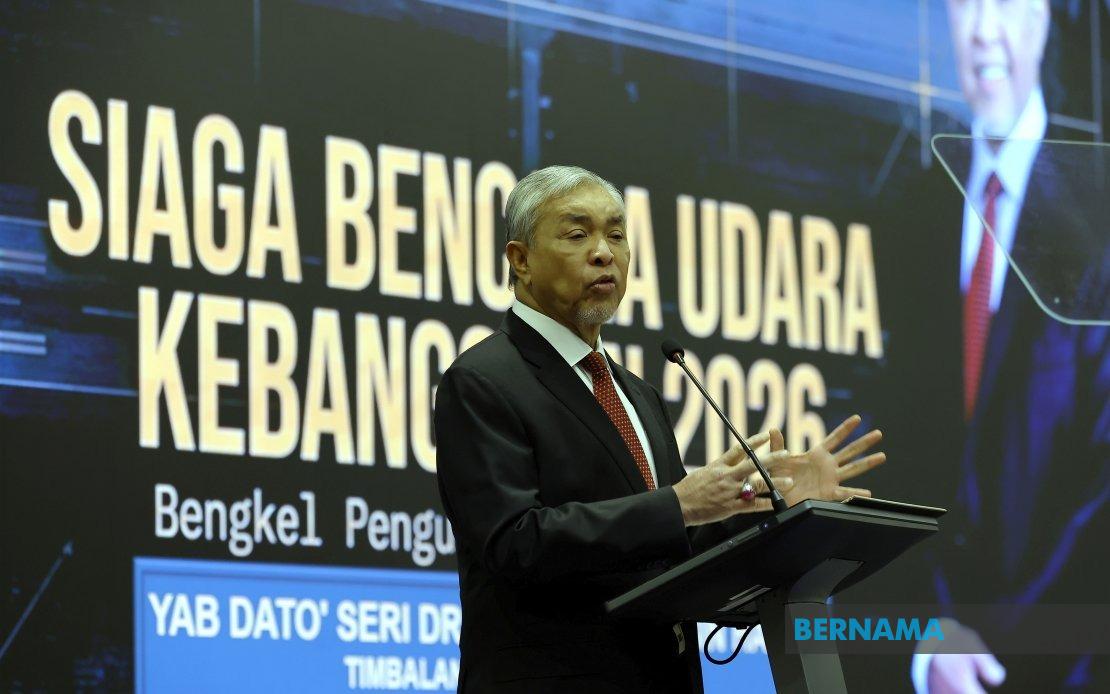
Malaysia must urgently establish a comprehensive, integrated air disaster management framework where all government agencies, security forces, and emergency responders operate under unified command and shared situational awareness, Deputy Prime Minister Datuk Seri Dr Ahmad Zahid Hamidi declared at the launch of the National Air Disaster Preparedness 2026 workshop in Sepang on July 27. The current fragmented approach to crisis response, he cautioned, leaves the country vulnerable to ineffective emergency operations when seconds matter most. Ahmad Zahid's intervention reflects growing concern among Malaysian leadership that existing protocols, while documented, have not been adequately tested under genuine pressure scenarios where rapid decision-making and seamless inter-agency coordination become critical to minimizing casualties and damage.
The Deputy Prime Minister articulated a philosophy of operational unity centered on three interlocking principles: a single integrated system, unified command authority, and synchronized action across all responding organizations. This governance model moves beyond simply assembling resources and personnel, instead focusing on how effectively those assets function together when crisis strikes. Ahmad Zahid noted that disaster management capability cannot be evaluated based on the quantity of equipment or staff deployed, but rather on the degree to which diverse agencies can synchronize their efforts toward one overarching objective—rapid containment and life preservation. The distinction he drew is particularly relevant for Malaysia's aviation sector, where the coordination gap between airport authorities, civil aviation regulators, rescue services, health authorities, and security agencies could prove fatal in time-sensitive scenarios.
The two-day workshop, which concluded following the Deputy PM's remarks, brought together more than 100 representatives spanning government ministries, law enforcement bodies, rescue operations, airline operators, airport management companies, and supporting industry stakeholders. This gathering served as an opportunity to stress-test existing procedures, evaluate whether communication systems function reliably during simulated crises, and identify gaps in operational role clarity. Rather than waiting for an actual aviation catastrophe to reveal systemic weaknesses in coordination or command clarity, Ahmad Zahid emphasized that Malaysia must proactively validate its disaster response infrastructure through rigorous exercises and tabletop simulations.
Four strategic priorities emerged from Ahmad Zahid's framework for system strengthening. First, Malaysia must conduct comprehensive reviews of existing command-and-control procedures to establish clear chains of authority and eliminate ambiguity about decision-making responsibility during emergencies. Second, the country requires enhanced mechanisms for real-time information sharing and integrated communication platforms that enable all participating agencies to access identical situational data simultaneously. Third, scenario-based training must expand beyond major airport facilities to encompass challenging environments such as remote locations, mountainous terrain, and difficult-to-access crash sites where rescue operations would prove logistically complex. Fourth, Malaysia must accelerate the digitalization of its entire disaster management infrastructure, moving away from paper-based systems that slow information dissemination during critical moments.
The emphasis on digital transformation carries particular significance for Southeast Asia, where legacy systems remain common across government agencies. By modernizing disaster management infrastructure, Malaysia can establish regional best practices that neighboring countries might emulate. Cloud-based platforms enabling real-time data sharing across independent agencies—from the Department of Civil Aviation to local fire departments to military rescue units—would represent substantial progress. Ahmad Zahid's vision implicitly acknowledges that aviation disasters, by their nature, demand seamless coordination involving actors who do not normally work together, making digital integration essential for overcoming bureaucratic silos.
Ahmad Zahid positioned aviation safety and preparedness as strategic national concerns rather than purely technical matters, linking disaster preparedness directly to Malaysia's economic interests and international reputation. This reframing proves important for securing sustained government investment in emergency preparedness, which often lacks political urgency until catastrophe occurs. Malaysia received 42.2 million international tourists in the previous year, generating RM110.6 billion in visitor revenue, while domestic tourism spending reached RM121.3 billion. A major aviation disaster affecting Malaysian airports or carriers would not merely cause immediate loss of life but would substantially damage international confidence in the country's safety standards, potentially deterring future visitors and investors. The Deputy PM's argument effectively transforms disaster preparedness from a technical responsibility into an economic protection mechanism.
The workshop included participation from Malaysia Airports Holdings Bhd (MAHB) and Malaysia Airports, the primary operators of major Malaysian aviation infrastructure, alongside Deputy Transport Minister Datuk Hasbi Habibollah and National Disaster Management Agency (NADMA) director-general Datuk Meor Ismail Meor Akim. This assembled leadership represented the institutional backbone of Malaysian aviation governance and emergency response, suggesting serious commitment to implementing the integrated system Ahmad Zahid described. The presence of senior figures from both the transport ministry and disaster management agency indicates coordination at ministerial level, though translating such high-level commitment into functional integration across dozens of lower-level organizations remains the genuine implementation challenge.
Ahmad Zahid's emphasis on testing systems under pressure conditions rather than relying on documented procedures reflects hard lessons from aviation incidents globally where bureaucratic confusion or communication failures delayed effective response. He explicitly rejected the notion that a disaster management system appearing complete on paper necessarily performs effectively under actual emergency conditions, when information changes rapidly and decision-makers face time constraints incompatible with lengthy consultation protocols. This distinction between theoretical completeness and operational reality proves particularly relevant for Malaysia, where multiple agencies with distinct chains of command and institutional cultures must somehow function as a unified entity during emergencies.
The expansion of scenario-based training to locations outside airport perimeters addresses a critical gap in Malaysian preparedness. Most aviation disasters occur outside active airport zones, in remote terrain where rescue coordination becomes exponentially more challenging. Training exercises limited to airport facilities inevitably emphasize scenarios where infrastructure and professional responders concentrate at single locations. Real-world crashes in jungle, mountainous, or maritime environments require coordination among military units, forestry departments, local authorities, and civilian agencies that rarely interact during non-emergency periods. Ahmad Zahid's emphasis on geographically diverse training scenarios implicitly acknowledges this complexity.
The Deputy Prime Minister's statement reflects broader regional concerns about aviation safety infrastructure in Southeast Asia, where rapid growth in air travel has sometimes outpaced corresponding investment in emergency preparedness systems. Malaysia's commitment to building integrated disaster management capability positions it as a regional leader in aviation safety standards, potentially influencing approaches adopted by neighboring countries. As ASEAN nations compete for international aviation investment and tourism revenue, reputations for safety and preparedness become competitive advantages. Malaysia's willingness to undertake comprehensive disaster management system upgrades signals confidence and professionalism to international carriers and passengers.
Implementing Ahmad Zahid's vision requires sustained political commitment beyond the immediate post-workshop period, as inter-agency integration initiatives frequently lose momentum once initial meetings conclude and competing priorities reassert themselves. The true test of Malaysia's commitment will emerge in the coming months through concrete allocation of resources, appointment of coordinating authorities with genuine cross-agency authority, and regular execution of increasingly complex disaster simulation exercises. The Deputy PM's explicit framing of this effort as essential for protecting national economic interests and international standing may prove instrumental in maintaining focus and resources through the inevitable bureaucratic obstacles that arise during institutional reorganization aimed at breaking down sectional boundaries.

