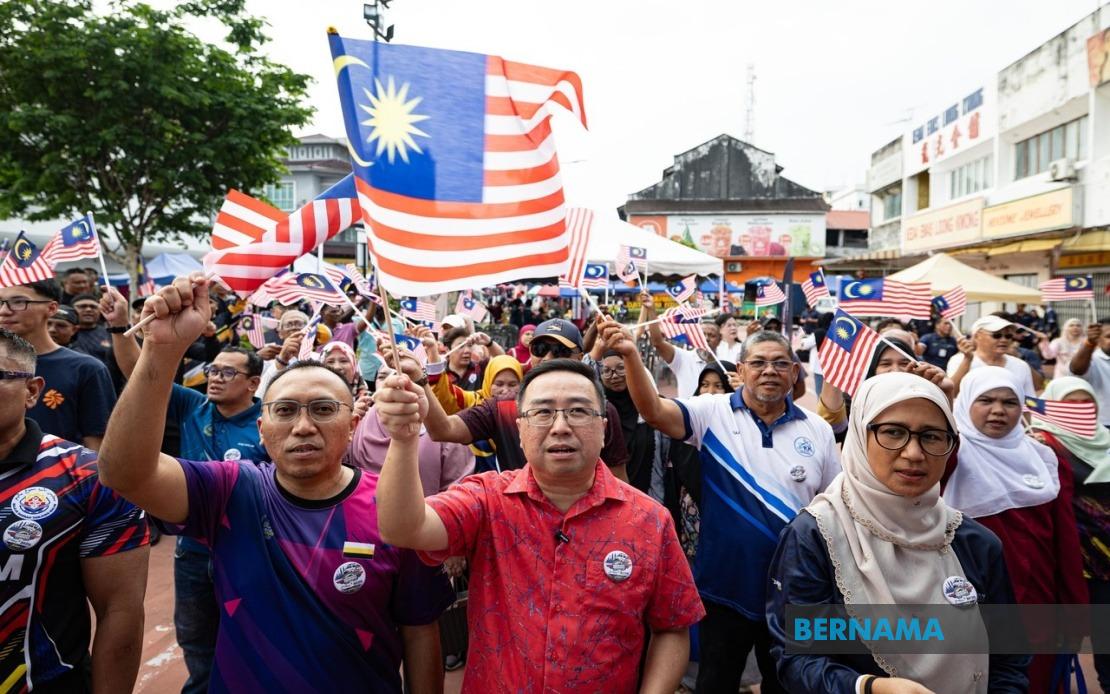
Malaysia's path forward requires abandoning the familiar framework of identity-driven politics in favour of a more sophisticated understanding of nationhood rooted in shared citizenship and mutual respect, according to Science, Technology and Innovation Minister Datuk Chang Lih Kang. In remarks marking this year's Merdeka celebrations, Chang articulated a vision for the country that fundamentally rejects the weaponisation of race and religion as mobilising tools, warning that such tactics inevitably fracture the social fabric and generate zero-sum perceptions among communities about resource distribution and opportunity.
The core tension Chang identifies reflects a persistent challenge in Malaysian politics: the temptation to mobilise supporters through fear-based narratives and appeals to sectarian identity rather than through shared visions of prosperity and national purpose. This approach has demonstrable consequences. When leaders consistently frame policy debates and national challenges through the lens of ethnic or religious interest, they inadvertently condition citizens to view fellow Malaysians as competitors rather than partners in nation-building. Over time, this erodes the trust necessary for effective governance and creates an atmosphere where compromise appears as capitulation rather than pragmatism.
Build genuine cohesion, Chang argues, requires institutional architecture that transcends patronage and parochialism. Strong, professionally managed institutions operating according to transparent rules applied consistently across all communities form the bedrock upon which inclusive governance rests. This encompasses law enforcement agencies that pursue cases without regard to the political affiliation or ethnic background of the accused, civil services that recruit and promote based on merit rather than connections, and regulatory bodies that function independently rather than as extensions of partisan political machinery. Such institutional integrity functions as a bulwark against the sorts of systemic inequities that generate legitimate grievance and provide fertile ground for divisive political messaging.
The minister's emphasis on proportionality and intent in enforcing patriotic observance addresses a particularly sensitive dimension of Malaysian political life. The treatment of the national flag, Jalur Gemilang, often becomes a flashpoint for symbolic contestation and excessive state response. Chang's argument—that a mature nation distinguishes between honest mistakes warranting education and deliberate provocations requiring sanction—reflects an understanding that heavy-handed enforcement can paradoxically undermine patriotic sentiment. When citizens fear disproportionate punishment for minor infractions, they become reluctant to publicly express attachment to national symbols, ceding patriotic discourse to those willing to deploy emotional extremism.
This framework carries particular relevance for Southeast Asia more broadly, where multiple nations navigate the complex terrain of managing diverse populations within post-colonial frameworks still contested by rival visions of national identity. Malaysia's ongoing struggles with this question offer cautionary lessons and potential insights for neighbours facing similar pressures. The question Chang poses—whether unity emerges through coercion or through genuine, voluntary belonging—admits of only one sustainable answer in diverse democracies. Imposed unity depends on constant enforcement, monitoring and punishment, creating an exhausting security apparatus that ultimately weakens rather than strengthens state capacity.
Central to Chang's argument is the proposition that diversity itself constitutes a national asset rather than a problem requiring management. This represents a significant shift in framing from much mainstream political discourse, which frequently treats religious and cultural plurality as a challenge to be neutralised or controlled. Instead, Chang suggests that cultural, linguistic and faith diversity genuinely enriches the national fabric when citizens and institutions regard such variation as normal and desirable rather than inherently threatening. This reframing requires political leaders willing to resist the perpetual pressure to prove their bona fides to specific constituencies by taking maximalist positions on issues touching group identity.
The reference to Sultan Perak Sultan Nazrin Shah's remarks at the World Conference on Islamic Thought and Civilisation strengthens Chang's argument by invoking Malay-Muslim intellectual and spiritual authority in support of inclusive nationalism. This deployment of royal endorsement signals an attempt to locate the vision of voluntary, shared belonging within established Malaysian frameworks of leadership and wisdom rather than portraying it as foreign or antithetical to Islamic values. The sultan's own articulation of unity based on shared belonging rather than imposed conformity carries particular weight in Malaysian discourse.
Crucially, Chang's framework does not advocate for the erasure of group identities or the pretence that such identities do not matter to people's lived experience and political consciousness. Rather, it proposes managing these identities through institutional contexts where they do not become the primary basis for distributing public resources, determining legal outcomes or structuring political competition. Citizens can maintain vibrant community associations and cultural practices while participating in a broader polity where governmental functions operate according to universalised principles rather than group-differentiated rules.
The implications for contemporary Malaysian governance are substantial. Civil service hiring, contract allocation, educational opportunity and criminal justice outcomes all remain areas where group identity continues to exert substantial influence over distribution patterns. Reforming these systems to emphasise competence, transparency and uniform application would constitute the practical instantiation of Chang's theoretical vision. Yet such reforms inevitably generate resistance from beneficiaries of existing arrangements and require political will sufficiently robust to weather accusations of abandoning community interests.
Looking forward, Chang's intervention in public discourse represents one voice among many competing visions of Malaysian identity and governance. His arguments align with cosmopolitan, pluralistic perspectives emphasising universal citizenship and institutional neutrality, while alternative framings continue to emphasise communal autonomy, group rights and the primacy of ethno-religious identity in ordering political life. The outcome of this ongoing contest will substantially shape Malaysia's trajectory through the coming decades, determining whether the country evolves toward more inclusive institutional practices or retreats further into compartmentalised communalism.
The question Chang ultimately poses transcends Malaysia, touching on fundamental challenges of democratic governance in diverse societies worldwide. How nations manage the relationship between group identity and individual citizenship, between communal belonging and shared national identity, between respect for difference and pursuit of common purpose remains unresolved across multiple contexts. Malaysia's particular historical trajectory, constitutional architecture and current political dynamics create a distinctive terrain where these abstract questions assume concrete, consequential form. The minister's call for mature nationhood grounded in genuine stake-holding rather than imposed conformity charts one possible trajectory among several.

