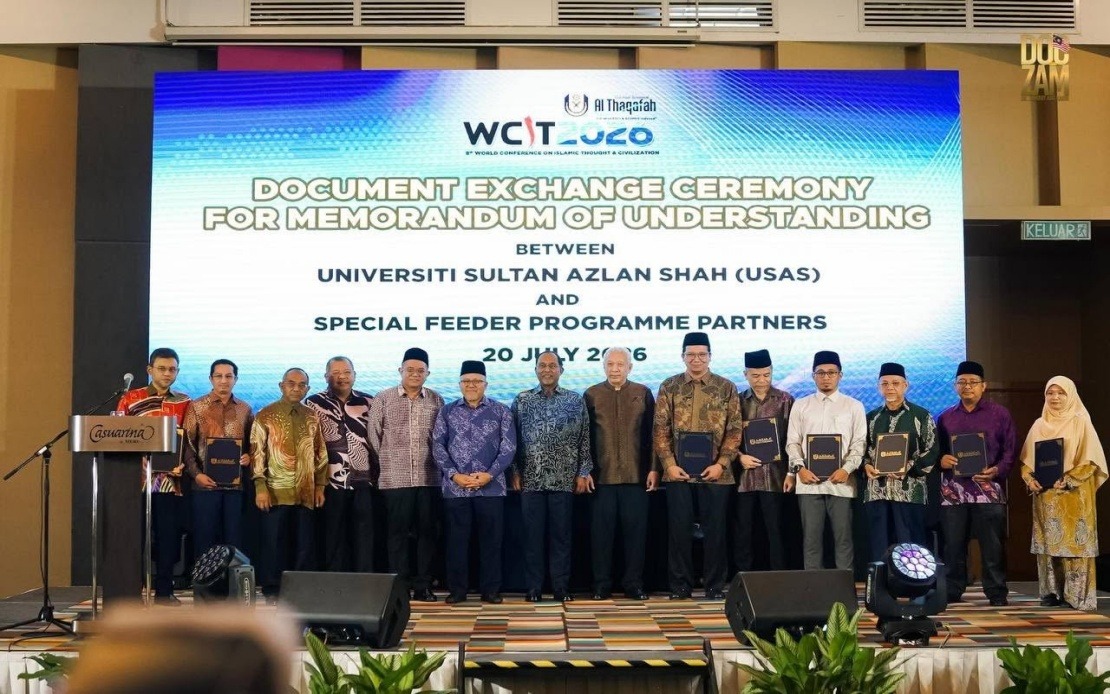
Malaysia's government has recommitted itself to serving as a gateway for intellectual exchange and a beacon for advanced Islamic scholarship, with Higher Education Minister Datuk Seri Dr Zambry Abdul Kadir positioning the nation as a critical node in developing a knowledge-driven ecosystem rooted in shared values and progressive thinking. The declaration came as the 8th World Conference on Islamic Thought and Civilisation (WCIT2026) commenced, an event that the ministry views as instrumental in fostering cross-border academic networks and generating solutions applicable to both the Muslim world and humanity at large.
The three-day conference, organised by Universiti Sultan Azlan Shah (USAS) in partnership with international institutions, assembled more than 180 specialists, academics, and intellectual leaders from multiple nations. This gathering underscores Malaysia's evolving ambition to transcend its historical role as a meeting point for commercial interests and to establish itself as a serious contender in the realm of high-level academic discourse. The attendance of such a diverse cohort signals growing recognition of Malaysia's institutional capacity and its geopolitical positioning in the Muslim world.
Zambry's intervention at a preparatory dinner event stressed a critical perspective: that the Islamic civilisation cannot rely solely on reverence for historical achievements but must construct its future upon contemporary pillars of knowledge creation, scientific research, and technological innovation. This framing reflects awareness among Malaysian policymakers that nostalgia, while culturally significant, offers insufficient foundation for competitive advancement in the modern knowledge economy. The minister's emphasis on integrity-driven leadership and robust higher education institutions suggests recognition that institutional quality rather than ideological assertion will determine influence in global academic hierarchies.
A particularly noteworthy dimension of Zambry's remarks centred on the notion that education and knowledge constitute universal human inheritance rather than the exclusive property of any single nation or civilisation. This philosophical stance carries practical implications for Malaysia's positioning. By articulating knowledge as a shared commons, the minister creates intellectual and diplomatic space for Malaysian institutions to collaborate with diverse academic partners while maintaining principled Islamic foundations. This balancing act reflects the nuanced role Malaysia seeks to play in a multipolar world where soft power increasingly derives from intellectual contribution rather than geopolitical alignment alone.
The minister drew historical parallels with considerable gravity, invoking the destruction of major intellectual centres including the libraries of Baghdad and Granada, the devastation of Sarajevo, and ongoing conflict in Palestine. These references serve dual purposes within his rhetoric. Superficially, they illustrate how civilisational decline follows the destruction of universities and knowledge repositories, making a case for protecting educational institutions. More substantively, they position Malaysia as a custodian of civilisational continuity at a moment when multiple regions experience violent upheaval. This framing elevates Malaysia's role beyond national self-interest to one of civilisational preservation, potentially enhancing its appeal to academic and intellectual constituencies globally.
The conference itself carries geopolitical significance for Southeast Asia. As Malaysia hosts discussions on Islamic thought and civilisation development, it reinforces its position as the region's natural headquarters for such dialogue. Regional competitors including Indonesia and Turkey would likewise claim roles in Islamic scholarship and civilisational advancement. Malaysia's institutional investments in this space, including universities like USAS dedicated to Islamic research, represent long-term positioning for intellectual leadership. Success here could translate into enhanced diplomatic influence and increased international academic partnerships channelled through Malaysian institutions.
For Malaysia's higher education sector specifically, the WCIT2026 platform offers tangible benefits. International exposure enhances recruitment capacity for both faculty and student cohorts, elevates institutional rankings through collaborative research opportunities, and generates funding through grants supporting inter-institutional research initiatives. The conference provides Malaysian universities visibility among global academic networks, potentially shifting perceptions of Malaysian institutions from regional players to serious contributors to international scholarly discourse. This perception shift carries economic implications, as higher perceived quality correlates with increased investment and student demand.
Zambry's remarks also implicitly address domestic Malaysian concerns regarding the relationship between education and politics. His assertion that knowledge must remain beyond political and conflict boundaries acknowledges tensions within Malaysia's own educational ecosystem, where questions of curriculum content, religious instruction, and academic freedom occasionally generate controversy. By elevating education above such parochial concerns, the minister frames commitment to international academic standards and collaborative knowledge production as compatible with Malaysia's Islamic values rather than antithetical to them.
The government's positioning of Malaysia as a bridge for dialogue reflects broader strategic thinking about soft power in an era of intensifying great-power competition. As traditional geopolitical influence becomes contested, nations increasingly compete for civilisational and intellectual leadership. Malaysia's strategy of hosting conferences, developing premier research institutions, and positioning itself as an intermediary in Islamic scholarship represents a deliberate effort to build influence through knowledge production rather than military or economic coercion. This approach suits Malaysia's actual capabilities and resources while offering a pathway to disproportionate influence through intellectual contribution.
Looking forward, the success of WCIT2026 in generating actionable resolutions and innovative frameworks for addressing global challenges will determine whether Malaysia's aspirations materialise. The conference must produce substantive intellectual output rather than mere diplomatic theatre to enhance Malaysia's credibility as a serious knowledge centre. Participants will scrutinise the quality of discussions, the originality of proposed solutions, and the commitment of attendees to implementing resolutions. Malaysia's reputation for hosting intellectually rigorous dialogue will depend on these outcomes, directly affecting its competitive position within global knowledge hierarchies and its influence in subsequent international academic forums.

