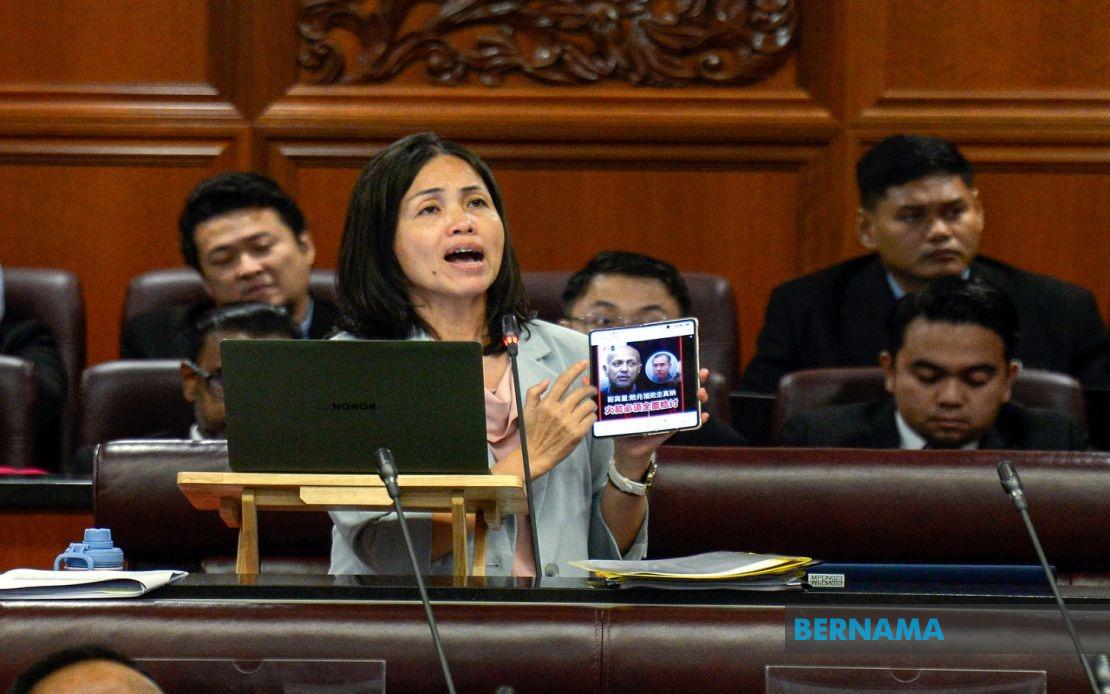
The Malaysian government has substantially intensified its crackdown on fraudulent online content, with nearly 100,000 scam-related posts removed from social media platforms by the end of July—a striking increase that underscores the accelerating challenge of digital fraud facing the nation. Deputy Communications Minister Teo Nie Ching revealed that as of July 31, some 99,693 scam items had been taken down across various platforms, representing a figure that has already surpassed the 98,503 pieces of illicit content removed throughout the entirety of 2025. The trajectory of removals illustrates a troubling widening of the problem, with 63,652 items deleted in 2024, 6,297 in 2023, and merely 242 in 2022—a nearly exponential growth pattern that reflects both improved detection capabilities and the proliferation of scam networks exploiting social media channels.
Teo made these disclosures during parliamentary proceedings in the Dewan Negara as lawmakers concluded debate on the Communications and Multimedia (Amendment) Bill 2026, which subsequently secured passage through a majority voice vote after deliberation among 15 senators. The legislative package represents a significant institutional shift, introducing a National Universal Service Provision (NUSP) framework designed to fortify national security infrastructure while simultaneously equipping the Malaysian Communications and Multimedia Commission (MCMC) with enhanced legal authority to operationalise the initiative. The amendments fundamentally restructure the regulatory relationship between the communications ministry and MCMC, permitting ministerial directives that compel the commission to support various undertakings involving network services and digital applications relevant to NUSP implementation.
The legislative expansion of MCMC's mandate reflects broader government recognition that traditional enforcement mechanisms have proven insufficient against the rapidly evolving sophistication of online fraud schemes. By establishing clearer statutory foundations for the commission's involvement in national security initiatives, the amendments provide both operational clarity and legal defensibility for regulatory actions that might otherwise face constitutional or procedural challenges. This legal scaffolding proves particularly crucial in Malaysia's context, where courts have historically scrutinised executive action against telecommunications infrastructure with considerable rigour. The amendments acknowledge this judicial tendency by explicitly embedding appeals mechanisms, permitting any party adversely affected by MCMC directives to petition an Appeals Tribunal chaired by a High Court judge, with further recourse available through judicial review.
Senator Datuk Seri Prof Dr Noor Inayah Ya'akub raised pertinent concerns during parliamentary deliberations regarding the criteria and parameters governing national security determinations. Her intervention highlighted the fundamental tension between executive efficiency and administrative transparency—particularly acute in telecommunications regulation, where decisions can rapidly cascade across millions of users. She implicitly cautioned against vague standards that might permit arbitrary implementation, emphasising instead the necessity for transparent, accountable decision-making processes that could withstand public scrutiny and legal challenge. This emphasis on procedural safeguards reflects evolving parliamentary consciousness that national security imperatives, however legitimate, require institutional checks to prevent mission creep or discriminatory application.
Senator Sheikh 'Umar Bagharib Ali contributed a complementary perspective, characterising communications infrastructure as strategically vital to both Malaysia's digital economic aspirations and public safety ecosystem. He articulated a thesis that governmental exercise of regulatory authority, when executed fairly and transparently within legal boundaries, engenders public confidence that subsequently transforms citizens into collaborative partners in security initiatives. This framing suggests an implicit governance philosophy wherein legitimacy derives not principally from coercive capacity but from perceived fairness and adherence to established legal frameworks. Sheikh 'Umar's commentary implicitly critiqued approaches that prioritise rapid action over procedural integrity, suggesting instead that sustained security benefits emerge only when regulatory interventions enjoy broad societal acceptance.
The Bill had previously cleared the Dewan Rakyat on July 15, embodying two substantive clauses that chiefly amend Section 202 of the Communications and Multimedia Act 1998. These revisions furnish MCMC with clearer statutory authority to participate in NUSP implementation, resolving prior ambiguities regarding the commission's proper institutional role in national security operations. Such clarification proves administratively essential, as MCMC had previously operated under frameworks conceived during pre-digital governance eras, when telecommunications regulation primarily involved telephone networks rather than the complex ecosystem of social media platforms, instant messaging applications, and content distribution systems that characterise contemporary communications infrastructure.
The exponential growth in removed scam content reflects the particular vulnerability of Southeast Asian populations to online fraud schemes. Social media platforms, predominantly designed by Western technology companies yet extensively utilised throughout the region with minimal localisation of safeguarding mechanisms, have become primary vectors for sophisticated criminal networks targeting individuals across Malaysia, Singapore, Indonesia, and the Philippines. These operations frequently exploit cultural trust dynamics, linguistic fluency, and intimate knowledge of local banking systems to craft convincing fraudulent solicitations. The Malaysian government's escalating removal rates suggest that detection systems—whether algorithmic, user-reported, or MCMC-directed—have become substantially more effective, though the underlying prevalence of scam attempts likely continues expanding.
The policy architecture emerging from these amendments attempts to balance competing imperatives that have troubled digital governance globally. Policymakers must simultaneously enhance security capabilities, protect public welfare through fraud prevention, maintain procedural legitimacy that preserves democratic institutions, and preserve space for lawful expression and innovation. Malaysia's approach—embedding appeals mechanisms, requiring High Court oversight of tribunal decisions, and permitting judicial review—suggests an attempt to thread this needle through institutional pluralism rather than centralised authority. Whether these safeguards prove adequate depends substantially on implementation fidelity, appellate court vigilance, and broader political commitment to procedural restraint.
For Malaysian citizens and businesses navigating the digital economy, the legislative developments carry practical implications. The clarified MCMC mandate potentially accelerates content removal timelines, offering faster remediation for victims of online fraud schemes. Simultaneously, the appeals infrastructure creates avenues for challenging removals deemed erroneous or excessive. Telecommunications platforms operating within Malaysian jurisdiction face clearer expectations regarding cooperation with NUSP initiatives, though ambiguity persists regarding how foreign technology companies will navigate these requirements against their global compliance obligations. The interplay between Malaysian regulatory expansion and multinational corporate policies will likely generate persistent friction requiring ongoing diplomatic and technical negotiation.
The legislative passage occurs within a broader regional and international context of intensifying regulation of digital platforms. Governments across Asia, Europe, and North America increasingly assert sovereignty over information flows occurring within their territories, utilising national security frameworks to justify interventions that earlier governance eras would have treated as commercial or civil matters. Malaysia's amendments represent one manifestation of this global trend, though with distinct characteristics reflecting local governance traditions and constitutional structures. Comparative analysis with regulatory approaches adopted by Indonesia, Singapore, and Thailand reveals both convergent strategies—emphasising content moderation and platform accountability—and divergent institutional mechanisms reflecting different constitutional balances and administrative cultures.
Looking forward, the efficacy of these amendments depends substantially on sustained resource commitment to MCMC, technological sophistication in detecting evolving fraud methodologies, and international cooperation with technology platforms and fellow governments combating transnational criminal networks. The scale of the challenge—evidenced by removal figures approaching six-figure annual quantities—suggests that legislative architecture alone cannot resolve fraud epidemics; complementary public education initiatives, financial sector vigilance, and law enforcement investigation remain essential. The government's willingness to embed procedural safeguards suggests recognition that sustainable security emerges only when regulatory interventions enjoy legitimacy grounded in transparent, accountable decision-making rather than unconstrained executive authority.

