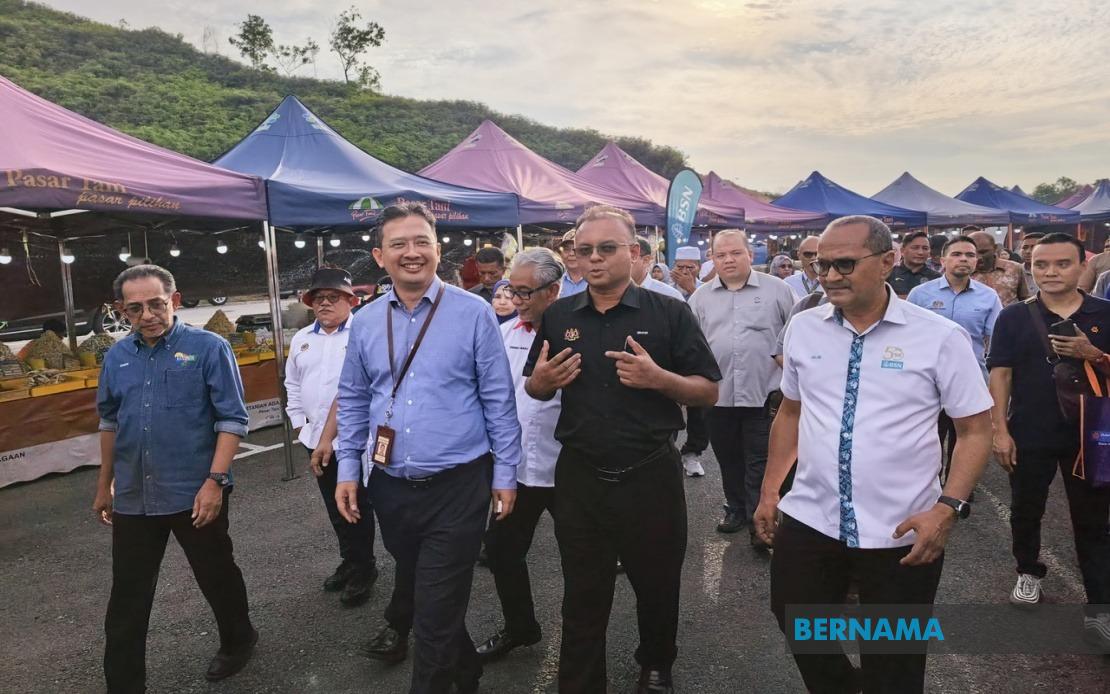
The Malaysian government is mounting a concerted push to increase awareness of over RM5 billion in micro-financing opportunities available to small entrepreneurs and traders, acknowledging that despite substantial resources, knowledge gaps remain a significant barrier to access. Treasury Secretary-General Tan Sri Johan Mahmood Merican highlighted this challenge during a visit to the Putrajaya Pasar Tani, where he outlined plans to mobilise government agencies across multiple sectors to conduct ground-level outreach particularly targeting small-scale traders and street vendors who represent a crucial segment of the informal economy.
The micro-credit initiative, announced by Prime Minister Datuk Seri Anwar Ibrahim, pools resources from six key financial institutions and government agencies. Agrobank, Bank Simpanan Nasional (BSN), Bank Rakyat, TEKUN Nasional, Amanah Ikhtiar Malaysia (AIM), and Majlis Amanah Rakyat (MARA) collectively administer the scheme. While the capital is substantial, evidence suggests that awareness remains uneven across potential beneficiaries, prompting the shift towards direct engagement at farmers' markets, wet markets, and trading hubs where small merchants congregate and conduct business. This targeted approach recognises that traditional marketing channels may not effectively reach individuals operating in the informal sector who often lack regular internet access or formal business registration.
During his visit to the Putrajaya pasar tani with more than 124 traders present, Merican gathered feedback suggesting that awareness campaigns are beginning to gain traction. A majority of traders surveyed indicated they had previously accessed government financing, with some having secured multiple rounds of support. This anecdotal evidence points to a foundation of trust and demonstrated effectiveness upon which the government can build broader promotional efforts. The fact that existing beneficiaries have returned multiple times suggests the products meet genuine market demand once traders become aware of them, validating the notion that the main constraint is information dissemination rather than scheme design or accessibility.
Agrobank's participation in the awareness campaign has already yielded measurable results within a limited timeframe. The bank's series of engagement sessions at farmers' markets across the country has generated over 160 applications seeking micro-financing support, totalling RM6.4 million in credit requests to date. This volume indicates strong latent demand once barriers to application are lowered through on-site presence and simplified access procedures. Agrobank President and Chief Executive Officer Datuk Tengku Ahmad Badli Shah Raja Hussin emphasised that the positive reception reflects traders' appetite for financial products specifically designed for their operational realities, including flexible repayment schedules aligned with irregular income patterns typical of hawkers and small vendors.
Beyond raw lending, the participating agencies recognise that sustainable business growth requires complementary support services extending beyond capital provision. Agrobank is coupling financing with financial literacy programmes, business digitalisation assistance, takaful insurance protection, and direct advisory services tailored to individual trader circumstances. This holistic approach acknowledges that many small traders lack formal business training and may struggle with inventory management, pricing strategy, or financial record-keeping. By bundling these services with credit access, the scheme aims to enhance not only immediate business operations but also long-term resilience and competitiveness in a rapidly evolving retail environment where informal traders face increasing competition from organised retail and e-commerce platforms.
The ground-level engagement strategy serves an additional function beyond awareness-raising. Direct interaction between bank representatives and traders allows financial institutions to gather real-time intelligence about specific sectoral challenges, pricing pressures, input cost fluctuations, and seasonal demand patterns. This intelligence, fed back to headquarters, can inform future product refinements and policy adjustments. Furthermore, personal relationships established during these visits reduce information asymmetries and build confidence that participating banks understand traders' actual circumstances rather than imposing standardised, one-size-fits-all lending criteria.
The government is simultaneously addressing pricing concerns that affect trader profitability and consumer perceptions. Ministry of Agriculture and Food Security Secretary-General Datuk Seri Isham Ishak referenced the SISDA portal, an Agro-food Supply and Marketing Monitoring and Intervention system administered by the Federal Agricultural Marketing Authority (FAMA), enabling real-time price tracking across agricultural and food products. This infrastructure serves dual purposes: it provides transparency for consumers concerned about inflation, and it alerts authorities to supply chain disruptions or price anomalies requiring intervention. Should the system detect sharp price increases suggesting supply constraints, authorities can mobilise resources to boost production or imports, protecting both trader margins and consumer purchasing power.
For Malaysian entrepreneurs and small traders, this multi-agency effort carries significant implications. Access to affordable micro-credit has long been constrained by collateral requirements and perceived bureaucratic complexity that disadvantage informal sector participants lacking formal business documentation or fixed assets. By bringing financial institutions directly into market spaces where traders congregate, the government effectively eliminates one major friction point. The integration of financial literacy and business development services means that credit recipients gain not merely capital but also knowledge and skills increasingly necessary to compete in modernising retail environments.
The initiative also addresses a persistent challenge facing Southeast Asian economies: translating ambitious monetary policy or fiscal allocation into actual business investment and productive activity at the grassroots level. Large funding pots mean little if they remain unutilised due to awareness gaps, application complexity, or perceived irrelevance to informal economy participants. Malaysia's hands-on approach—with Treasury officials and bank executives physically present at pasar tani—represents pragmatic recognition that effective policy implementation requires meeting stakeholders where they are rather than expecting them to navigate complex bureaucratic channels.
Longer-term success will depend on whether this momentum translates into sustained institutional relationships rather than episodic visits. Traders require reliable, ongoing access to capital for seasonal restocking, emergency repairs, or expansion opportunities. The challenge ahead involves converting initial awareness and successful applications into a self-sustaining ecosystem where traders view government-backed micro-credit as a standard business tool, accessible as naturally as supplier relationships or informal saving groups. This requires consistency in service delivery, manageable repayment terms, and continued refinement based on user feedback gathered during continued field engagements.
The multi-sector coordination evident in the scheme—spanning agricultural banking, general banking, development finance, and food security monitoring—reflects a sophisticated understanding that trader prosperity depends on interconnected systems rather than credit alone. Input prices, market information, insurance protection, and digital tools all influence trading viability. By orchestrating these elements through a coherent strategy anchored in direct community engagement, Malaysia's government is attempting to create comprehensive ecosystems supporting informal sector formalisation and growth, with potential lessons for other Southeast Asian nations managing similar challenges of bridging the formal-informal economy divide.

