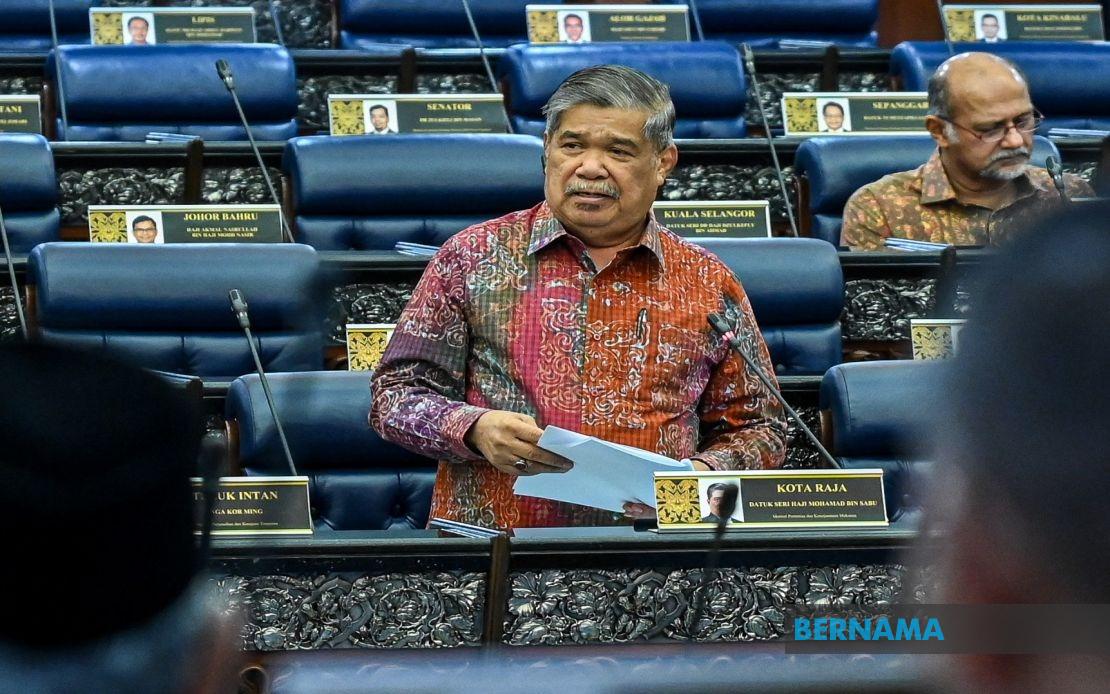
Malaysia's government is moving decisively to shield its agro-food sector from the looming El Niño phenomenon, deploying a multi-layered strategy that combines technological innovation with direct farmer support. Agriculture and Food Security Minister Datuk Seri Mohamad Sabu detailed the comprehensive approach during parliamentary proceedings, signalling that policymakers view climate-driven agricultural disruption as a critical national security concern requiring sustained intervention across water resources, crop development, and rural livelihoods.
The administration's response centres on optimising how the nation manages its water supplies during periods of reduced rainfall and elevated temperatures. Continuous surveillance of water levels across dams and catchment areas forms the backbone of this monitoring framework, allowing authorities to track availability in real time and anticipate potential shortages. Beyond simple observation, the government is implementing integrated water resource management protocols designed to balance competing demands from agriculture, urban consumption, and industrial use. These administrative mechanisms aim to ensure that farming communities—particularly rice producers who depend on consistent irrigation—maintain adequate water access even as overall supplies contract.
Technological solutions are playing an increasingly central role in the government's mitigation strategy. Smart irrigation monitoring systems represent a step forward from conventional flooding methods, allowing farmers to apply water more precisely and reduce waste. Drip irrigation infrastructure, which delivers moisture directly to plant roots rather than saturating entire fields, offers further efficiency gains. These technologies address a fundamental vulnerability in Malaysia's agricultural model: heavy reliance on rainfall-dependent water sources combined with production methods that consume significant volumes. By promoting their adoption, the government aims to decouple farm productivity from weather patterns, though rollout speed and farmer uptake remain practical challenges in rural areas where capital constraints and technical literacy vary widely.
Crop research and development represents another strategic pillar. The Malaysian Agricultural Research and Development Institute (MARDI) has been tasked with accelerating the development of drought-resistant rice varieties better suited to El Niño conditions. This work addresses a fundamental biological reality: existing paddy strains evolved under Malaysia's normally reliable monsoon patterns and perform poorly when moisture becomes scarce. By cultivating new genetics, policymakers hope to establish agricultural production that remains viable even when weather patterns shift. The Prime Minister has explicitly directed MARDI to expand these research efforts, reflecting recognition at the highest levels that climate volatility presents a long-term competitive threat to the nation's self-sufficiency in rice, a staple food central to Malaysian dietary culture and social stability.
Cloud seeding operations add another dimension to the government's climate intervention toolkit, though effectiveness remains weather-dependent and scientifically contested. These operations aim to induce precipitation when atmospheric conditions permit, potentially supplementing natural rainfall during dry periods. While not a reliable solution, cloud seeding demonstrates governmental willingness to explore unconventional tools when conventional resources appear inadequate. The caveat regarding weather conditions underscores the reality that such interventions operate within strict natural limits and cannot manufacture water where atmospheric moisture is genuinely insufficient.
Financial assistance mechanisms directly address farmer welfare during drought events. Since 2024, the government has channeled RM45.24 million to support 8,224 rice farmers in its initial assistance phase. More substantially, through June 30, 2026, a total of RM38.53 million has been distributed across 55,058 affected rice farmers cultivating 16,933 hectares, predominantly in the drought-vulnerable peninsular north and east. These figures underscore both the scale of climate impact and governmental commitment to preventing agricultural collapse from translating into rural economic devastation. The assistance schemes provide crucial income replacement during periods when drought reduces yields or renders fields unproductive, helping preserve farming communities' viability and preventing mass rural-to-urban migration that could strain urban infrastructure and social services.
National rice stockpiling policy reflects long-term food security thinking. The government maintains reserves sufficient for approximately six months of domestic consumption, alongside continued imports calibrated to actual supply requirements. This dual approach—maintaining strategic reserves while managing imports—provides buffer capacity against supply shocks. Malaysia's rice self-sufficiency has declined over decades due to agricultural land conversion and economic shifts, making import reliability crucial. The government's continued emphasis on domestic production expansion through large-scale rice development in Sarawak, Pahang, and other states seeks to reverse this trend, though productivity gains must compete against urbanisation and industrial development pressures.
Expansion of controlled environment agriculture represents a longer-term adaptation strategy. Protected farming systems—including greenhouses and vertical farming—reduce crops' exposure to weather extremes and allow more precise resource management. While capital-intensive and better suited to high-value crops initially, these methods could eventually support staple food production at greater weather resilience. The government's promotion of such practices signals recognition that traditional open-field agriculture faces inherent climate vulnerability that technological buffering cannot entirely eliminate.
Beyond rice, the government confronts secondary agricultural challenges created by climate volatility. Recent durian price collapses driven by supply gluts underscore how weather events ripple through commodity markets, affecting farmer incomes across multiple sectors. Minister Mohamad identified market expansion as a key response, particularly targeting China where durians command premium prices. The rationale recognises that developing sophisticated export logistics and customs arrangements to reach smaller Chinese cities—markets currently underserved by Malaysian suppliers—could absorb domestic surplus and stabilise prices for local producers. This export-oriented approach complements domestic measures, acknowledging that food security encompasses not merely adequate supply but also farmer income stability that enables continued production investment.
The comprehensive nature of Malaysia's El Niño response reflects evolving policy recognition that climate variability now constitutes a permanent structural feature of agricultural planning rather than occasional disruption. By combining real-time resource monitoring, technological adoption, crop research, direct income support, and market development, the government attempts to address multiple vulnerability points simultaneously. Whether this multi-pronged approach proves sufficient depends on implementation fidelity, farmer engagement with new technologies, research breakthrough timing, and ultimately on El Niño's actual intensity and duration—factors partly beyond national control. The strategy nonetheless demonstrates that policymakers understand food security cannot be assured through supply management alone but requires parallel attention to production resilience, farmer welfare, and market stability across an interconnected system facing genuine climatic stress.

