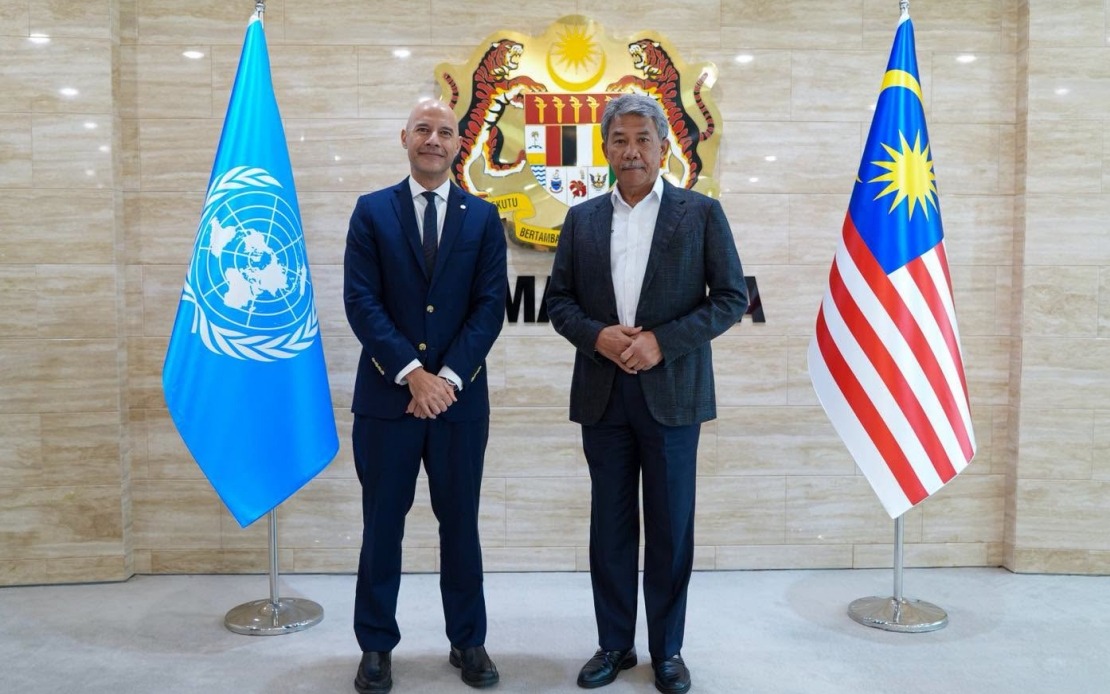
Malaysia's Foreign Minister Datuk Seri Mohamad Hasan met with newly appointed United Nations Resident Coordinator Nikolas Myint at the ministry's headquarters in Wisma Putra on Wednesday, marking an important engagement as the UN official settles into his expanded regional role across three Southeast Asian nations.
The meeting between Mohamad and Myint served as a platform for bilateral dialogue on the scope and nature of Malaysia's ongoing collaboration with United Nations agencies operating on Malaysian soil. Such courtesy calls, while formal in nature, carry substantive weight in diplomatic circles, as they typically establish the tone and priorities for future engagement between host governments and international organisations during the coordinator's tenure.
Myint, who assumed his position as UNRC for Malaysia, Singapore and Brunei following his appointment by United Nations Secretary-General António Guterres on May 31, 2026, brings the UN's coordinating function across the Brunei, Indonesia, Malaysia, Philippines East ASEAN Growth Area region under his oversight. His appointment reflects the UN's recognition of the interconnected nature of development challenges across the subregion and the efficiency gains from consolidated coordination.
In his statement shared via social media, Mohamad emphasised Malaysia's commitment to the United Nations' mission of addressing multifaceted global crises. The Foreign Minister specifically highlighted the nation's appreciation for the organisation's efforts in tackling transnational challenges—ranging from climate change and sustainable development to humanitarian emergencies and peacekeeping operations. This framing aligns Malaysia's foreign policy with contemporary global priorities whilst underscoring the country's positioning as a responsible international player.
The minister articulated Malaysia's intention to deepen working relationships not merely with the resident coordinator but with the full spectrum of UN agencies embedded within the country. This distinction matters: while the UNRC serves as the UN Secretary-General's representative and oversees system-wide coordination, individual agencies such as UNDP, UNHCR, and UNESCO operate with considerable autonomy. Mohamad's emphasis on collective engagement signals openness to comprehensive partnerships across the UN system.
Government development aspirations and global well-being featured prominently in the Foreign Minister's characterisation of Malaysia's UN engagement. This dual focus reflects a recognition that Malaysia's prosperity increasingly depends upon regional stability and addressing cross-border challenges—from transnational crime and irregular migration to pandemics and environmental degradation. The framing suggests Malaysia views its UN partnership not as charity or altruism but as enlightened self-interest aligned with national advancement.
For Malaysia's policymakers and development community, Myint's appointment carries particular significance given the coordinator's simultaneous responsibility for Singapore and Brunei. This triangular relationship within the ASEAN subregion—spanning city-state, constitutional monarchy, and sultanate—presents both coordination challenges and opportunities for promoting shared approaches to development financing, humanitarian assistance, and disaster management. Malaysia's proactive engagement signals willingness to lead multilateral dialogue on regional priorities.
The timing of this meeting also reflects Malaysia's positioning ahead of potential UN policy initiatives. With global emphasis intensifying on climate action, digital transformation, and pandemic preparedness, Malaysia seeks to ensure its voice shapes how UN resources and technical assistance flow toward Southeast Asian priorities. Early engagement with new resident coordinators allows governments to influence the coordinator's understanding of local contexts and capacity needs.
From a broader analytical perspective, Malaysia's demonstrated commitment to UN partnership serves multiple strategic purposes. Domestically, it reassures civil society and development-focused constituencies that the government takes global commitments seriously. Regionally, it positions Malaysia as a bridge between ASEAN solidarity and universal UN principles. Internationally, it reinforces Malaysia's credentials as a reliable partner for multilateral governance structures at a moment when such partnerships face strain in various quarters.
The Foreign Ministry's decision to publicise this engagement through official channels also carries messaging value, signalling to Malaysian stakeholders and international observers that Malaysia prioritises its UN relationships and approaches them at appropriately senior levels. In an era of shifting geopolitical alignments and contested international institutions, such visible commitment to multilateralism carries diplomatic and soft-power implications.
Moving forward, the quality of Malaysia's collaboration with Myint's office will likely influence the country's leverage on issues ranging from sustainable development financing to humanitarian emergencies affecting regional populations. Given Malaysia's economic development status and strategic location, the country occupies a distinctive position within UN frameworks—neither a least-developed nation requiring maximum assistance nor a wealthy donor with outsized institutional influence, but rather a middle-income country with considerable regional influence and specific development challenges requiring targeted UN support.

