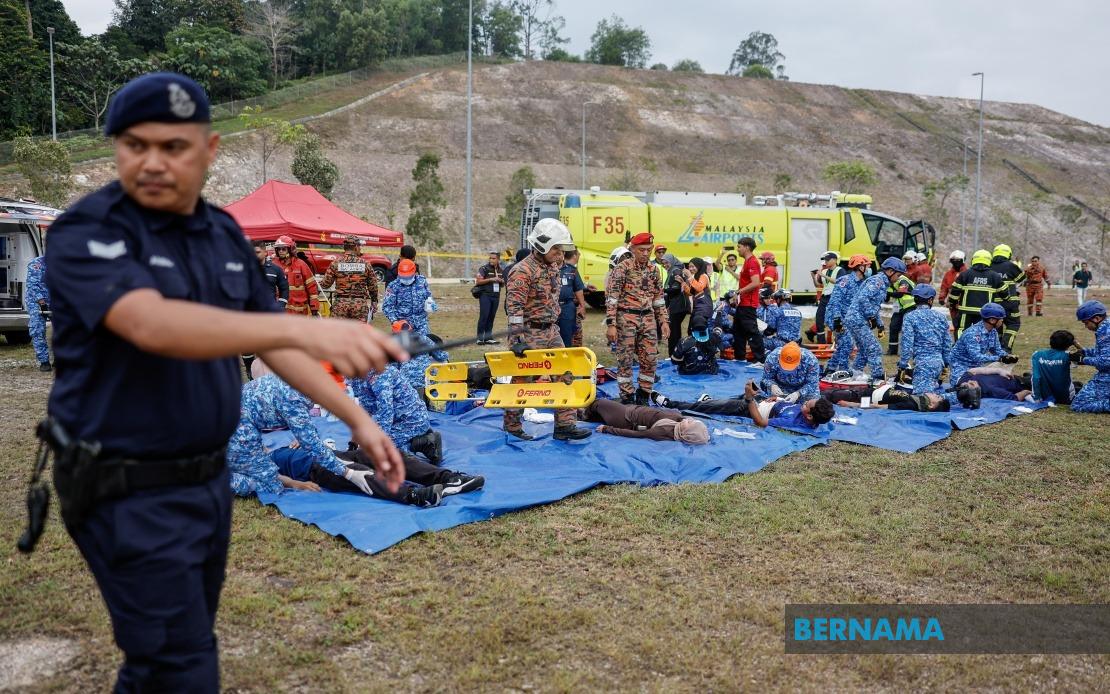
Malaysia has conducted its most comprehensive off-airport aviation disaster exercise to date, deploying over 20 enforcement and emergency response agencies in a coordinated test of national preparedness. The Ex Urban Falcon 2026 simulation, held at the Denai Alam Rest and Service Area adjacent to the Damansara-Shah Alam Elevated Expressway, presented participating teams with a realistic scenario centred on an ATR72 aircraft incident occurring approximately six kilometres from Sultan Abdul Aziz Shah Airport in Subang. The drill involved 450 participants from both public and private sectors tasked with managing the complexities of aviation disaster response in a densely populated suburban environment.
Airport Fire and Rescue Services general manager Muhammad Hidayat Ismail emphasised that this particular exercise represented a significant departure from previous testing protocols. Historically, Malaysia has conducted emergency drills focused on incidents occurring at or immediately adjacent to airport boundaries, where infrastructure, accessibility, and coordination mechanisms remain relatively straightforward. The off-airport scenario introduced variables that fundamentally alter response dynamics, requiring agencies to navigate civilian road networks, contend with toll infrastructure, and establish command structures across jurisdictional boundaries. This shift in focus reflects growing recognition within Malaysia's aviation safety community that real-world disasters do not invariably conform to operational best-case scenarios.
The National Aeronautical Search and Rescue Manual establishes that Airport Fire and Rescue Services maintains operational responsibility extending eight kilometres from an airport's midpoint, yet previous exercises had rarely tested the practical execution of this mandate in realistic off-airport conditions. Muhammad Hidayat identified the logistical challenge of rapid deployment through congested urban areas as among the most demanding aspects agencies encountered during the simulation. Response teams encountered multiple toll plazas and narrow access roads that significantly complicated transit times to the simulated crash site, highlighting infrastructure constraints that would present genuine obstacles during actual emergency operations.
The exercise methodology deliberately incorporated elements reflecting the heightened severity of off-airport aviation incidents. Aircraft crashes occurring outside airport precincts typically involve substantially lower victim survival rates compared to incidents happening on or near aerodrome facilities. The uneven terrain characteristic of suburban locations, combined with the absence of specialised emergency infrastructure, compounds rescue difficulties and multiplies complications for disaster victim identification operations. The simulation accordingly presented rescue coordinators with casualty-to-survivor ratios more aligned with off-airport realities, demanding enhanced coordination particularly among Royal Malaysia Police Disaster Victim Identification teams who bear primary responsibility for victim management and forensic documentation.
Muhammad Hidayat highlighted that the exercise validated the technical capabilities currently deployed across Malaysia's aviation emergency response infrastructure. Airport Fire and Rescue Services operates aircraft firefighting vehicles conforming to specifications and standards established by the International Civil Aviation Organisation and Malaysia's Civil Aviation Authority of Malaysia, ensuring equipment compatibility with international protocols. However, technical sophistication alone proves insufficient without coordinated inter-agency procedures tested under realistic operational pressures. The simulation provided concrete evidence that participating agencies generally executed their assigned responsibilities according to established protocols, though the experience also illuminated areas requiring refinement and enhanced coordination mechanisms.
The strategic composition of participating organisations reflected the multifaceted nature of aviation disaster management in a contemporary Malaysian context. Malaysia Airports Holdings Berhad provided overarching coordination capacity as the primary aviation authority responsible for emergency planning. The National Disaster Management Agency contributed disaster management expertise, while Selangor state government representation ensured alignment with local emergency protocols and resources. PROLINTAS-DASH, the expressway operator, brought essential knowledge of road network management and toll infrastructure that would prove critical during actual off-airport incidents. This partnership model demonstrates recognition that aviation disasters transcend traditional airport boundaries and demand seamless integration across multiple governmental and quasi-governmental entities.
The identification of specific challenges emerging from the drill exercise indicates that Malaysian aviation authorities intend to translate this simulation into tangible operational improvements. Muhammad Hidayat announced that participating agencies would convene during late July to conduct detailed analysis of observed challenges and develop enhanced response protocols. This structured review process moves beyond theoretical risk assessment into evidence-based procedure refinement grounded in actual performance data collected during the large-scale simulation. The approach reflects international best practices in aviation safety management, wherein exercises serve not merely as compliance exercises but as mechanisms for continuous operational improvement.
For Malaysian aviation safety stakeholders, the Ex Urban Falcon 2026 exercise carries implications extending beyond immediate emergency response capability. The simulation demonstrated institutional capacity to mobilise substantial resources in coordinated fashion, a prerequisite for maintaining public confidence in aviation safety frameworks. Malaysia's aviation sector remains integral to regional economic connectivity and tourist arrivals, factors making aviation safety perception commercially significant beyond purely regulatory considerations. Successful demonstration of comprehensive disaster response capability contributes to reassurance for passengers and international aviation partners regarding Malaysia's commitment to safety management.
The exercise also reflects regional patterns in aviation disaster preparedness. Southeast Asian nations have increasingly recognised that rapid, coordinated response to aviation incidents requires planning extending well beyond airport property boundaries. Countries sharing Malaysia's characteristics—dense urban environments surrounding major aviation hubs, complex transportation infrastructure, and multiple jurisdictional entities—face comparable challenges in disaster response coordination. Experience generated through Ex Urban Falcon 2026 may inform discussions within regional aviation forums regarding optimal practices for off-airport incident management.
Muhammad Hidayat characterised the sustained commitment demonstrated by participating agencies as evidence of Malaysia's institutional readiness to address potential aviation disasters comprehensively. The exercise encompassed approximately 450 personnel from critical agencies, representing substantial resource commitment and organisational prioritisation of aviation safety. This deployment of human and material resources signals that Malaysian authorities view aviation disaster preparedness as warranting continuous investment and refinement rather than accepting historical protocols as immutable.
Looking forward, the review workshop scheduled for late July will prove crucial in translating exercise observations into operational improvements. The integration of lessons learned into revised standard operating procedures, enhanced inter-agency communication protocols, and refined resource deployment strategies will determine whether the simulation translates into substantive safety enhancement. Malaysian aviation authorities appear committed to this translation process, recognising that aviation disaster preparedness represents an ongoing institutional challenge requiring continuous recalibration as operational environments evolve.

