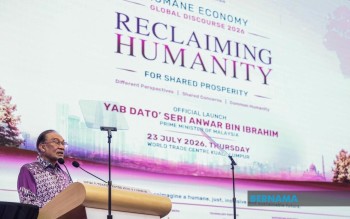
Prime Minister Datuk Seri Anwar Ibrahim has signalled that the government will commence work on Budget 2027 from next month, with formal tabling of the spending plan slated for early October. Speaking in his capacity as both premier and Finance Minister, Anwar emphasised that the upcoming budget will be underpinned by a philosophy placing human welfare at the centre of economic policymaking, rather than pursuing growth as a standalone objective.
Addressing delegates at the Humane Economy Global Discourse (HEGD) 2026 in Kuala Lumpur, Anwar articulated a vision of economics that extends beyond traditional metrics. He argued that numerical indicators of economic expansion—higher gross domestic product, increased consumer spending, or wealth accumulation—should never become ends unto themselves. Instead, he framed the economy as a tool serving broader societal purposes: enabling citizens to live with dignity, security and genuine hope for the future.
This framing suggests a deliberate shift in how Malaysia's government intends to measure and pursue economic success. Rather than celebrating growth rates in isolation, the administration appears committed to evaluating whether that expansion genuinely reaches ordinary Malaysians through improved circumstances. The philosophy underpinning Budget 2027 will therefore hinge on testing policy decisions against fundamental questions: does growth expand opportunity or concentrate it further; does it bolster family structures and community cohesion or leave them fragile; and crucially, are citizens treated as partners in development or merely as factors of production.
For Malaysian households grappling with rising costs of living, stagnant wages in many sectors, and housing affordability crises, this rhetoric signals potential recalibration of budgetary priorities. The government appears to be committing itself to ensuring that economic policies translate into measurable improvements: higher wages relative to living expenses, employment that offers meaning and stability, residential options within reach of working families, healthcare systems accessible without financial ruin, and educational pathways that genuinely improve social mobility rather than entrenching existing disparities.
The timing of this announcement is significant for the region. As Southeast Asian economies navigate post-pandemic recovery, persistent inflation, and structural shifts in global manufacturing, Malaysia faces particular pressures. The semiconductor sector remains crucial, yet wage stagnation in many industries threatens social cohesion. By framing Budget 2027 around human-centred economics, Anwar is positioning Malaysia to potentially diverge from purely growth-maximising approaches that have characterised much regional policymaking, offering an alternative model that might appeal across the developing world.
Anwar's emphasis on sustainability adds another dimension to the budget's anticipated philosophy. He stressed that development cannot burden future generations with environmental degradation, mounting financial obligations, or social fractures. This signals that Budget 2027 may contain provisions addressing climate transition, debt management, and social investment designed to benefit not merely current taxpayers but citizens yet unborn. In a region increasingly vulnerable to climate impacts, this framing could influence how infrastructure spending, energy policy, and environmental protection receive budgetary treatment.
The innovation principle articulated by the Prime Minister further clarifies how technology spending might be approached. Rather than pursuing technological advancement for its own sake, the government appears committed to ensuring that innovation expands human capabilities across society, rather than deepening divides between those with access to new tools and those left behind. This could shape Malaysia's digital transformation agenda, ensuring that broadband expansion, artificial intelligence initiatives, and technological skilling programmes reach beyond urban centres and affluent communities.
As Malaysia's government formulates the budget over the coming weeks, several policy domains appear likely to receive heightened scrutiny through this human-centred lens. Healthcare spending will probably face pressure to demonstrate how investments translate into better access and outcomes for ordinary citizens rather than merely expanding system capacity. Education budgets may shift toward ensuring quality improvement reaches underserving areas. Housing policy could be reexamined to address how public investment can assist working Malaysians in acquiring homes rather than merely stimulating construction sector activity.
The August-to-October timeline provides a compressed preparation period for such substantial reorientation of budgetary philosophy. Finance Ministry officials will need to reconcile the government's commitment to controlling inflation and debt with expansionist spending in social areas. This balance will prove particularly challenging given Malaysia's existing fiscal constraints and debt-to-GDP ratio, which limits room for substantial new spending without corresponding revenue measures or reallocation from existing programmes.
For investors and business observers, the emerging priorities signal that Budget 2027 will attempt balancing market-friendly policies with social redistribution. Sectors dependent on low-wage labour may face pressure regarding wage competitiveness, while export-oriented industries could benefit from government support for innovation and skills development. The semiconductor industry, identified by Anwar as a strategic priority, will likely receive continued support, though potentially structured to ensure that benefits reach Malaysian workers and communities beyond executive corridors.
Regionally, Malaysia's approach to human-centred economics could influence neighbouring economies wrestling with similar challenges. If Budget 2027 successfully demonstrates that growth and equity need not be contradictory, it may offer lessons for other Southeast Asian nations seeking development models that build broader-based prosperity. Conversely, if implementation falls short of rhetoric, it will highlight the persistent difficulty of translating philosophical principles into concrete policy outcomes.
The coming months will clarify whether the government's emphasis on translating economic growth into tangible welfare improvements reflects genuine budgetary reorientation or constitutes rhetoric disconnected from resource allocation. The detail of Budget 2027, when tabled in early October, will reveal whether sustainability, human dignity, and genuine social mobility have become governing principles or remain aspirational statements. For Malaysian citizens and neighbouring observers, the test of this philosophy arrives when the government must make concrete spending choices.

