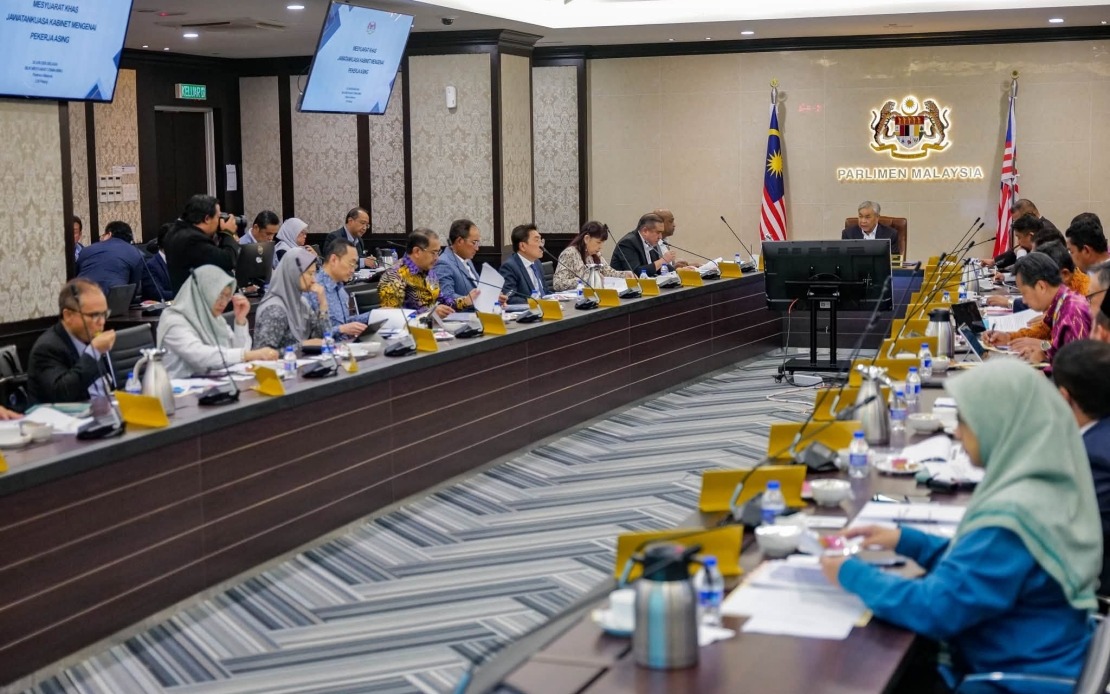
Deputy Prime Minister Datuk Seri Dr Ahmad Zahid Hamidi has signalled a significant shift in how Malaysia manages its foreign workforce, announcing comprehensive restructuring measures designed to create a more seamless and responsive system. The overhaul emerges from deliberations at a specially convened Cabinet Committee on Foreign Workers gathering held at Parliament, where senior officials charted a new direction for an industry that has long grappled with coordination challenges and regulatory inconsistencies. The initiative reflects growing recognition within government that the current framework requires modernisation to balance competing demands between employers seeking labour, national security interests, and the imperative to create meaningful opportunities for Malaysian workers.
Central to the restructuring effort is the relocation of the One Stop Centre for Foreign Worker Management under the purview of the Ministry of Human Resources. This administrative repositioning carries more than symbolic weight in the Malaysian bureaucratic context. By consolidating foreign worker oversight within a single ministry rather than distributing authority across multiple agencies, the government aims to eliminate the friction and duplication that has historically characterised the sector. The move acknowledges that managing a workforce involving millions of individuals requires institutional coherence—a lesson learned through years of challenges ranging from documentation inconsistencies to inadequate worker protections and labour disputes.
Ahmad Zahid articulated the government's foundational objective as creating a foreign worker management apparatus that simultaneously serves multiple constituencies and values. The framework must satisfy industry demands for adequate labour supply while safeguarding national security through robust vetting and monitoring protocols. Equally important, the system must prioritise employment pathways and advancement prospects for Malaysian citizens, addressing longstanding concerns that reliance on cheaper foreign labour has displaced local workers or depressed wage conditions in certain sectors. This tripartite balancing act has proven contentious in regional discourse, where countries struggle to reconcile economic pragmatism with nationalist sentiment and worker advocacy.
The Cabinet Committee's decisions extend beyond administrative restructuring to encompass strategic reassessment of labour importation itself. Government officials will undertake a comprehensive review of foreign labour requirements, moving away from historical patterns where sectoral demand was often met through reactive, ad-hoc approval mechanisms. Instead, the approach emphasises evidence-based planning aligned with genuine industry necessity rather than convenient access to inexpensive workers. This calibration matters considerably for Malaysia's economic trajectory, as it forces policymakers to confront difficult questions about which sectors genuinely require foreign labour and which should instead invest in automation, technological advancement, or workforce development initiatives.
Parallel to restructuring the foreign worker intake system, the government has reaffirmed commitment to reducing structural dependence on migrant labour. This commitment manifests through three complementary mechanisms: expanding local workforce participation across sectors traditionally reliant on foreign workers, developing skilled local talent through targeted training and education initiatives, and facilitating industrial transition toward automation and advanced manufacturing processes. These elements represent a longer-term vision transcending immediate labour market pressures. For Malaysia specifically, such transitions carry particular urgency given demographic pressures and the need to position the workforce for higher-value economic activities as the country pursues upper-middle-income status.
The initiative arrives amid regional context where Southeast Asian economies wrestle with similar tensions. Thailand, Indonesia, and Vietnam all employ significant foreign workforces while simultaneously grappling with questions about local employment protection and the sustainability of migration-dependent models. Malaysia's approach offers instructive lessons about how governments attempt to calibrate these competing interests, though implementation will ultimately determine whether announced restructuring translates into meaningful change or represents merely administrative reshuffling.
Integrity within the foreign worker management system emerged as an explicit priority from the Cabinet Committee discussions. This emphasis acknowledges persistent challenges related to document fraud, trafficking, wage exploitation, and inadequate working conditions affecting migrant workers in Malaysia. Enhanced coordination mechanisms under unified ministerial oversight theoretically create opportunities for more robust monitoring and enforcement of labour standards. Whether such structural improvements will meaningfully reduce exploitation depends substantially on resource allocation, enforcement capacity, and political will to sanction employers who violate regulations—areas where Malaysian performance has historically proved uneven.
The restructuring initiative carries implications extending beyond bilateral employer-worker relationships to encompass broader economic planning and workforce development strategy. By subjecting foreign labour requirements to more rigorous needs assessment, the government signals that future economic growth will increasingly depend on domestic productivity improvements, technological adoption, and human capital development rather than simply expanding access to lower-cost workers. This reorientation aligns theoretically with Malaysia's aspirations for economic upgrading, though achieving such transitions requires sustained investment and coordination across education, industrial policy, and regulatory frameworks.
For Malaysian employers and industry associations, the restructuring introduces both opportunities and constraints. Streamlined approval processes through a unified One Stop Centre could reduce bureaucratic delays currently hampering workforce planning. Conversely, more rigorous needs assessment may constrain access to foreign labour in sectors previously reliant on steady recruitment streams. Industries will require greater clarity regarding which roles can be filled by foreign workers and under what conditions, necessitating strategic workforce planning rather than opportunistic labour sourcing. This recalibration particularly affects labour-intensive sectors including agriculture, construction, domestic work, and manufacturing, where foreign workers constitute significant proportions of employment.
Ahmad Zahid's articulation that all government measures remain guided by national interest and public wellbeing, while rhetorically reassuring, ultimately depends on definitional clarity and implementation fidelity. National interest encompasses multiple, sometimes competing priorities—economic growth, worker welfare, social cohesion, and security. Different constituencies will interpret these emphases distinctly. Labour advocates will scrutinise whether restructuring genuinely improves protections for migrant workers or simply enhances state capacity for control and deportation. Employers will assess whether streamlined processes compensate for enhanced scrutiny. Malaysian workers will evaluate whether policies genuinely create better employment opportunities or merely restrict immigrant competition without addressing underlying structural economic challenges.
The Cabinet Committee's decisions represent a significant administrative and policy intervention, yet their ultimate impact will unfold through implementation by relevant government agencies, employer responses, and measurable outcomes regarding local employment, labour standards, and economic growth. Success requires not merely restructured institutions but sustained political commitment to enforcement, adequate resource allocation, and willingness to navigate inevitable tensions between competing policy objectives. For Malaysia and the broader Southeast Asian region, how this restructuring evolves will offer important insights into whether governments can effectively modernise labour migration management while simultaneously protecting workers and citizens.

