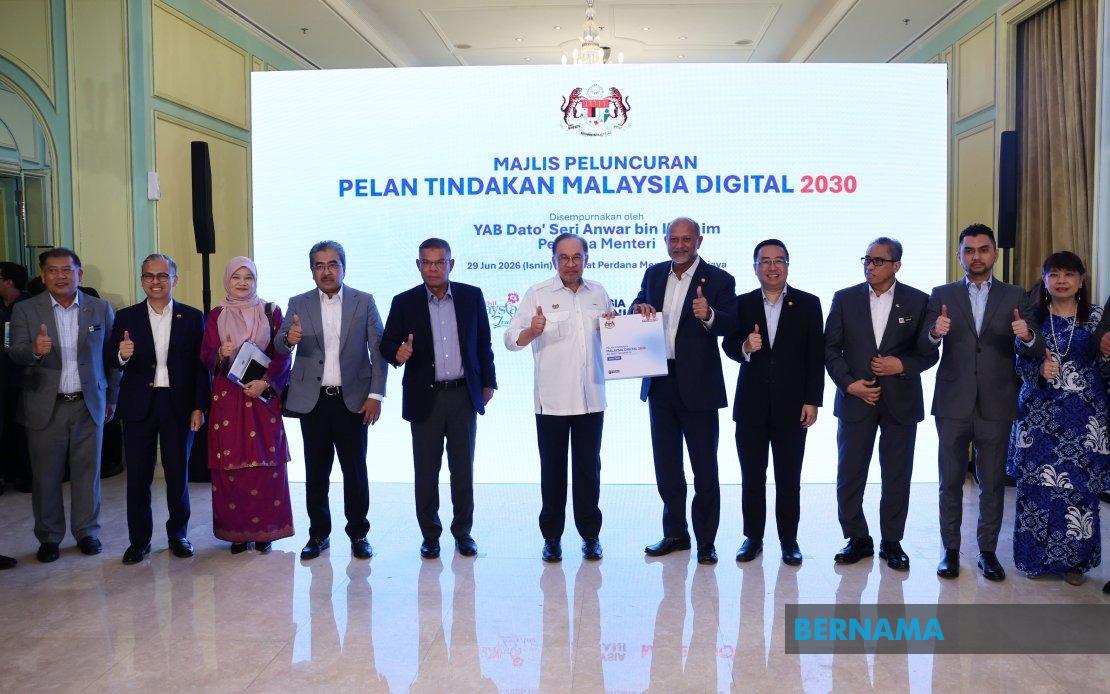
Prime Minister Datuk Seri Anwar Ibrahim has unveiled Malaysia Digital 2030 (MD2030), a transformative national strategy that signals a fundamental reorientation of the country's technological ambitions. Launched in Putrajaya on June 29 with senior government officials including Digital Minister Gobind Singh Deo and Communications Minister Datuk Fahmi Fadzil in attendance, the action plan represents Malaysia's deliberate pivot away from passive technology consumption toward becoming a homegrown innovation producer. This strategic shift carries significant implications not only for the domestic economy but also positions Malaysia as a potential regional competitor in the increasingly crucial artificial intelligence and digital services sectors.
The roadmap establishes an ambitious set of economic and operational benchmarks for the 2026-2030 period that reflect the government's confidence in accelerating digital transformation across the nation. By the end of the decade, Malaysia aims to elevate the digital economy's contribution to gross domestic product to 30 per cent—a substantial increase from current levels that would fundamentally reshape economic output. Complementing this financial target, the plan seeks to generate 500,000 high-value digital jobs, addressing both employment concerns and the need to develop a sophisticated workforce capable of competing in global digital markets. Additionally, the government intends to realise RM4.5 billion in operational savings through digitalisation of public sector functions, while transitioning 95 per cent of government services to fully integrated online delivery systems.
The architectural framework underpinning MD2030 reflects a sophisticated whole-of-government approach centred on seven interconnected strategic pillars, each addressing distinct dimensions of digital transformation. The Government pillar, overseen by Chief Secretary to the Government Tan Sri Shamsul Azri Abu Bakar, will establish GovTech Malaysia as the primary mechanism for modernising public service delivery. The Economy pillar, led by Investment, Trade and Industry Minister Datuk Seri Johari Abdul Ghani, specifically targets Malaysia's positioning as a regional digital innovation and trade hub through promotion of locally-developed products and accelerated technology adoption in high-growth, high-value sectors. This pillar also emphasises unlocking economic value from data, digital assets and intellectual property—resources that many developing economies have historically underexploited.
Infrastructure development constitutes another foundational element, with Communications Minister Datuk Fahmi Fadzil driving nationwide high-quality internet connectivity while simultaneously building modern digital infrastructure encompassing data centres, cloud computing facilities and smart city technologies. The critical importance of this pillar cannot be understated for a geographically dispersed nation like Malaysia, where rural and urban digital divides have historically constrained inclusive growth. The Talent pillar, coordinated by Human Resources Minister Datuk Seri R. Ramanan, addresses workforce readiness through comprehensive policy frameworks and agile transition initiatives designed to prepare Malaysians for digital economy employment while strengthening the country's appeal as a regional digital talent destination. This human capital dimension proves essential, as technological infrastructure without adequate skilled personnel cannot deliver the envisioned transformation.
The Society pillar, overseen by Women, Family and Community Development Minister Datuk Seri Nancy Shukri, emphasises inclusive participation in the digital ecosystem through institutionalisation of the Malaysian Digital Inclusion Index and targeted rural community empowerment. This focus acknowledges that meaningful transformation requires equitable participation rather than concentration of digital benefits among urban, affluent populations. Simultaneously, the Trust and Security pillar, helmed by Digital Minister Gobind Singh Deo, endeavours to balance innovation imperatives with robust data protection through operationalisation of the National Data Commission and development of a comprehensive National Digital Trust and Data Security Strategy. In an era of heightened data breaches and privacy concerns, this emphasis on security foundations distinguishes Malaysia's approach from purely growth-focused digital strategies seen elsewhere.
The Innovation pillar, directed by Science, Technology and Innovation Minister Datuk Chang Lih Kang, seeks to strengthen the complete innovation pipeline from research through commercialisation by establishing a robust Research, Development, Commercialisation, Innovation and Economy (RDCIE) ecosystem. This structural approach recognises that genuine technological capacity requires not merely consuming external innovations but cultivating domestic capabilities to generate, refine and market original digital solutions. The emphasis on commercialisation particularly matters for Malaysia, where research institutions have sometimes struggled to translate discoveries into market-viable products.
Implementation of this ambitious agenda will leverage an extensive network of government agencies and entities specifically established or designated for digital transformation purposes. The National AI Office (NAIO) will provide strategic direction on artificial intelligence integration, while the National Digital Department, operating as GovTech Malaysia, will handle government digital modernisation. The Malaysia Digital Economy Corporation (MDEC) will support business sector digitalisation, with CyberSecurity Malaysia ensuring protective frameworks, MyDIGITAL Corporation managing broadband expansion, and the Malaysia Centre for the Fourth Industrial Revolution (MYCentre4IR) fostering emerging technology development. This institutional proliferation suggests the government recognises digital transformation's complexity and the necessity of specialised agencies with defined mandates.
Digital Minister Gobind Singh Deo characterised the launch as demonstrating Malaysia's readiness to transcend its historical role as technology consumer, asserting the country's intention to become a respected digital innovation producer. His remarks emphasised that the Digital Ministry, functioning as the lead coordinating entity, bears responsibility not merely for economic targets but equally for ensuring the transformation rests upon foundations of trust, data security and robust governance. This framing is significant because it acknowledges persistent scepticism in some quarters regarding government technological capacity and data handling practices. By foregrounding governance and security concerns, the ministry implicitly recognises these constitute potential obstacles to public and private sector adoption of digital solutions.
The MD2030 vision articulates a desired future state wherein artificial intelligence permeates all facets of national life, data functions as a recognised strategic asset, intelligent and autonomous systems become normalised operational practice, and populations flourish alongside technological systems rather than experiencing displacement or marginalisation. This aspirational framing extends beyond purely economic metrics to encompass social and human dimensions of technological change. For Malaysian policymakers and stakeholders, the strategy represents acknowledgment that regional digital competition intensifies as neighbouring economies similarly invest in AI capabilities and digital infrastructure, particularly given technology's accelerating importance to economic competitiveness and national influence.
The timing and scope of MD2030 reflect broader geopolitical currents wherein digital technological capacity increasingly determines national influence and economic resilience. Southeast Asian nations compete for foreign investment in technology sectors, talent recruitment and regional positioning as digital hubs. Malaysia's explicit pivot toward becoming an AI nation signals awareness that historical manufacturing and commodity export strengths require augmentation through knowledge-intensive digital industries. The MADANI government's commitment language regarding inclusive and equitable transformation suggests consciousness that rapid digitalisation risks exacerbating existing disparities unless deliberately designed to benefit all Malaysians. Implementation effectiveness will ultimately depend on sustained political commitment, adequate resource allocation, institutional coordination across numerous agencies, and private sector responsiveness to government incentives and frameworks.

