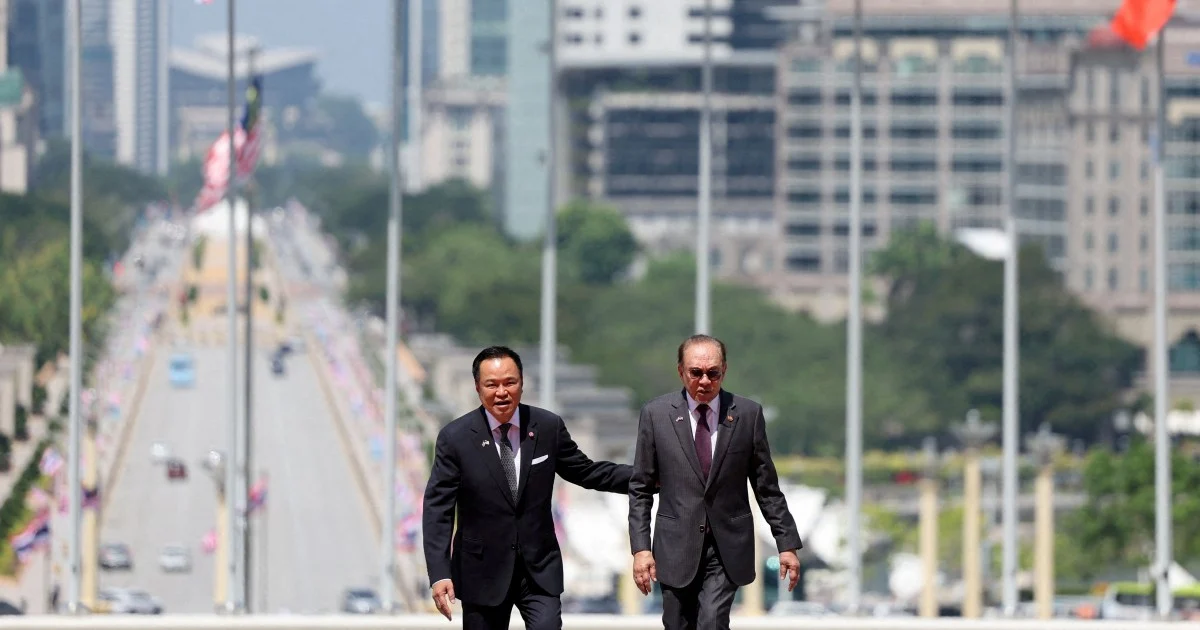
Malaysia regards the escalating crisis in Myanmar as a challenge that demands broad-based participation from all key actors rather than narrow diplomatic channels or external pressure, according to Prime Minister Datuk Seri Anwar Ibrahim speaking from Putrajaya. The Malaysian leader's position reflects growing concerns within ASEAN about the humanitarian and security consequences of the conflict, whilst advocating for a path that respects Myanmar's sovereignty and the agency of its population.
Anwar's statement underscores Malaysia's commitment to ASEAN's founding principle of non-interference in member states' internal affairs, yet also recognises that regional stability cannot be achieved through isolation or indifference. The approach seeks to balance diplomatic pragmatism with the urgent humanitarian realities on the ground, where Myanmar's political deadlock has created widespread displacement, economic dislocation, and suffering among ordinary citizens. By emphasising inclusive engagement, Malaysia signals that any lasting solution must incorporate diverse voices from Myanmar's government structures, civil society, opposition movements, and ethnic minority communities—a recognition that military-dominated approaches or narrow elite settlements will likely prove temporary.
The Myanmar crisis, which intensified following the military coup in February 2021, has defied conventional diplomatic remedies. Previous ASEAN-led initiatives, including the Five-Point Consensus agreement, have yielded limited tangible progress in restoring democratic processes or humanitarian access. Malaysia's renewed emphasis on inclusivity suggests frustration with the status quo and a belief that traditional quiet diplomacy has reached its limits. The call for stakeholder engagement implicitly acknowledges that Myanmar's complex web of political factions, military interests, and ethnic armed organisations cannot be bridged through top-down arrangements alone.
For Malaysia and other Southeast Asian nations, the Myanmar impasse carries direct strategic implications. The refugee crisis alone has strained border communities, particularly Thailand, whilst broader regional stability is compromised by the prospect of prolonged armed conflict. Economic disruption in Myanmar also affects regional supply chains and investment, matters of concern to Malaysian businesses with operations in the country. Beyond immediate economic considerations, an unstable Myanmar risks becoming a haven for transnational criminal networks, human trafficking operations, and other organised crime that inevitably spills across borders into Malaysia and neighbouring states.
Anwar's position also reflects Malaysia's own democratic transition and the complex realities of post-authoritarian governance. Having navigated contentious politics and reforms over recent years, Malaysia understands that sustainable political solutions require buy-in from multiple constituencies and that exclusion breeds resentment and instability. The principle that Myanmar's people must determine their own future—a cornerstone of Anwar's statement—resonates with Malaysia's own experiences and values, whilst also serving as a diplomatic counterweight to suggestions that external powers should impose solutions on the country.
The emphasis on self-determination carries additional importance given the historical sensitivity surrounding Myanmar's independence and territorial integrity. Myanmar's experience with colonial rule and subsequent military dominance has created deep-rooted resistance to external prescriptions. By framing the resolution process as one driven by Burmese agency, Malaysia positions itself as a partner supporting local ownership rather than imposing foreign agendas—a distinction that could prove crucial in building trust with different Myanmar factions and securing regional consensus around any resolution framework.
ASEAN's institutional response to Myanmar has been complicated by the bloc's consensus-based decision-making and varying national interests. Cambodia's alignment with Myanmar's military leadership, Thailand's border security concerns, and Indonesia's weight in regional matters all influence collective positions. Malaysia's articulation of the inclusive engagement pathway may serve to recalibrate ASEAN discussions, encouraging member states to commit more actively to dialogue facilitation rather than accepting indefinite stalemate. Such reframing could prove particularly important as international attention to Myanmar gradually shifts, risking a slow-motion humanitarian catastrophe conducted out of the global spotlight.
The timing of Anwar's comments also matters in relation to broader geopolitical shifts. With major powers—China, India, and the United States—all maintaining interests in Myanmar, Malaysia's emphasis on inclusive regional resolution rather than external mediation carves out political space for ASEAN leadership. This approach appeals to ASEAN's collective desire to maintain relevance in regional security matters despite the bloc's diminishing ability to enforce consensus outcomes. By advocating for stakeholder engagement rather than coercive measures, Malaysia positions ASEAN as a forum for inclusive dialogue rather than as an instrument of pressure—a more credible and sustainable role for a consensus-based regional organisation.
Looking ahead, realising the inclusive engagement model will require concrete mechanisms. ASEAN may need to deepen mechanisms for dialogue, perhaps through expanded track-two diplomacy involving civil society, technical experts, and previously marginalised voices within Myanmar. Malaysia could contribute through hosting dialogue facilities or providing technical expertise in conflict resolution, drawing on regional experience with post-conflict transitions. The ultimate success will depend on whether key Myanmar stakeholders—particularly the military and opposition movements—view inclusive engagement as a genuine path to addressing their concerns rather than as a forum for imposing external preferences.
Anwar's articulation of Malaysia's position also acknowledges the long-term dimension of Myanmar's crisis. Quick fixes imposed from outside or negotiated purely among narrow elite circles are unlikely to produce durable outcomes. Instead, a foundation that incorporates diverse stakeholder perspectives and respects Burmese agency in determining their political future offers better prospects for sustainable stability. For Malaysia, supporting this approach reinforces its standing as a responsible regional partner whilst advancing its own interests in Myanmar's stabilisation and broader Southeast Asian security.

