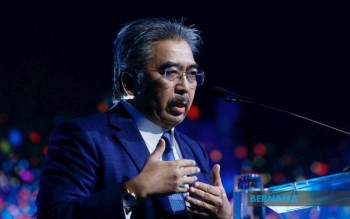
The Malaysian government is methodically examining ways to finance a sprawling nationwide electric vehicle charging network, with the Ministry of Investment, Trade and Industry signalling that a potential EV levy remains under active consideration rather than a settled policy matter. Speaking during a Dewan Negara session and subsequently at an RHB Bank conference, MITI Minister Datuk Seri Johari Abdul Ghani clarified that authorities have not yet committed to implementing such a levy, instead remaining focused on identifying the most workable framework that could distribute costs equitably between manufacturers, consumers, and the state budget.
The core challenge confronting policymakers reflects Malaysia's dual fiscal and developmental constraints. The government has sustained substantial subsidies across the transportation sector while simultaneously grappling with a widening fiscal deficit, creating competing pressures that complicate infrastructure investment decisions. Johari articulated this tension explicitly, noting that the state cannot indefinitely absorb mounting subsidy costs while also funding the substantial capital expenditures required to establish charging infrastructure comparable to networks operational in advanced markets. This admission reveals the fundamental arithmetic problem underlying the policy debate: maintaining affordability requires ongoing government support, yet expanding that support without new revenue sources deepens the nation's fiscal imbalance.
Under consideration is a point-of-sale levy imposed on every electric vehicle sold within Malaysia, with collected revenues channelled into a dedicated fund explicitly designated for public charging station development. This mechanism would theoretically create a self-sustaining revenue stream directly tied to EV market growth, ensuring that charging infrastructure expands in proportion to vehicle adoption rather than competing with other budgetary priorities. The approach acknowledges that manufacturers and distributors, while instrumental in the EV ecosystem, cannot be expected to bear sole responsibility for building publicly accessible charging networks that benefit all drivers regardless of vehicle brand.
Johari's comments reveal careful political positioning around the levy's ultimate incidence. While authorities might technically impose costs on manufacturers, the minister bluntly acknowledged that businesses would pass these charges to consumers through higher vehicle prices. This transparency about cost transmission suggests the government recognises public sensitivity around EV affordability; framing a levy as a manufacturer tax while knowing it effectively becomes a consumer tax represents a particular communications challenge. The minister's emphasis that "if those costs are imposed on manufacturers, they will ultimately pass them on to consumers" indicates authorities understand this dynamic and are wrestling with how to communicate it to the public.
Malaysia's energy generation profile substantially complicates the EV transition narrative. Unlike nations that have rapidly decarbonised their electricity grids, Malaysia remains substantially dependent on gas and coal-fired generation, meaning that widespread electrification of transport does not automatically translate into equivalent emissions reductions. Johari highlighted this reality, noting that policymakers must account for the infrastructure costs associated with electricity supply expansion necessary to support mass EV adoption. This constraint renders the transition more expensive than it might appear in markets with cleaner grids, and it justifies the government's caution around committing resources without understanding the full financial implications.
The minister's broader framing positions the levy question within Malaysia's macroeconomic circumstances rather than as a standalone sectoral issue. By repeatedly referencing the fiscal deficit and the multiplicity of government expenditure demands, Johari sought to establish that EV infrastructure funding cannot be divorced from budget realities. This approach—situating the levy within wider economic constraints—differs markedly from advocacy-oriented arguments that emphasise climate imperatives or competitive necessity. Instead, it grounds the policy discussion in practical constraint: the government cannot simultaneously maintain subsidies, fund charging infrastructure, and ignore fiscal pressures.
The government's recognition that a Chinese-scale public charging infrastructure cannot be replicated in Malaysia under current fiscal conditions represents significant candour about capability limits. China's massive charging network reflects not merely technological sophistication but enormous state investment sustained over years. Johari's acknowledgment that Malaysia cannot match this spending level, at least in the near term, suggests authorities are calibrating expectations and avoiding commitments they cannot fulfil. This realism may frustrate EV advocates expecting aggressive infrastructure expansion, yet it likely reflects an honest assessment of available resources.
For Malaysian consumers contemplating EV purchases, the levy discussion carries immediate relevance. If implemented, such a levy would increase vehicle prices, potentially dampening demand precisely when market momentum could help establish a viable EV ecosystem. The government faces a genuine policy dilemma: without infrastructure, EV adoption will remain limited, yet imposing costs that suppress adoption undermines the preconditions for infrastructure viability. This chicken-and-egg dynamic has confounded EV transitions globally and appears to be shaping Malaysia's deliberations.
Regionally, Malaysia's cautious approach contrasts with more aggressive EV policies adopted by neighbouring Indonesia and Thailand, which have established substantial tax incentives and subsidised charging networks. The slower Malaysian pace may reflect either different fiscal capacity or different political calculations about consumer readiness. As ASEAN nations pursue electrification at varied tempos, Malaysia's more measured approach reveals differing assessments of what fiscal constraints permit and what market conditions demand.
The government's extended deliberation over levy mechanics suggests authorities recognise the decision's significance for industrial competitiveness and consumer welfare. Rushing toward implementation without settling fundamental questions about rate structure, revenue allocation, and enforcement mechanisms could create policy instability that discourages manufacturer investment and consumer confidence. Conversely, indefinite postponement risks leaving the charging infrastructure inadequately funded as EV adoption accelerates naturally through market forces and regulatory incentives already in place. Johari's public signalling appears designed to manage expectations while authorities work through these competing considerations privately.

