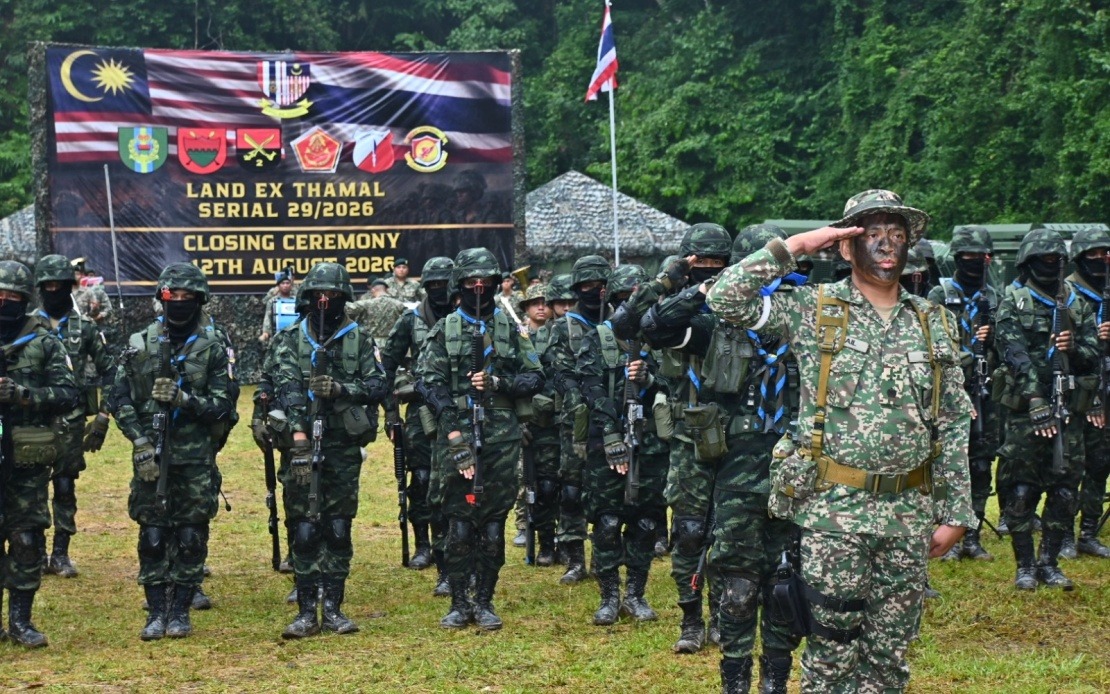
A combined contingent of 252 military personnel from Malaysia and Thailand launched Exercise LAND THAMAL Series 29/2026 in Gerik on August 5, marking another significant milestone in the two nations' deepening defence partnership. The multinational operation, which brings together 197 Malaysian Army officers and soldiers alongside 55 Thai counterparts, represents a concrete commitment to building interoperability and shared understanding between the two armed forces at a time when regional security cooperation has become increasingly vital.
The exercise, which is being overseen by Malaysia's 2nd Infantry Division Headquarters, unfolds across three distinct operational phases designed to progressively test and refine joint capabilities. The Cross Training Exercise phase allows personnel to familiarise themselves with each other's doctrines and procedures, while the Field Training Exercise component exposes troops to authentic tactical scenarios including combat manoeuvres, obstacle negotiation, camp establishment, reconnaissance missions, and assault operations. The third component, Combined Military Civil Action, extends the exercise beyond purely military objectives to encompass humanitarian and community engagement activities.
For Southeast Asia, such bilateral exercises carry particular significance given the region's complex security landscape. Malaysia and Thailand share a lengthy border and face common challenges ranging from transnational crime and irregular maritime activities to the ever-present threat of natural disasters that periodically devastate both nations. By practising coordinated responses to these multifaceted threats, the two armies develop the muscle memory and mutual trust necessary for rapid, effective collaboration when actual crises occur. The emphasis placed by Thai 5th Infantry Brigade Commander Senior Colonel Taweeporn Kanatong on preparedness for natural disasters, security threats, and regional conflicts underscores recognition that modern defence extends far beyond traditional military confrontation.
The exercise reflects a broader strategic calculation in the region. Malaysia and Thailand have long maintained cordial military relations, yet deepening these ties through intensive joint training sends important signals about regional stability and commitment to rules-based cooperation. For Malaysian readers, the exercise demonstrates that the military establishment continues to prioritise pragmatic partnerships that address concrete security needs rather than pursuing isolated or fortress-like approaches to defence policy. This collaborative mindset proves especially important given Malaysia's diverse strategic interests and vulnerabilities across multiple domains.
The tactical training components themselves reveal how both militaries have evolved their operational thinking. Traditional infantry skills—patrolling, ambush tactics, base security—remain foundational, yet the exercise framework suggests sophisticated integration of these fundamentals with broader campaign objectives. Personnel gain exposure to diverse operational environments and enemy tactics, building adaptive capacity that translates into enhanced readiness across the force structure. Such cross-training also reduces the knowledge asymmetries that can impede joint operations, ensuring that officers and enlisted personnel at various levels can communicate effectively and coordinate movements with minimal friction.
The community relations dimension through the Jiwa Murni Programme merits particular attention, as it illustrates how contemporary military exercises serve functions beyond combat preparation. By engaging in joint civil action activities at Sekolah Menengah Kebangsaan Sultan Idris Shah II in Gerik, soldiers from both countries build personal relationships and demonstrate to local populations that military cooperation serves constructive purposes. Such activities soften any potential suspicions communities might harbour toward the military presence and generate positive associations with defence institutions among younger generations who will ultimately shape regional attitudes toward security cooperation.
Brigadier General Datuk Mohd Zaini Hashim, commanding the 30th Malaysian Infantry Brigade, and Senior Colonel Taweeporn Kanatong jointly presided over the official launch ceremony at Gerik Airstrip, a symbolic arrangement that emphasises equality and shared ownership of the exercise outcomes. Such ceremonial parity matters in the military world, where protocols and rankings carry significant meaning. The joint officiating arrangement suggests that both nations view the exercise not as one partner obliging another or as a senior-junior relationship, but as a genuine peer-to-peer engagement between professional military organisations with complementary interests and capabilities.
The success of LAND THAMAL Series 29/2026 must ultimately be measured not merely by whether participants complete all scheduled activities, but by whether genuine professional relationships develop that persist beyond the exercise conclusion. Military personnel who have shared field experiences, faced simulated challenges together, and learned each other's operational methods often develop collegial bonds that facilitate smoother cooperation in subsequent interactions. These interpersonal networks become invaluable assets when actual emergencies demand rapid cross-border coordination or when policy decisions require technical military input on bilateral matters.
For Malaysia's defence establishment, hosting such exercises also reinforces the country's positioning as a credible, professionally competent military actor in Southeast Asia. The ability to organise multinational training operations at this scale and sophistication level demonstrates institutional capacity and operational maturity. It signals to regional partners that Malaysia possesses the logistical infrastructure, planning acumen, and leadership capability necessary to serve as a reliable security partner in future multilateral ventures that may extend beyond bilateral arrangements with Thailand alone.
Looking forward, Exercise LAND THAMAL Series 29/2026 arrives at a moment when regional security dynamics are shifting in complex ways. Traditional concerns about maritime security, terrorism, and smuggling persist, while novel challenges including cyber warfare, disinformation, and great power competition increasingly demand attention. The exercise's focus on conventional tactical skills should not obscure the reality that future Malaysian-Thai security cooperation will need to evolve continuously to address these emerging threat categories. The foundation of professional military-to-military relationships established through exercises like LAND THAMAL provides essential groundwork for such evolution.
Both the Malaysian Army and Royal Thai Army have indicated their commitment to sustaining this exercise series as a permanent fixture in their bilateral defence calendar. This institutionalisation speaks to confidence that the initiative delivers genuine value and justifies continued investment of personnel, resources, and command attention. For Malaysian defence planners and the broader security community, the message is clear: sustained engagement with neighbouring militaries through structured, purposeful training initiatives yields dividends that ripple across multiple dimensions of national security policy and regional stability.

