Coronary artery disease remains a leading health concern across Southeast Asia, and Malaysian cardiologists are now at the forefront of testing innovative solutions to address one of its most challenging complications: severely calcified arteries that resist conventional treatment. A team of Malaysian researchers led by consultant cardiologist Datuk Dr Tamil Selvan Muthusamy has begun investigating an advanced device called the Hertz Contact-IVL System, designed to tackle hardened plaque buildup with greater precision and safety than existing methods. This development carries significant implications for cardiac patients throughout the region, where the prevalence of atherosclerosis continues to rise alongside lifestyle-related risk factors.
Atherosclerosis develops over many years as a mixture of fat, cholesterol, calcium, cellular debris and fibrin accumulates along artery walls, gradually narrowing blood vessels and restricting blood flow to vital organs. When left untreated, this progressive narrowing can precipitate life-threatening events including heart attacks, heart failure and strokes. The pathophysiology behind plaque formation involves complex inflammatory processes, and different plaques respond differently to treatment depending on their composition and consistency. Soft plaques can sometimes be managed through conventional balloon angioplasty, where physicians inflate a balloon to compress the material and restore arterial diameter, often followed by stent placement to maintain the newly opened passage and prevent reclosure.
However, severe calcification fundamentally changes the treatment landscape. When calcium deposits harden the plaque substantially, conventional balloons simply cannot compress the material effectively, leaving physicians with limited and technically demanding options. Cardiologists must then resort to specialized techniques including rotational atherectomy, which involves mechanically grinding away calcium; high-pressure balloon angioplasty, which applies extreme force at considerable risk; or intravascular lithotripsy, which harnesses sonic pressure waves to fracture the calcium deposits. Each approach carries its own risks and technical limitations, and success rates diminish as calcification severity increases.
Traditional intravascular lithotripsy, though representing a breakthrough when first introduced, operates through externally generated ultrasound pulses directed into calcified lesions via specialized catheters. Dr Tamil Selvan explains that this energy-based approach works by positioning the catheter at the blockage site and inducing acoustic waves that create pressure waves powerful enough to fracture calcium. Yet this methodology carries inherent constraints: the number of ultrasound pulses is predetermined and limited—older devices permitted only eight pulses, while newer versions allow twelve—meaning physicians must fracture all calcium deposits within these predetermined bursts. Additionally, the bulky catheter design creates delivery challenges, particularly when arteries are severely narrowed with minimal internal space, sometimes necessitating additional invasive techniques just to position the equipment.
Another fundamental problem with conventional lithotripsy lies in its one-size-fits-all balloon design. Coronary arteries naturally taper as they branch and extend distally, with vessel diameters varying significantly along their length. A vessel might measure 3.5 to 4 millimetres at its origin but narrow to 2 to 3 millimetres further downstream. The standard IVL balloon must match one specific diameter measurement, creating situations where a device sized appropriately for the proximal artery becomes oversized for the distal segment, or conversely, proves too small for the proximal portion. This mismatch reduces treatment efficacy and complicates the procedural approach, often requiring operators to exchange equipment multiple times during a single intervention.
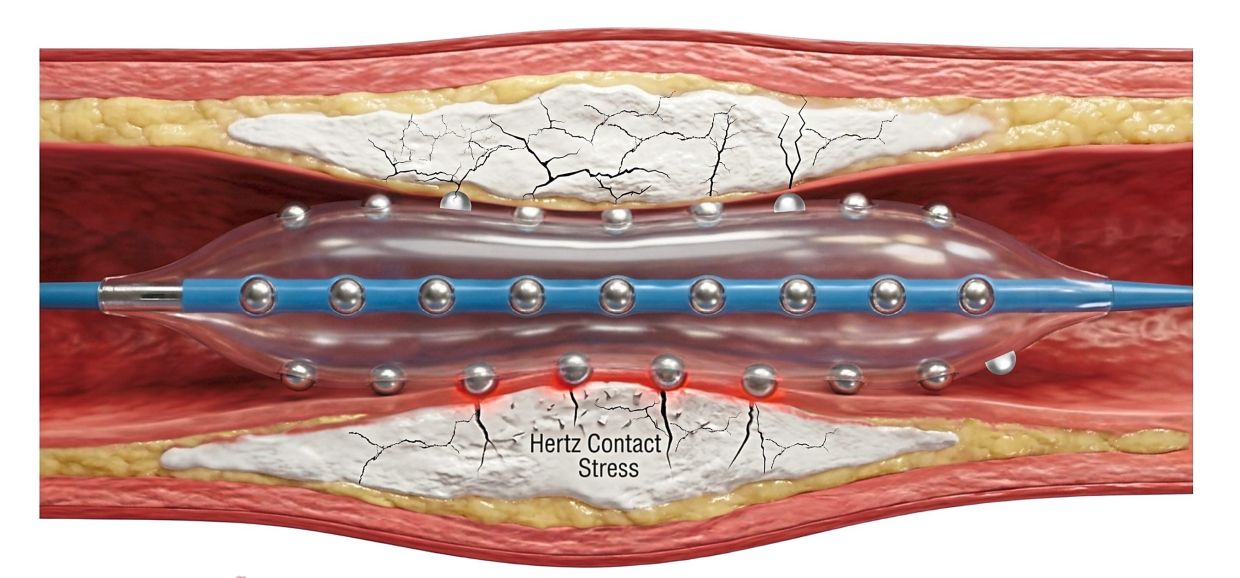
The Hertz Contact-IVL System represents a fundamental redesign addressing these limitations through mechanical rather than energy-based mechanisms. Instead of relying on external ultrasound generators, the HC-IVL device incorporates a balloon with embedded metallic hemispheres—essentially tiny stainless steel domes integrated into the balloon structure. When this modified balloon contacts the hardened plaque and physicians apply pressure, the hemispheres amplify and concentrate that pressure at focal points, transmitting multiplied force directly into the calcium deposits. This mechanical amplification creates deep, widespread cracks throughout the calcified plaque while minimizing trauma to surrounding arterial tissue, a critical distinction that reduces the risk of arterial perforation and other serious complications.
Dr Tamil Selvan and his colleagues identified a critical advantage in the device's superior deliverability profile. Because the catheter can navigate through the entire vessel length with minimal difficulty, the single balloon can effectively treat multiple lesions or lengthy blockages that might otherwise require device exchanges. This represents more than mere procedural convenience—improved deliverability directly translates to shorter procedure times, reduced radiation exposure during fluoroscopic guidance, and decreased procedural complications. The enhanced ease of insertion becomes particularly valuable in patients with severely calcified disease where vessel access presents major technical obstacles.
The genesis of the Malaysian research initiative reflects a gap in the international evidence base. The HC-IVL device developer had completed only small, single-center studies across multiple United States institutions, providing limited data regarding real-world efficacy and safety across diverse patient populations. Dr Tamil Selvan and his research team recognized the opportunity to conduct a more robust, larger-scale investigation within Malaysia's healthcare context, where patient demographics and disease patterns differ from predominantly Western populations in the original studies. This decision to undertake expanded local investigation demonstrates Malaysia's growing capacity for independent cardiac research and its commitment to establishing evidence appropriate for Southeast Asian patient populations.
The research initiative carries broader implications for regional cardiac healthcare. Coronary artery disease prevalence continues climbing throughout Southeast Asia, driven by rapid urbanization, adoption of Western dietary patterns, rising obesity rates and increasing diabetes incidence. Many patients in the region present with advanced atherosclerotic disease due to delayed diagnosis and limited access to preventive interventions. Treatment-resistant, heavily calcified coronary lesions represent a particularly vexing clinical problem in developing healthcare systems where advanced imaging and interventional infrastructure may be limited. Successful validation of HC-IVL technology through Malaysian research could accelerate regional adoption and potentially improve outcomes for thousands of patients who currently face limited options for their severe calcified disease.
Beyond the immediate therapeutic benefits, this research exemplifies Malaysia's emerging role in global cardiovascular innovation and clinical evidence generation. The nation possesses experienced cardiologists capable of conducting rigorous investigational studies, established interventional cardiology infrastructure, and patient populations that reflect real-world disease patterns across the Asia-Pacific region. When Malaysian researchers publish results from HC-IVL studies, their findings carry particular credibility with other Southeast Asian healthcare systems and physicians managing similar patient populations. This positions Malaysia not merely as an adopter of international medical advances but as a contributor to the evidence base shaping how advanced cardiac interventions are performed globally.
The underlying clinical question addressed by HC-IVL technology speaks to fundamental challenges in modern interventional cardiology: how can physicians safely and effectively open severely calcified coronary arteries while minimizing procedural complications and optimizing long-term patency? Previous generations faced a relatively binary choice between accepting persistent blockage and accepting the risks of aggressive mechanical or high-pressure techniques. Intravascular lithotripsy introduced a middle path, but limitations inherent to the energy-based design constrained its effectiveness in certain lesion morphologies. The mechanical amplification approach embodied in HC-IVL technology potentially offers yet another incremental advance, demonstrating how continuous innovation can address previously unsolved problems in interventional medicine.
The completion and publication of this Malaysian research will likely influence practice patterns throughout Southeast Asia and potentially beyond. Interventional cardiologists across the region currently managing complex calcified lesions will scrutinize the results to determine whether HC-IVL represents a genuine advancement worthy of adoption or simply an alternative with comparable benefits and limitations. The quality of the Malaysian research will therefore directly impact clinical decision-making for thousands of patients who might benefit from improved calcified lesion treatment strategies. For Malaysian cardiologists specifically, contributing to the international evidence base for major therapeutic innovations reinforces the nation's position as a center of excellence for interventional cardiology and enhances the prestige and attractiveness of Malaysian cardiac centers to regional and international colleagues.

