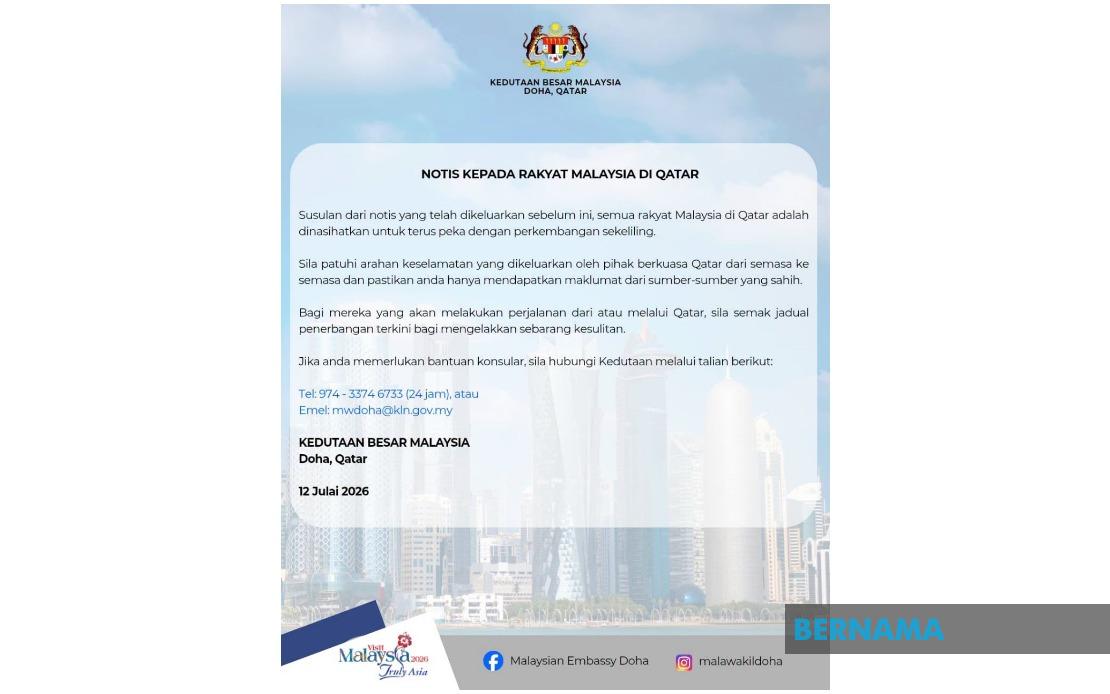
The Malaysian Embassy in Doha has issued a formal security advisory to Malaysian citizens residing in or transiting through Qatar, directing them to adhere strictly to instructions from Qatari authorities in response to escalating military tensions between the United States and Iran. The embassy's statement, released through its official social media channels, emphasises the importance of situational awareness and accessing only reliable information during this period of heightened regional instability.
According to the embassy's guidance, Malaysians are required to remain vigilant about their immediate surroundings and comply with any security directives that Qatari authorities issue over the coming days. The notice specifically cautions against relying on unverified sources for information about the security situation, recognising the potential for misinformation to spread rapidly during international crises. For those planning to travel through Qatar or departing the country, the embassy recommends checking updated flight schedules with airlines to minimise the risk of disruptions caused by operational changes.
The advisory comes in response to a dramatic escalation in hostilities this week, triggered by Iranian military action against commercial shipping in the Persian Gulf. On Sunday, Iran's Islamic Revolutionary Guard Corps navy conducted military strikes targeting a vessel transiting the Strait of Hormuz, a chokepoint through which approximately one-third of the world's seaborne oil passes. In retaliation, the United States launched its third wave of military strikes against Iranian targets within a single week, marking a dangerous acceleration in the tit-for-tat cycle of attacks between the two adversaries.
Crucially, Iran's Islamic Revolutionary Guard Corps announced on Sunday that it was implementing a unilateral closure of the Strait of Hormuz, a move with potentially severe implications for global energy markets and international commerce. The Iranian military declared that no vessels would be permitted passage through the strategic waterway until further notice, explicitly conditioning the reopening on the cessation of what it characterises as US interventions throughout the Middle East. This unprecedented assertion of control over one of the world's most critical maritime routes represents a significant escalation in the conflict and threatens to disrupt trade flows affecting every major economy.
The current crisis represents a dramatic deterioration from just weeks earlier, when regional tensions appeared to have stabilised. In June, Tehran and Washington had brokered a Pakistan-mediated memorandum of understanding intended to terminate the military conflict that had engulfed the region since late February. The agreement, hailed at the time as a potential breakthrough, committed both sides to ceasing hostilities across all fronts, lifting the US naval blockade that had strangled Iranian commerce, and reopening the Strait of Hormuz to international shipping traffic. The memorandum appeared to offer a pathway toward sustained peace and the restoration of normal economic activity throughout the region.
However, the recent renewal of attacks suggests that underlying disagreements between Washington and Tehran remain fundamentally unresolved despite the formal agreement. Both sides have cited violations by the other, with disputes emerging particularly around the passage of commercial vessels through the Strait of Hormuz. These renewed confrontations indicate that the political mechanisms established by the June accord may be insufficient to prevent military escalation when disputes arise, and they raise serious questions about whether the underlying framework can withstand the pressures of ongoing regional competition.
The implications of this escalation extend well beyond Qatar and directly affect Malaysian interests in multiple ways. Malaysia, as a major trading nation dependent on open maritime routes, faces potential economic damage from any sustained closure of the Strait of Hormuz or disruptions to shipping. Malaysian companies with operations, investments, or supply chain connections in the Gulf region may face operational challenges, security risks, or financial losses if tensions continue to mount. The oil and gas industry, which supplies significant energy resources to Malaysia and regional partners, could face supply disruptions that affect energy prices and availability across Southeast Asia.
For Malaysian nationals currently in Qatar, the security situation presents both immediate practical concerns and longer-term uncertainty. Qatar, while not a direct participant in the US-Iran conflict, hosts numerous American military installations and serves as a hub for international business activity. Any further escalation could potentially trigger broader disruptions affecting aviation, telecommunications, and commercial activity throughout the emirate. The Malaysian Embassy's emphasis on maintaining contact through its 24-hour hotline and email channels reflects official concern about the potential for rapid deterioration requiring emergency assistance to evacuate or protect nationals.
The strategic significance of the Strait of Hormuz cannot be overstated for Malaysian policymakers and business interests. As a maritime nation with substantial shipping and energy trading activities, Malaysia has a direct stake in ensuring freedom of navigation through international waterways. Any precedent allowing one country to unilaterally close or control access to critical chokepoints poses long-term challenges for global commerce and for the rules-based international system that Malaysia has traditionally supported. The current crisis therefore represents more than a bilateral US-Iran dispute—it is a test of whether international law and maritime conventions can constrain great power competition.
Malaysia's response, through embassy communications rather than official government statements, reflects the delicate diplomatic balance required in navigating this crisis. As a Muslim-majority nation with significant economic ties to both Western and Middle Eastern partners, Malaysia must avoid appearing to take sides while protecting its nationals and interests. The embassy's pragmatic focus on security compliance and reliable information gathering suggests a preference for de-escalation and reliance on international mechanisms to resolve the underlying dispute.
Looking ahead, Malaysian authorities will likely continue monitoring developments closely while maintaining contingency plans for evacuating nationals if necessary. The sustainability of the June memorandum of understanding between the US and Iran will be critical not only for regional stability but for the restoration of normal maritime traffic patterns essential to Southeast Asian economies. The coming weeks will reveal whether diplomatic channels can arrest the current escalation and rebuild the fragile peace that appeared promising just weeks ago.

