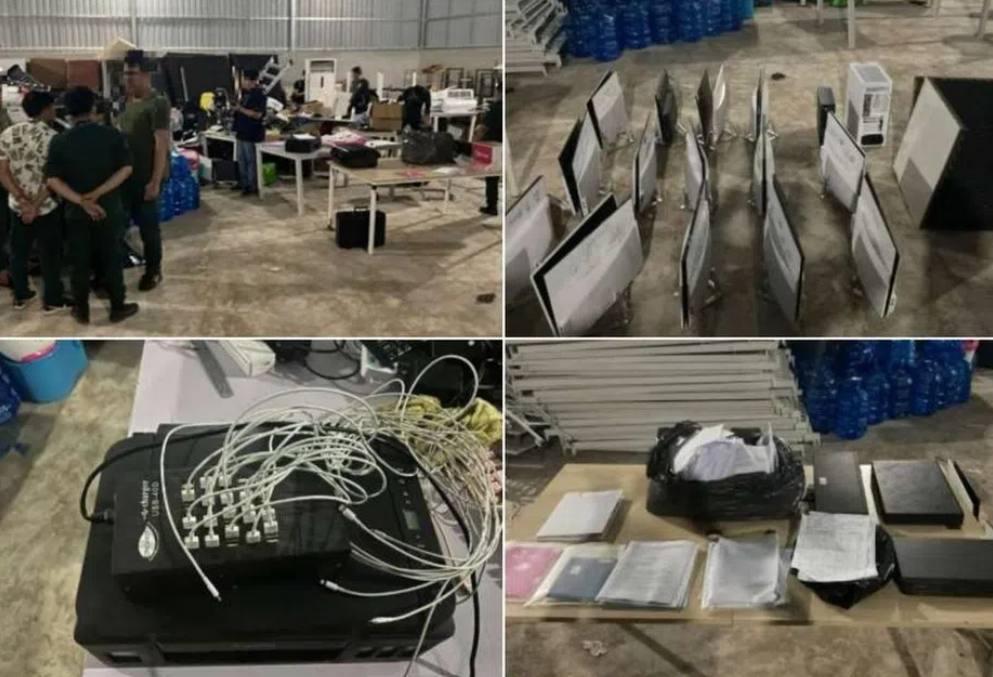
A 30-year-old Malaysian has been handed a prison sentence of 16 months and two weeks for his involvement with an international scam operation based in Phnom Penh, Cambodia, that systematically defrauded Singaporeans. Yip Chee Ming's brief and unsuccessful tenure with the criminal network lasted merely three days before he was terminated for his complete inability to swindle any victims, despite receiving formal training and scripts from his supervisors. He pleaded guilty on Friday to a single charge of membership in an organised crime syndicate, with an additional charge relating to fraud taken into account during sentencing.
The Cambodian scam operation that Yip joined represents a sophisticated and expansive criminal enterprise spanning multiple countries and targeting Southeast Asian victims across international boundaries. Between September 2024 and September 2025, the syndicate orchestrated at least 528 documented scam incidents, resulting in cumulative losses of approximately S$52.5 million. The group specialised in impersonating government officials, a fraud method that has proven increasingly effective in deceiving victims who assume legitimacy when contacted by persons claiming to represent state authorities. Intelligence from authorities suggested the criminal network encompassed at least 78 suspected members, each filling specific roles within a hierarchical structure designed for operational efficiency and profit maximisation.
Yip's entry into the scam world began innocuously through a personal connection. In October 2024, a friend identified as Jason informed him of available positions within the criminal enterprise and invited him to participate. Intrigued by the employment opportunity, Yip agreed to join his acquaintance. Both men were subsequently inducted into a Telegram group by Tang Soon Wah, identified by authorities as one of the syndicate's senior leaders. Tang extended an invitation to visit the scam compound in person, offering to arrange and fund their travel to Cambodia to observe the operation's scale and infrastructure.
When Yip and Jason travelled to Cambodia on November 21, 2024, they discovered the syndicate's base was housed in a five-storey purpose-built facility with armed security personnel stationed at the perimeter. The physical setup reflected the operation's substantial financial resources and organisational ambition. Upon arrival, Yip commenced his employment the following day, November 22, 2024, in a position that required him to impersonate banking officers when calling potential victims. The compensation package included a monthly salary equivalent to US$1,800 in cryptocurrency alongside a commission structure offering one percent of funds extracted from successfully defrauded targets.
Despite having received detailed scripts prepared by experienced trainers within the organisation, Yip proved remarkably inept at the deceptive craft. The syndicate's training protocols included coaching on communication techniques designed to enhance persuasiveness, such as adopting convincingly authentic Singaporean speech patterns and accents to establish credibility with victims. However, these carefully constructed guides and professional development interventions proved insufficient to overcome Yip's fundamental inadequacy for the role. His initial attempt to execute a scam failed entirely, as did his second effort on November 23, 2024.
After observing Yip's abject failure across consecutive working days, Tang made the business decision to terminate his employment and remove him from the operation. The syndicate leader deleted all electronic communications with Yip, seemingly to obscure the brief association. Court documents provide no information regarding Yip's method of departure from Cambodia or his immediate whereabouts in the months following his dismissal.
Approximately ten months later, Yip's criminal past caught up with him. On September 9, 2025, he was arrested in Singapore as authorities conducted a comprehensive joint operation against the syndicate alongside the Cambodian National Police. Yip became one of twelve individuals charged as suspected members of the criminal organisation. Of this cohort, nine defendants were Singaporean nationals—Deon Tan Ke Yuan, 25; Lester Ng Jing Hai, 29; Christy Neo Wei En, 29; Heiqal Lee, 30; Tay Jun Xiang, 32; Ng Wei Kang, 33; Zachary Lee Jia An, 35; Melvin Tan Wenzheng, 35; and Lau Haoxiang, 39—while the remaining three comprised Yip and two other non-citizens: Malaysian national Muhamad Asyraf Anuar, 29, and Filipino national De Villar Rizalyn Panganiban, 34.
The scam operation's specialisation in government official impersonation reflects a troubling trend affecting the broader region. Despite an overall decline in reported scam incidents throughout 2025, cases specifically involving fraudulent impersonation of state officials surged dramatically, nearly doubling from 1,504 recorded incidents in 2024 to 3,363 in 2025. This crime category ranked as the fifth most prevalent scam type across the year, indicating victims' particular vulnerability to schemes leveraging the perceived authority and legitimacy of government representatives. The sophistication of such operations—combining international networks, advanced training, technological infrastructure, and money laundering mechanisms—presents ongoing challenges for law enforcement across Southeast Asia.
Yip's case demonstrates both the scale of transnational organised crime in the region and its relative lack of selectivity regarding participant competence. That an individual so thoroughly unsuited to the criminal enterprise's core function still faced prosecution underscores authorities' determination to dismantle these operations at every organisational level. Under Singapore law, membership in an organised crime group carries penalties of up to five years' imprisonment and fines reaching S$100,000. Yip's sentence of 16 months and two weeks reflects the severity with which courts treat participation in cross-border criminal syndicates, even when individual contributions prove negligible.

