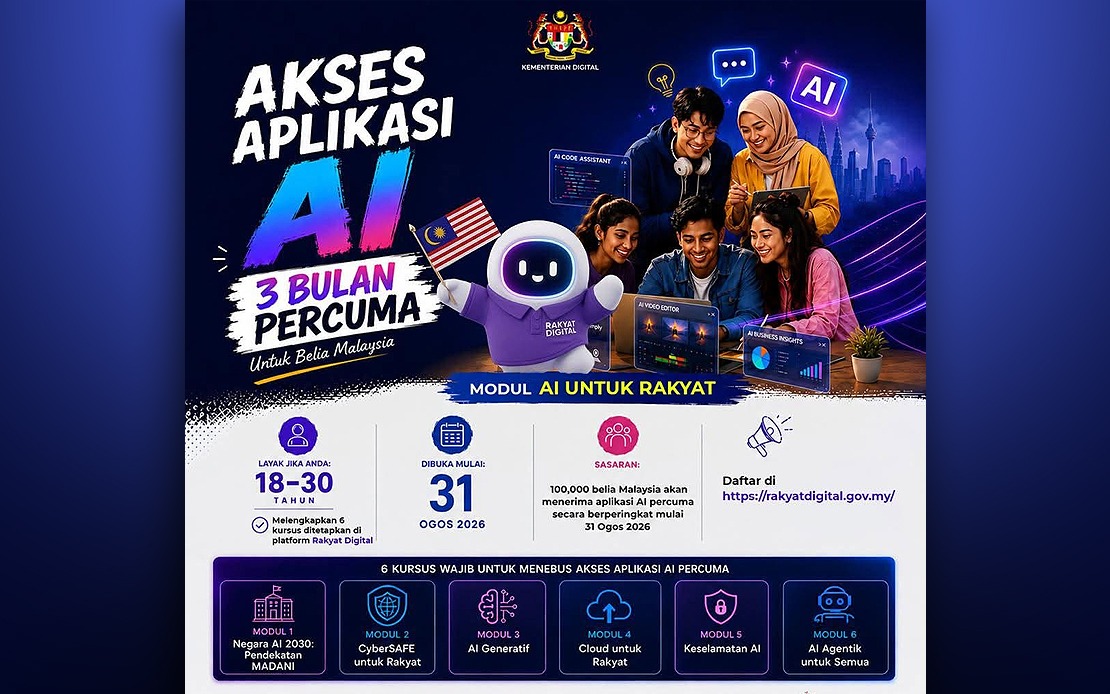
Malaysia's Digital Ministry has launched an ambitious national initiative to democratise access to artificial intelligence technology among young Malaysians, announcing that participants completing a structured training curriculum will gain complimentary three-month access to cutting-edge AI applications and software. The AI for the People (AI Untuk Rakyat) programme, unveiled by Prime Minister Datuk Seri Anwar Ibrahim on August 30 in Putrajaya as part of broader youth-focused digital initiatives, aims to reach 100,000 Malaysians between the ages of 18 and 30 over the coming five years, with full rollout scheduled through 2027.
The initiative represents a significant policy shift toward inclusive technological development, reflecting the government's recognition that artificial intelligence competency will become essential for economic participation and social mobility in the digital age. Rather than leaving AI literacy to private markets or university institutions, the programme positions the state as an active facilitator, removing financial barriers that might otherwise exclude lower-income youths from accessing premium AI tools and training. This approach aligns with Malaysia's stated objective to build what officials describe as an "inclusive AI Nation by 2030," a framework that emphasises equitable distribution of technological benefits across society.
Prospective learners can register immediately through the Rakyat Digital portal at rakyatdigital.gov.my, with enrolment proceeding in phases. The curriculum comprises six mandatory modules designed to provide both conceptual understanding and practical competency: AI Nation 2030: The MADANI Approach, which contextualises artificial intelligence within Malaysia's development framework; CYBERSAFE for the People, focusing on digital security awareness; Generative AI, covering large language models and related technologies; AI Security, addressing safeguards and ethical considerations; Agentic AI for All, introducing autonomous AI systems; and Cloud for the People, exploring cloud computing infrastructure. Successful completion and passing of all six components triggers qualification for the free subscription benefit.
The complimentary access package is notably diverse, featuring tools from both established international technology giants and emerging Malaysian providers. Google's Gemini Enterprise offers large language model capabilities, while Alibaba's Wonderclip and MuleRun provide alternative generative platforms. YTL AI Labs' IlmuChat, a locally developed conversational AI application, signals the government's intention to support domestic tech entrepreneurship alongside international partnerships. The ministry indicated that additional AI software and tools from other technology companies will be progressively incorporated, suggesting the programme's scope will expand as partnerships develop and new technologies mature.
Digital Ministry Secretary-General Datuk Fabian Bigar characterised the initiative as fundamental to ensuring young Malaysians possess not merely theoretical knowledge of artificial intelligence but authentic hands-on capability with production-grade tools. This distinction matters considerably: access to commercial-quality software allows participants to develop practical problem-solving abilities and portfolio-building experience that academic instruction alone cannot provide. The emphasis on actual tool usage rather than pure knowledge transfer recognises that technology adoption requires familiarity with real workflows, interfaces, and practical constraints.
The programme's target demographic—Malaysians aged 18 to 30—encompasses secondary school leavers, university students, early-career professionals, and vocational trainees. This broad age range reflects recognition that artificial intelligence skills will prove valuable across education levels and career paths. For students still in transition between school and employment, early exposure to AI platforms could influence career choices toward technology-adjacent fields. For those already in the workforce, the training addresses urgent upskilling needs as AI automation reshapes labour markets across service, manufacturing, and creative sectors.
The three-month subscription period, while time-limited, provides sufficient duration for motivated learners to develop operational competency and determine whether deeper specialisation aligns with their interests and career aspirations. Beyond the initial three-month window, participants who achieve proficiency may find pathways into paid employment with technology companies or leverage skills for entrepreneurial ventures, potentially justifying the government's investment through improved labour market outcomes and economic participation rates among youth cohorts.
Context matters significantly for Malaysian and Southeast Asian readers evaluating this announcement. Throughout the region, anxieties about artificial intelligence job displacement compete with recognition that countries failing to develop indigenous AI expertise risk technological dependency on foreign vendors and reduced capacity for autonomous economic development. Malaysia's approach—investing public resources in broad-based population-level AI literacy—represents a middle path between hands-off market reliance and protectionist industrial policy. The initiative also signals government confidence in Rakyat Digital, the national digital learning infrastructure previously developed through MyDIGITAL Corporation, validating earlier investments in digital public goods.
The programme's implicit economic logic rests on increasing the supply of AI-capable workers available to both multinational technology companies and emerging Malaysian tech startups. By subsidising training and tool access, the government reduces hiring and training costs for employers while positioning Malaysia as a destination for technology investment and operations. This strategy echoes successful models in Singapore and South Korea, where public investment in technology workforce development has attracted significant foreign direct investment in tech sectors. Whether Malaysia can convert training into sustained employment will depend on parallel growth in technology sector job creation—a factor beyond the programme's direct control.
Implementation challenges will likely emerge as the programme scales. Ensuring consistent quality across thousands of concurrent trainees, maintaining motivation through six sequential modules, and providing technical support at scale all present operational complexities. The phased rollout approach, rather than launching at full capacity, provides opportunity for refinement based on early feedback. Success metrics remain undefined in the announcement, though natural benchmarks would include completion rates, participant satisfaction, and ultimately employment outcomes for graduates.
The AI for the People programme also carries symbolic significance within Malaysia's ongoing debate about digital governance and technological sovereignty. By treating AI training as a public good comparable to primary education, the government implicitly reframes artificial intelligence not as a luxury technology for elites but as essential infrastructure for inclusive development. This framing contrasts with earlier technology adoption narratives emphasising innovation and competitiveness, instead emphasising equity and breadth. For Malaysian readers observing government technology initiatives, the announcement suggests shifting priorities toward democratisation over selectivity.

