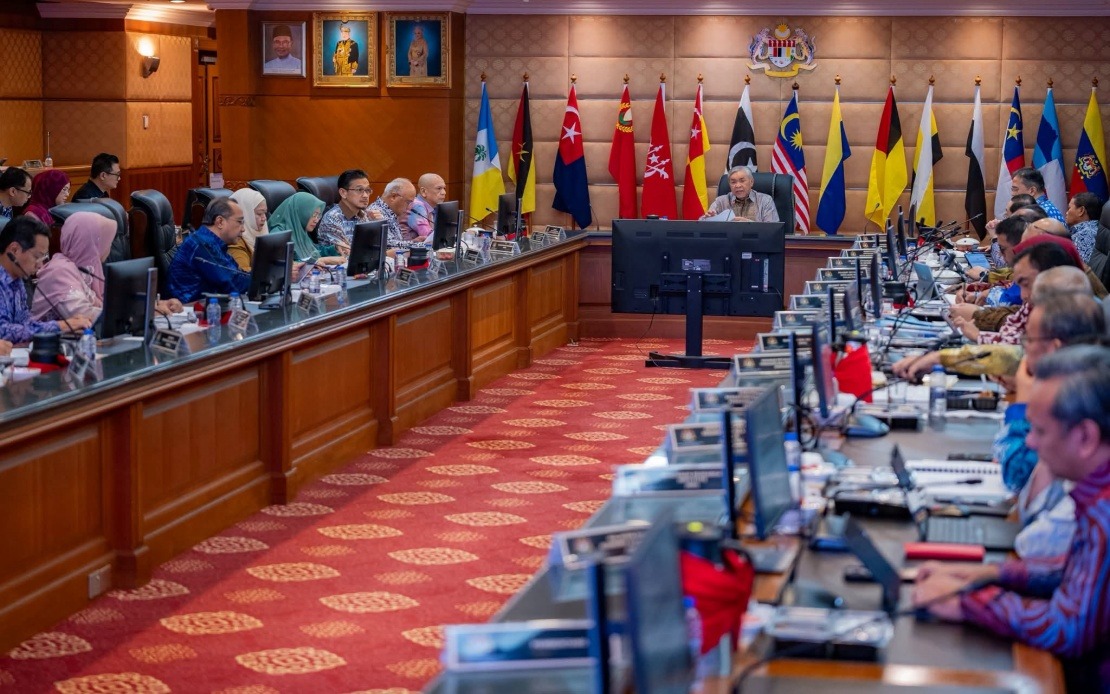
The National Cost of Living Action Council held its 18th executive committee meeting in Putrajaya this week to address mounting pressure on household budgets, with Deputy Prime Minister Datuk Seri Dr Ahmad Zahid Hamidi signalling a more comprehensive approach than previous efforts. Rather than focusing solely on retail prices, the council's deliberations reflected recognition that tackling affordability requires simultaneous intervention across production efficiency, supply chain resilience, nutritional access, medical expenses, and educational opportunity—a shift that carries significant implications for how Malaysia manages its welfare system.
The centrepiece of discussion was a revised roadmap for local white rice, a staple that carries outsized political and social weight in Malaysia's cost-of-living debate. The proposed strategy incorporates what officials describe as a soft-landing transition framework, which envisions a gradual move away from blanket subsidies through a period of targeted support aimed at shielding low-income families during the adjustment phase. This reflects policymakers' awareness that abrupt subsidy removal, while economically rational, can trigger social friction and hardship among vulnerable populations who lack alternative coping mechanisms.
Ahmad Zahid's emphasis on balancing consumer welfare against farmer viability underscores a longstanding tension in Malaysian agricultural policy. Local rice producers operate under structural disadvantages compared to regional competitors—higher labour costs, land constraints, and weather unpredictability—meaning subsidy cuts or price decontrol without accompanying support mechanisms risk accelerating rural-to-urban migration and agricultural abandonment. The council's recognition of this dynamic suggests policymakers are attempting to craft a rice transition that avoids the pitfall of undermining domestic food security while gradually improving fiscal sustainability.
A noteworthy expansion emerging from the council's review is the proposal to broaden the Sumbangan Asas Rahmah (SARA) assistance scheme beyond its current cash-transfer model to include direct provision of fresh produce such as fruits, vegetables, and protein sources. This represents a conceptual shift from purely income-supplementation toward nutritional intervention, acknowledging that low-income households often face a paradox where affordability constraints push them toward cheaper, calorie-dense but nutritionally poor foods. By incorporating fresh items into the aid basket, the government aims to interrupt patterns of diet-related lifestyle disease that ultimately impose downstream healthcare costs on both households and the public system.
The council's attention to external economic pressures reflects growing acknowledgement of Malaysia's vulnerability to global shocks beyond domestic control. Geopolitical tensions, particularly instability in West Asia, have reshaped energy prices and supply-chain routing, while regulatory compliance burdens associated with food imports add hidden costs that trickle through to consumers. Agricultural producers face a squeeze from multiple directions: input costs driven by global commodity prices, logistics expenses inflated by geopolitical disruption, and the paradoxical impact of subsidy rationalisation, which simultaneously lowers government transfer costs but raises production burdens on farmers attempting to compete. This interplay underscores why Malaysian policymakers cannot treat cost-of-living pressures as purely domestic policy questions.
Healthcare affordability emerged as a secondary but significant policy focus, with the council reviewing rollout of eleven initiatives under a RESET strategy framework designed to constrain private sector medical inflation while expanding public access and treatment modalities. This reflects an implicit recognition that healthcare represents a growing drag on household budgets, particularly for chronic disease management. Malaysia's ageing demographic profile means this pressure will intensify, as older populations require more frequent medical intervention and face higher catastrophic-illness risk. By attempting to preempt private-sector cost escalation, the council is signalling intent to preserve healthcare affordability before pricing dynamics further compress household discretionary spending.
Education support mechanisms also received detailed scrutiny, with council analysis revealing that 62,937 Form Six and university students accessed assistance totalling RM589.6 million across 13 separate tertiary education aid schemes during the previous year. While this funding volume appears substantial, the distribution across multiple overlapping programmes raises questions about administrative efficiency and coverage adequacy. Ahmad Zahid's framing of education support as essential to talent development regardless of socioeconomic background reflects understanding that cost barriers to higher education ultimately constrain labour market competitiveness and social mobility, with long-term implications for productivity growth and inequality trajectories.
The council's invocation of the Cost of Living Action Plan 2030 signals intent to move beyond episodic policy responses toward a more integrated, cross-sectoral framework spanning food, healthcare, and education. This represents a substantial departure from earlier Malaysian approaches, which tended to isolate interventions by sector or demographic group. An integrated framework theoretically allows policymakers to identify complementarities and trade-offs more systematically—for instance, how improved nutritional access might reduce preventable healthcare costs, or how education support correlates with labour market earnings potential. However, such coordination requires sustained bureaucratic effort and political consensus, both of which remain challenging in Malaysia's fragmented policy environment.
For Malaysian households already absorbing multiple cost pressures, the council's deliberations offer modest indication that the government recognises the depth of affordability stress. The shift toward more targeted, transitional approaches rather than indiscriminate subsidy expansion suggests growing fiscal realism about the sustainability of universal programmes. However, the council's emphasis on proposals requiring further consideration at Prime Minister Anwar Ibrahim's main NACCOL meeting indicates these initiatives remain in exploratory phase rather than confirmed policy. The pace of implementation and the adequacy of allocated resources will ultimately determine whether these frameworks deliver tangible relief or represent largely symbolic gestures.
Regional perspectives warrant note: Malaysia's approach to rice policy, agricultural support, and food security carries implications for ASEAN food system resilience. As a regional importer competing for available supplies, Malaysia's rice production decisions influence regional market dynamics and food price stability across Southeast Asia. Similarly, the council's experience attempting to balance affordability, sustainability, and farmer welfare offers potential lessons for neighbouring countries facing analogous pressures. The apparent willingness to move beyond price controls toward supply-side and demand-side interventions may signal a broader regional shift toward more sophisticated policy toolkit application.

