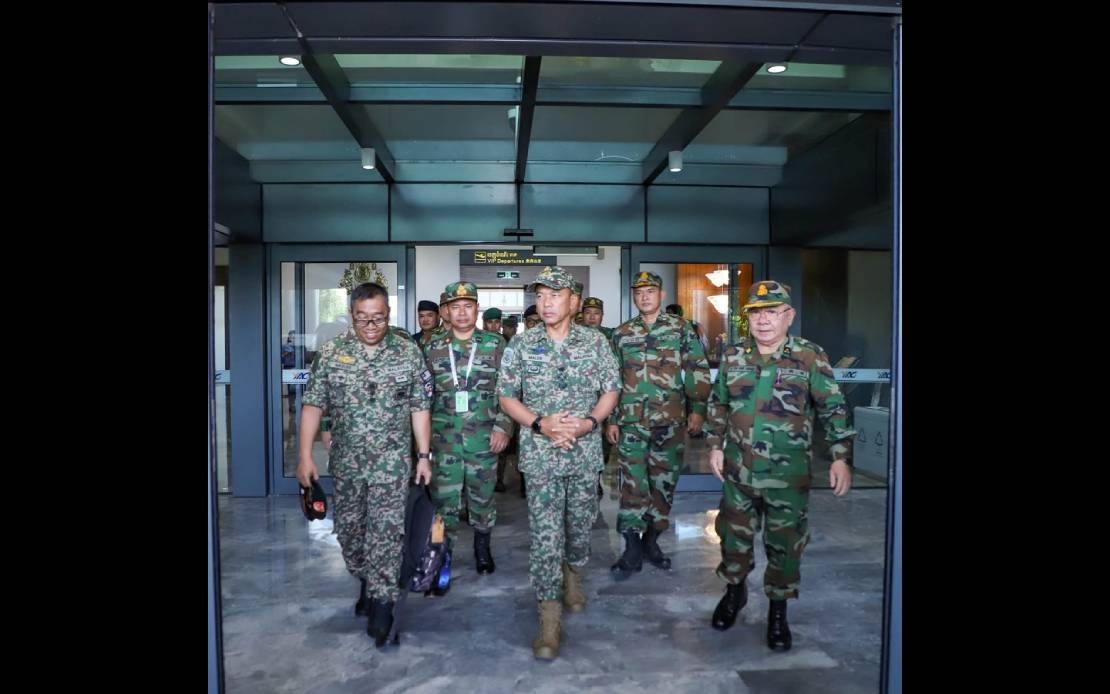
Malaysia's top military commander has travelled to Cambodia's northwestern frontier to conduct an on-site evaluation of border security conditions, signalling Kuala Lumpur's active involvement in regional stability efforts. General Tan Sri Malek Razak Sulaiman arrived in Banteay Meanchey province on Wednesday at the invitation of Cambodia's military leadership, undertaking a four-day official visit through July 11 that positions Malaysia as a concerned stakeholder in one of Southeast Asia's most sensitive geopolitical zones.
The visit centred on consultations with the ASEAN Observer Team, a multinational monitoring force deployed to the Cambodia-Thailand border region to oversee implementation of a ceasefire agreement. The AOT briefed Malaysia's Chief of Defence Force on the current security environment in the province, providing detailed assessments of ground conditions and the effectiveness of regional peacekeeping mechanisms. This direct engagement reflects Malaysia's strategic interest in ensuring that border disputes between ASEAN members do not escalate into broader regional conflict.
The Cambodia-Thailand border has represented one of Southeast Asia's most volatile flashpoints in recent years. The ceasefire agreement that the AOT now oversees followed a significant military confrontation that erupted on July 24, 2025, stemming from long-standing territorial disputes between the neighbouring nations. The establishment of the observer team was a critical diplomatic response aimed at preventing renewed violence and creating a framework for monitoring compliance with peace commitments. Malaysia's high-level military delegation demonstrates the seriousness with which ASEAN's larger members view their collective responsibility for preventing conflict escalation.
The Philippines currently leads the AOT in its capacity as ASEAN chair, positioning the bloc's regional authority at the forefront of border dispute resolution. This structure underscores how ASEAN mechanisms, despite the organisation's traditional emphasis on consensus and non-interference, have evolved to address transnational security challenges that threaten multiple member states. Malaysia's participation in these oversight structures, through its Defence Chief's personal engagement, shows how Kuala Lumpur is leveraging its military and diplomatic influence to shape regional outcomes.
Malek Razak's tour of the border area serves multiple purposes beyond mere fact-finding. It signals to Cambodia and Thailand that ASEAN's major powers are actively monitoring the situation and maintaining pressure on both sides to uphold ceasefire terms. Such high-level visits also serve as diplomatic reassurance to smaller nations that regional powers take their security concerns seriously. For Malaysia specifically, maintaining stability along Cambodia's borders is strategically significant, as any spillover violence could eventually affect the broader region's security architecture.
The timing of the visit underscores Malaysia's commitment to ASEAN solidarity and regional security cooperation. By positioning himself at the front line of border monitoring, Malek Razak demonstrates Malaysia's willingness to invest political and military capital in conflict prevention. This contrasts with more isolationist approaches that some countries might adopt, instead framing Malaysia as an active guardian of regional peace rather than a passive observer of others' conflicts.
The broader context reveals how ASEAN has adapted its institutional responses to modern security challenges. The observer team model, while modest in scope compared to international peacekeeping operations elsewhere, represents a significant step for an organisation built on non-intervention principles. That Malaysia's military leadership engages directly with this mechanism shows how pressing regional members view the need for collective action, even when such action requires scrutinising another member's domestic security affairs.
From Malaysia's perspective, Cambodia represents both an important neighbour and a nation where strategic interests converge. Cambodia's stability affects trade routes, refugee flows, and the broader geopolitical balance in mainland Southeast Asia. The presence of Malaysian military observers or coordinators in border monitoring operations would naturally interest Kuala Lumpur's defence establishment, making Malek Razak's visit a practical step in understanding how Malaysia can better contribute to regional security architecture.
The visit also carries symbolic weight for how Malaysia positions itself within ASEAN's power structure. While not a claimant to the Cambodia-Thailand border dispute, Malaysia's engagement signals that major ASEAN economies view transnational stability as a collective concern rather than bilateral issue. This approach reflects lessons learned from past regional conflicts where early multilateral engagement might have prevented escalation, making Malaysia's proactive stance a prudent investment in preventing future crises.
Looking forward, Malek Razak's assessment will likely inform Malaysia's positions in ASEAN defence meetings and bilateral discussions with both Cambodia and Thailand. The insights gathered during the border visit could shape recommendations regarding military deployments, observer team configurations, or diplomatic initiatives aimed at achieving permanent border demarcation. Malaysia's demonstrated commitment to understanding ground realities enhances its credibility when advocating for particular approaches to conflict resolution within ASEAN forums.

