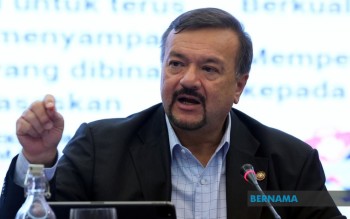
Malaysia's economy continues to expand despite a challenging global environment marked by trade tensions and regional instability, with Finance Minister II Datuk Seri Amir Hamzah Azizan projecting cumulative growth of 5.6 per cent for this year. Speaking at the GEAR-uP Progress Report press conference in Putrajaya, the minister outlined an impressive trajectory: steady expansion at 5.2 per cent across both 2024 and 2025, followed by accelerating momentum in the first half of this year, with first-quarter GDP climbing to 5.4 per cent and second-quarter advance estimates reaching 5.8 per cent.
These figures underscore Malaysia's growing economic clout within the Southeast Asian region, particularly as the nation navigates macroeconomic headwinds that have rattled peer economies. The consistency of Malaysia's performance is noteworthy given the external pressures—including renewed trade friction and ongoing tensions in West Asia—that typically weigh on export-dependent nations. The minister's emphasis on resilience carries practical significance for Malaysian investors and policymakers alike, signalling that structural improvements to the economy are taking root beyond mere cyclical recovery.
The finance minister attributed this sustained expansion to the effective implementation of the MADANI Economy Framework, a comprehensive policy architecture designed to reorient the economy toward inclusive, high-value growth. The framework has shifted beyond theoretical positioning into tangible implementation across multiple government ministries and economic sectors. Amir Hamzah framed the recent performance as validation that policy reforms initiated over the past two years are beginning to translate into measurable economic benefits for households and businesses, a critical threshold that separates aspiration from achievement in development policymaking.
Central to this growth narrative is the GEAR-uP programme, a government-led initiative launched under the Ministry of Finance's stewardship since 2024. The programme represents an ambitious domestic investment mobilisation effort, channelling RM120 billion across the 2024-2028 period to catalyse private sector expansion and industrial development. This domestic-focused approach differs markedly from traditional foreign direct investment strategies, reflecting a deliberate shift toward leveraging Malaysia's own capital and institutional capacity to drive economic transformation. The financing scale alone signals serious commitment from the government to reshape the economy's growth drivers.
Government-linked investment companies and government-linked companies emerge as critical accelerants within this strategy. These institutional players function as more than passive capital allocators; they serve as bridges connecting domestic industries with essential resources—talent acquisition, technical expertise, and market access. The minister underscored this facilitating role, noting that GLICs and GLCs help local industries attract both human capital and foreign investors seeking partnership opportunities within Malaysia. This intermediary function becomes particularly valuable in sectors requiring sophisticated technical capacity or where information asymmetries might otherwise deter private investment.
Amir Hamzah's comments reveal a nuanced economic philosophy that extends beyond simply attracting foreign capital into Malaysia. The minister acknowledged the distinction between fund mobilisation and fund utilisation, emphasising that inflows alone produce limited developmental impact without corresponding institutional capacity and sectoral competitiveness. This reflects hard-won experience from previous development cycles where capital infusions failed to generate sustained productivity improvements or meaningful technology transfer. The emphasis on accompanying investment with know-how transfer and talent development signals a maturation of Malaysia's development thinking, moving beyond volume metrics toward quality and sustainability measures.
The geopolitical context amplifies the significance of Malaysia's economic performance. With trade wars reshaping global supply chains and West Asian tensions creating commodity price volatility, many developing economies face pronounced headwinds. Malaysia's ability to maintain growth above 5.4 per cent under these conditions—and to project further acceleration—positions the nation as a relative bright spot within the regional economic landscape. For Southeast Asian observers, Malaysia's trajectory offers insights into how institutional reforms and coordinated domestic investment can insulate economies from external shocks.
The MADANI Economy Framework itself represents a shift in development strategy from Malaysia's previous growth models. Rather than relying primarily on foreign direct investment or commodity exploitation, the framework emphasises inclusive growth, local value creation, and social equity alongside economic expansion. This holistic approach means economic gains are theoretically more broadly distributed and less vulnerable to the vulnerability cycles that plague single-sector or export-dependent economies. The 5.6 per cent growth figure thus carries implications beyond headline GDP arithmetic—it suggests the framework is producing results across multiple dimensions.
Looking forward, the minister expressed confidence that Malaysia remains positioned to achieve long-term development ambitions, conditional on sustained cooperation across government agencies, the private sector, and civil society in advancing the MADANI agenda. This conditional framing acknowledges that economic management requires continual course correction and stakeholder alignment. For Malaysian investors and regional observers, the consistent growth trajectory and institutional commitment to reform signal that the economic foundation remains sound, even as global uncertainties persist. The trajectory suggests the economy has moved beyond vulnerability to export shocks toward a more diversified growth model capable of weathering international volatility while supporting the country's transition toward developed economy status.

