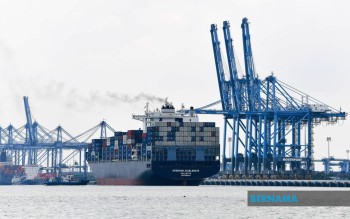
Malaysia's export sector is poised for robust acceleration in 2026, with leading financial institutions revising their growth forecasts sharply upward based on exceptional performance so far this year. RHB Investment Bank Bhd has elevated its outlook for annual export expansion to 21.7 per cent, a significant leap from its earlier projection of 15.3 per cent, reflecting the stronger-than-anticipated trajectory of shipments through the first half of 2026. The upgrade follows year-to-date export growth of 27.5 per cent, suggesting momentum that outpaces earlier expectations and provides a solid foundation for sustained momentum through the remainder of the year.
The revision by RHB IB underscores a fundamental shift in Malaysia's trade dynamics, moving beyond previous baseline assumptions about global demand and pricing conditions. This upward adjustment carries particular weight because investment banks typically calibrate their models conservatively; when such institutions materially revise forecasts upward, it typically signals confidence grounded in observed market movements rather than speculative optimism. The timing of this forecast upgrade—rooted in tangible half-year performance data—suggests that Malaysia's exporters have successfully navigated what many anticipated would be a more challenging external environment in 2026.
The electrical and electronics sector stands at the epicentre of this export resurgence, benefiting from concurrent global tailwinds in semiconductor demand and accelerating adoption of artificial intelligence-driven technologies. The ongoing AI investment cycle has created sustained appetite for semiconductors, advanced computing components, and related manufacturing services across consumer electronics, cloud infrastructure, and enterprise applications. Malaysia's deep integration into this supply chain—leveraging its established manufacturing base, skilled workforce, and proximity to regional tech hubs—positions the nation to capture disproportionate gains from this technological upcycle. As global technology companies expand capacity for AI-enabled products and services, Malaysian manufacturers find themselves well-positioned to supply critical intermediate goods and finished components.
The trade balance has improved dramatically, reflecting not merely export growth but a favourable recalibration of export-to-import dynamics. Malaysia recorded a trade surplus of RM83.9 billion in the second quarter of 2026, a striking improvement compared to RM15.3 billion in the same quarter of 2025. This expansion of the trade surplus will provide meaningful support to second-quarter GDP calculations, as the trade balance component represents a significant driver of economic growth measurement. The magnitude of this improvement—more than fivefold—underscores the extent to which export momentum has outpaced import growth, a development that bolsters the country's overall macroeconomic position and external account strength.
RHB IB attributes Malaysia's resilience and export capacity to several structural factors that extend beyond cyclical demand variations. The nation's diversified economic base—spanning electronics, petroleum and gas, palm products, chemicals, and services—provides insulation against sector-specific shocks that might devastate economies more heavily dependent on single export categories. Malaysia's intricate embedding within regional and global supply chains creates multiple revenue pathways; when one market faces headwinds, alternative channels often absorb displaced demand. Concurrently, deliberate efforts to expand geographic markets and broaden product offerings have reduced concentration risk and built flexibility into Malaysia's export portfolio.
However, the outlook carries meaningful downside scenarios warranting careful monitoring by policymakers and businesses alike. Protracted geopolitical tensions—particularly involving major trading partners or critical shipping routes—could disrupt supply chains and elevate operational costs across manufacturing sectors. Persistently elevated crude oil prices would increase production, transportation, and logistics expenses for export-oriented manufacturers, effectively squeezing profit margins even as shipment volumes expand. Such cost pressures could dampen international purchasing power, ultimately reducing global demand for Malaysia's exports precisely when producers face higher input costs, creating a particularly pernicious squeeze on competitiveness.
The semiconductor and electronics export outlook remains constructively supported by visible structural demand drivers extending well beyond near-term cyclical factors. Global demand for semiconductors continues to expand across established consumer segments—smartphones, personal computers, automotive electronics—while emerging applications in electric vehicles, autonomous systems, industrial automation, and artificial intelligence infrastructure represent incremental demand sources. Cloud computing and data centre infrastructure buildout requires vast quantities of advanced processing components and related hardware. This multi-decade technology transition provides a fundamental demand floor beneath Malaysia's E&E export sector, suggesting export growth could prove more resilient than historical patterns might suggest.
MBSB Investment Bank Bhd offers a complementary perspective, projecting export growth of 18.9 per cent for 2026 compared to 6.6 per cent in 2025, a forecast that aligns directionally with RHB IB's upgraded outlook while suggesting somewhat more conservative growth assumptions. MBSB attributes this expansion to strong demand for technology products—echoing RHB IB's electronics thesis—while additionally emphasizing commodity-related products including petroleum derivatives and liquefied natural gas. As global energy demand pressures prices and production capacity constraints in key exporting regions create supply discipline, Malaysia's hydrocarbon export revenues could benefit from both volume and price dynamics. Simultaneously, MBSB has upgraded its import growth forecast to 13 per cent for 2026, reflecting accelerating domestic economic activity and business investment.
June 2026 trade statistics provide confirmation of the broad momentum underpinning these upgraded forecasts. Malaysia's total trade volume surged 44.7 per cent year-on-year to RM340.9 billion, driven by roughly symmetrical growth in both exports and imports. Exports expanded 45.4 per cent to RM177.9 billion while imports grew 43.9 per cent to RM163.0 billion, demonstrating both international demand strength and domestic consumption vitality. The trade surplus expanded dramatically, reaching RM14.9 billion in June and reflecting a 64.9 per cent year-on-year increase. This monthly snapshot corroborates the half-year trends underlying the investment banks' upgraded annual forecasts, suggesting that sustained momentum rather than temporary spikes explains the stronger projections.
Downside risks require acknowledgment despite the positive outlook. Export sectors remain vulnerable to supply-chain disruptions stemming from geopolitical events, port congestion, or transportation bottlenecks. Elevated input costs—whether energy, raw materials, or labour—could compress margins even as volumes expand. Weaker-than-expected global demand, particularly from developed economies facing growth challenges, would quickly dampen international purchasing power for Malaysian exports. Trade policy risks, especially tighter commercial restrictions potentially implemented by major trading partners including the United States, could disrupt established trade flows and require costly supply-chain reconfiguration.
The Malaysian export narrative for 2026 reflects a confluence of cyclical and structural factors favouring outbound shipments, yet prosperity cannot be assumed inevitable. While the electronics sector and commodity markets offer genuine demand tailwinds, and Malaysia's supply-chain integration provides competitive advantages, the external environment remains inherently uncertain. Policymakers and exporters should capitalize on current momentum by strengthening competitive positioning, diversifying market exposure further, and building resilience into supply chains to withstand potential disruptions. The upgraded forecasts represent opportunity, but translating opportunity into sustained prosperity requires active management of both domestic competitiveness and external risks.

