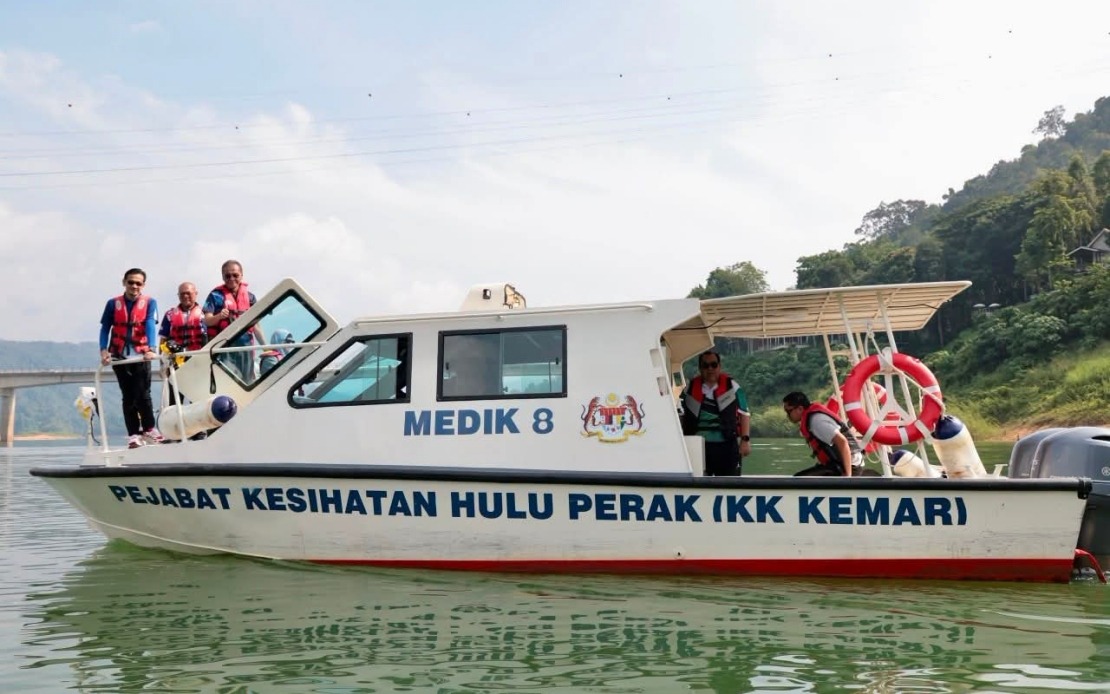
The Ministry of Health has taken a significant step toward bridging healthcare disparities in peninsular Malaysia's interior by expanding its river-based medical transport fleet in Hulu Perak. The launch of Medic Boat 8, a RM350,000 multipurpose vessel capable of carrying 12 passengers, marks a deliberate commitment to serving the Orang Asli population of the Kemar Resettlement Scheme in Gerik, where geographic isolation has historically constrained rapid access to emergency medical care. Health Minister Datuk Seri Dr Dzulkefly Ahmad unveiled the new service at the Belum Rainforest Resort jetty, underscoring the administration's determination to ensure that communities inhabiting Malaysia's most challenging terrain do not fall behind in healthcare provision.
The addition of Medic Boat 8 expands the MOH's existing fleet to seven boats dedicated to servicing waterborne populations across the country. For the 4,500-plus Orang Asli residents scattered across the Kemar scheme, river transport represents far more than convenience—it constitutes the only reliable pathway connecting their settlements to medical facilities. Dense jungle, steep terrain, and the monsoon-dependent seasonal conditions mean that conventional road networks either do not exist or become impassable during certain periods. The boat service thus represents a lifeline, transforming what might otherwise be a journey of days into a journey of hours, potentially making the difference between survival and tragedy in acute medical emergencies.
Dr Dzulkefly acknowledged that infrastructure alone cannot deliver healthcare. His remarks emphasised that even the most advanced government equipment remains hollow without personnel willing to operate it under arduous conditions. The health professionals assigned to these routes—doctors, nurses, paramedics, and boat operators—regularly navigate unpredictable river currents, exposure to tropical weather systems, and extended periods away from established medical infrastructure. Their willingness to work in such circumstances reflects a professional commitment that deserves recognition, yet often goes unnoticed in mainstream policy discussions centred on urban health outcomes.
The initiative sits within the broader Malaysia MADANI framework, which positions equitable healthcare access as a foundational principle rather than a luxury. Under this banner, the government has signalled that geographical remoteness should not determine the quality or timeliness of medical intervention available to citizens. This philosophical stance differs markedly from earlier eras when Orang Asli communities were treated as peripheral populations whose health needs could be addressed through occasional visiting clinics or informal arrangements. The deployment of dedicated aquatic medical transport reflects a paradigm shift toward proactive, permanent solutions designed specifically for indigenous populations whose settlement patterns and livelihoods remain intrinsically tied to riverine ecosystems.
For Southeast Asian readers, the Malaysian initiative offers instructive lessons about healthcare governance in regions where significant portions of the population inhabit areas beyond conventional infrastructure. The Kemar scheme and similar Orang Asli settlements in Perak, Pahang, Terengganu, and Kelantan face comparable challenges, yet funding and political will to address them unevenly distribute across jurisdictions. Malaysia's central government commitment to expanding boat-based medical services suggests recognition that indigenous and remote populations represent a distinct demographic with needs that standardised urban health systems cannot adequately serve.
The economic dimension merits consideration as well. While RM350,000 represents a substantial investment for a single boat, the cost-benefit calculus extends far beyond acquisition expense. Emergency medical evacuation by helicopter—the alternative for truly critical cases—costs considerably more per incident and remains unavailable in many areas. By positioning boats as the primary response mechanism, the MOH reduces overall expenditure while simultaneously improving accessibility and reducing response times for non-critical but medically significant conditions. This efficiency gain becomes particularly valuable when applied across the entire fleet and projected across multiple years of operation.
The Orang Asli population has historically experienced lower health outcomes across multiple indicators compared to national averages, reflecting cumulative disadvantages in access, health literacy, economic status, and social marginalisation. Maternal mortality, childhood malnutrition, infectious disease prevalence, and delayed diagnosis of chronic conditions all register higher among indigenous communities. The boat services programme addresses one structural barrier—transport—but success ultimately depends on complementary investments in health promotion, disease prevention, and workforce development within these communities. The mere existence of transport infrastructure creates necessary but insufficient conditions for genuine health equity.
Weather patterns and seasonal variations add complexity to river-based medical service delivery. During the monsoon season, particularly from September through November, river levels rise dramatically and currents intensify, making boat operations hazardous. The MOH's expanding fleet must therefore function as a network with overlapping capacity, allowing service continuity despite weather disruptions. This requirement underscores why a single boat per region proves inadequate—redundancy in transport assets protects communities against service interruptions precisely when access barriers are highest and health risks are greatest.
The healthcare workers' role in this equation transcends their formal job descriptions. Beyond clinical competence, they serve as bridges between government institutions and communities that have experienced limited institutional trust. Their presence in boats navigating rivers to reach far-flung settlements demonstrates institutional commitment in tangible, visible form. Over time, this presence can shift community perceptions of government responsiveness and build confidence in formal healthcare systems that have historically felt distant and inaccessible.
Moving forward, the sustainability of boat-based medical services depends on adequate budget allocation, maintenance protocols, staff retention, and community engagement strategies. Political commitment to indigenous health equity requires sustained political will across election cycles and governmental transitions. The Kemar scheme's experience with Medic Boat 8 will generate operational data—response times, utilisation patterns, cost-effectiveness metrics—that can inform expansion decisions elsewhere. Other Southeast Asian nations facing analogous indigenous health access challenges may find Malaysia's boat programme instructive as they consider policy options for underserved populations.
The launch of Medic Boat 8 ultimately represents a declaration that geography need not determine health outcomes. For the Orang Asli residents of Hulu Perak's remote communities, the new vessel offers something intangible but precious: confirmation that their health matters enough to warrant dedicated investment and continued government attention. This message, conveyed through concrete infrastructure and sustained service provision, may prove as therapeutically valuable as the medical interventions the boat carries.

