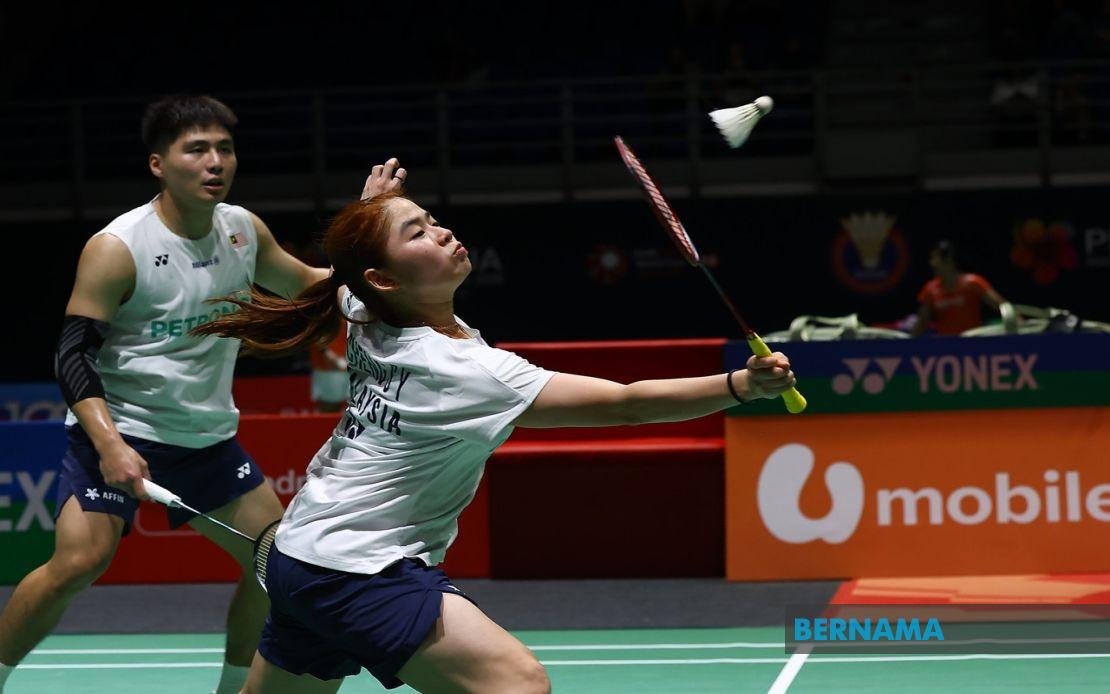
Malaysia's hopes at the 2026 Japan Open ended on July 18 in Tokyo when the nation's final two badminton pairs fell at the semi-final stage, bringing an effective close to what had been a reasonably successful tournament showing by the Malaysian delegation. The mixed doubles combination of Jimmy Wong and Cheng Su Yin bowed out to Hong Kong's experienced Tang Chun Man and Tse Ying Suet, while the men's doubles team of Goh Sze Fei and Nur Izzuddin Rumsani found themselves unable to overcome South Korea's Kim Won Ho and Seo Seung Jae, the world's top-ranked pair in their category.
The mixed doubles encounter proved particularly competitive, with the Malaysian unseeded pair mounting an impressive performance that showcased their capability to contest matches against the sport's elite operators. Their battle against the Hong Kong duo stretched 69 minutes, reflecting the intensity of top-level badminton competition where every rally demands precision and tactical acumen. The scoreline of 17-21, 21-18, 21-15 ultimately favoured the more experienced Hong Kong pairing, but the Malaysian team's trajectory through the tournament demonstrated they possess the technical skills and mental fortitude required to compete effectively against pairs ranked among the world's finest. For Malaysian badminton enthusiasts and observers, the performance vindicated the pair's inclusion in the squad and provided evidence of developing depth in mixed doubles, a category where Malaysia has traditionally held strong ground.
What made the mixed doubles loss particularly noteworthy was the unconventional path the Malaysian pair had carved through the earlier rounds. Competing without the elevated seeding typically afforded to top-ranked combinations, Wong and Cheng's progression represented the kind of upset-generating performance that captures the imagination of badminton followers throughout Asia. Their ability to navigate past seeded opponents and reach the semi-final stage suggested they have the tools to develop into consistent challengers at international tournaments, provided they continue to refine their game and gain experience against the elite tier of mixed doubles competitors.
Meanwhile, the men's doubles pairing of Goh and Nur Izzuddin faced the unenviable task of confronting South Korea's Kim Won Ho and Seo Seung Jae, a duo that occupies the pinnacle of world rankings in the men's doubles discipline. The match revealed a familiar pattern in badminton competition—tactical vulnerability early in matches can prove difficult to overcome, even when a team demonstrates strong resilience in recovery. The Malaysian pair stumbled significantly in the opening game, dropping 21-12, but their response in the second game was commendable. They recalibrated their approach, tightened their court positioning, and executed more disciplined shot selection to claim the second set 21-11 and force a decisive third game. However, the South Koreans' experience and consistency proved too substantial to overcome, with Kim and Seo securing the decider 21-13.
The historical record between these teams provides context for understanding the difficulty of Malaysia's challenge. Having fallen to the South Korean combination three times across five previous encounters, the Malaysian pair faced not only a world number one ranked duo but also an opponent with whom they carried a losing record. Such statistical disadvantages frequently weigh on team morale and strategic confidence, though Goh and Nur Izzuddin fought throughout the 58-minute contest without surrendering mentally. Their comeback in the second set demonstrated they refused to accept defeat passively, a characteristic that Malaysian sports observers often associate with resilient international performers.
From a regional perspective, these results underscore the competitive intensity within Asian badminton. South Korea's continued dominance in men's doubles reflects the country's sustained investment in player development systems and coaching infrastructure. Hong Kong's continuing competence in mixed doubles similarly indicates that the sport remains deeply embedded in the competitive landscape of East Asian nations. For Malaysia, a country with a storied badminton heritage that includes numerous world champions and Olympic medalists, these semi-final exits suggest that while the nation retains capable players, the competitive field continues to narrow in terms of accessibility to major tournament medals.
The 2026 Japan Open served as an important barometer of Malaysia's current standing in international badminton. The tournament gathered many of the world's highest-ranked players and demonstrated clearly where Malaysian pairings currently position themselves relative to Asia's strongest badminton nations. The performances of both pairs provided valuable data for the national coaching staff regarding technical development areas and strategic preparation requirements for future competitions.
For Malaysian badminton stakeholders, including the Badminton Association of Malaysia and tournament sponsors, these results carry implications for planning and resource allocation moving forward. The gap separating Malaysian players from the very highest tier of international competition remains measurable but not insurmountable. The resilience shown by both pairs in reaching the semi-finals, despite the unseeded status of the mixed doubles combination, indicates that Malaysia retains the fundamental capabilities required for sustained international competitiveness. What remains required is consistent performance over extended periods and demonstration that Malaysian pairings can replicate their strongest form with regularity on the international circuit.

