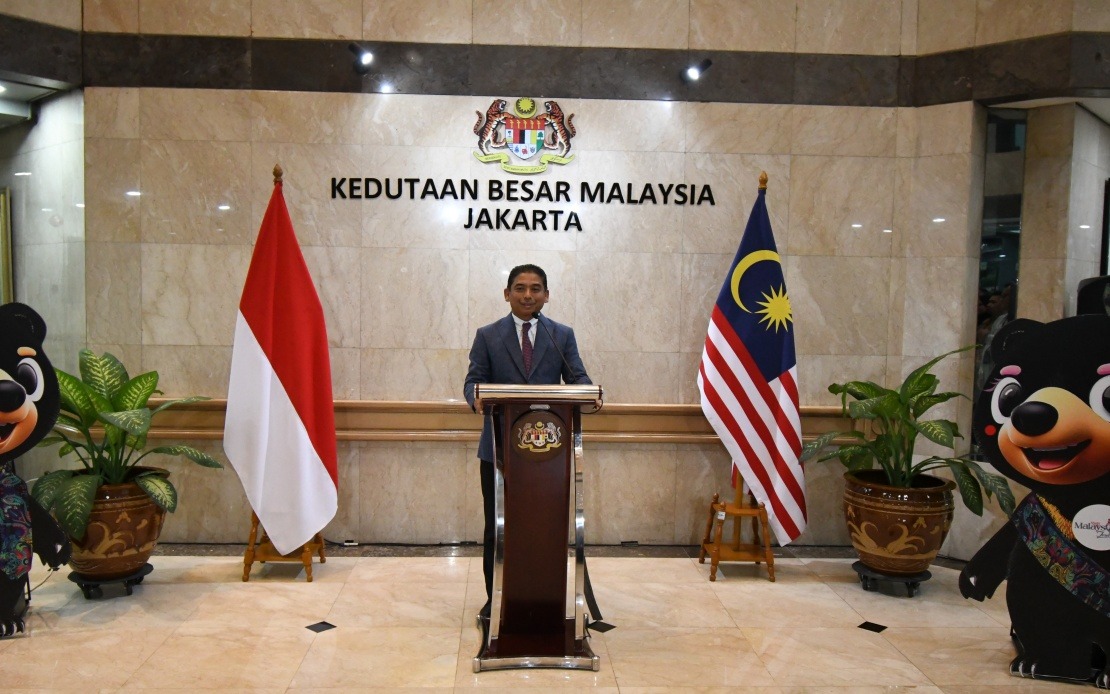
Datuk Muzafar Shah Mustafa has commenced his duties as Malaysia's Ambassador to Indonesia, arriving in Jakarta on August 10 following a distinguished career across three continents. The seasoned diplomat, who spent nearly three years representing Malaysian interests in India, formally reported for duty at the embassy and begins a new chapter in one of Southeast Asia's most strategically important bilateral relationships. His arrival marks a transition that underscores the continuous renewal of Malaysia's diplomatic corps across key posting locations.
Muzafar's appointment to the Indonesian posting came in July, when he received his letter of credence from Yang di-Pertuan Agong Sultan Ibrahim at Istana Negara on July 14. The formal investiture of credentials represents the constitutional culmination of a process that had been developing through diplomatic channels, establishing his official standing to represent Malaysian interests before the Indonesian government. His posting to Jakarta follows directly upon the conclusion of his mission in New Delhi, where he departed on July 9 after completing a demanding multi-year assignment managing bilateral relations with India.
The career diplomat's journey to Jakarta reflects a progression through increasingly complex and significant posting assignments. Having joined the Foreign Ministry in 1995, Muzafar has accumulated nearly three decades of experience navigating diverse political, cultural and economic contexts. His earlier assignment as Malaysia's Ambassador to Mexico from 2018 to 2023 provided him with responsibility not only for bilateral relations with Mexico itself but also for representing Malaysian interests in Belize, Costa Rica, El Salvador, Guatemala and Honduras—a portfolio that required managing multiple relationships across Central America simultaneously.
Prior to his Mexican posting, Muzafar served as Ambassador to Venezuela from 2016 to 2018, further expanding his expertise in Latin American affairs. These substantial overseas assignments demonstrate the Foreign Ministry's confidence in his diplomatic acumen and capacity for managing complex regional relationships. His appointment to Indonesia—a nation with which Malaysia shares deep historical, cultural and economic ties, as well as significant maritime boundaries requiring constant diplomatic attention—suggests recognition of his seniority and proven capability in addressing multifaceted bilateral challenges.
Earlier phases of Muzafar's diplomatic career established foundational expertise in different regions and operational contexts. He served as counsellor at the Malaysian Embassy in Berlin from 2007 to 2011, positioning him at the heart of Europe during pivotal years marked by economic challenges and institutional evolution within the European Union. His posting as second secretary at the Malaysian Embassy in Baghdad from 1999 to 2003 placed him in one of the world's most demanding diplomatic environments, requiring adaptability and resilience during a period of significant geopolitical upheaval in the Middle East.
The Indonesia posting carries particular significance within Malaysia's diplomatic framework. As the closest major neighbour and a fellow ASEAN member, Indonesia shapes the regional context for virtually all aspects of Malaysian foreign policy. The two nations share extensive people-to-people connections, complementary economic relationships, and collaborative security arrangements. An ambassador to Jakarta requires not only diplomatic sophistication but also a deep understanding of how regional developments cascade across Southeast Asia, making it a posting that typically goes to experienced senior diplomats.
Muzafar's family background adds another dimension to his profile as a diplomat representing Malaysian interests abroad. Married to Datin Najwa Zainal and father of four, he represents the demographic profile of Malaysia's professional diplomatic service—individuals who balance significant family responsibilities with the demands of representing national interests in multiple countries over extended periods. The stability of diplomatic family life, while maintaining constant readiness to relocate to new postings, forms an often-underappreciated foundation of foreign service operations.
The transition from India to Indonesia represents a shift in geographical focus but continuity in the demands placed upon senior ambassadors. India, as a South Asian major power undergoing rapid economic transformation, required sustained attention to bilateral investment, people-to-people exchange, and India's expanding regional influence. Indonesia, as the regional hegemon within ASEAN and the world's largest Muslim-majority nation, presents different but equally substantial diplomatic challenges centred on maintaining positive relations while navigating complex intra-ASEAN dynamics and Indonesia's assertive regional diplomacy.
Muzafar's arrival occurs at a time when Malaysia-Indonesia relations operate within the broader context of ASEAN cooperation frameworks, maritime boundary considerations, transboundary environmental issues, and people movements between the two nations. His experience managing diverse diplomatic priorities across multiple postings positions him to address these interconnected issues with a perspective informed by work in distinct regional contexts. The appointment of a diplomat with his calibre to Jakarta signals Malaysia's commitment to sustaining high-level attention to this crucial relationship.
The transition also reflects the practical requirements of diplomatic succession management within the Foreign Ministry. Ensuring that ambassadorships to strategically important countries pass to appropriately experienced personnel requires careful coordination of posting timelines and personnel development. Muzafar's move from India to Indonesia demonstrates how the ministry structures career progression for its most senior diplomatic staff, positioning proven performers in roles of increasing consequence and visibility within Malaysia's overall diplomatic presence.

