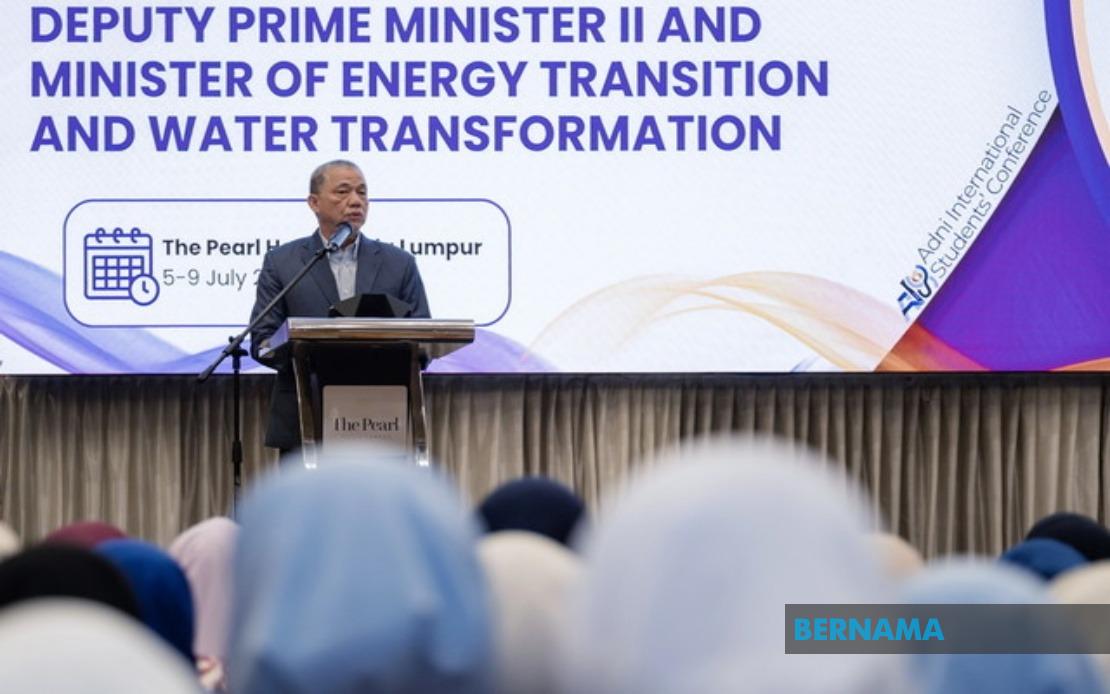
Malaysia's trajectory in the coming decades will be determined less by its economic machinery or technological prowess than by the caliber of its people, Deputy Prime Minister Datuk Seri Fadillah Yusof said on July 6 while opening the ADNI International Students' Conference (AISC) 2026 in Kuala Lumpur. The remark represents a significant shift in national development philosophy, placing emphasis on human capability as the bedrock of competitive advantage rather than infrastructure or capital investment alone.
Fadillah articulated a specific vision of what constitutes effective human capital for the modern era. The nation requires individuals equipped with critical thinking skills, capable of communicating across linguistic and cultural boundaries, and possessing the flexibility to navigate technological and social transformation. These attributes, he suggested, form the foundation upon which all other national achievements must rest. Without such a foundation, economic gains become fragile and technological adoption becomes hollow.
The Deputy Prime Minister anchored his argument to the reality of contemporary global challenges. Issues including climate change, infectious disease outbreaks, rapid digital transformation, and persistent social inequality transcend national borders and resist unilateral solutions. He emphasized that these interconnected problems demand coordinated responses involving multiple stakeholder groups—government bodies, universities and research institutions, commercial enterprises, community organizations, and crucially, the younger generation. This framing positions human capital development as not merely an economic imperative but a societal necessity.
In connecting his remarks to government policy, Fadillah noted that the MADANI Government has positioned human capital development as central to its vision of national advancement. This principle echoes observations made decades earlier by Malaysia's third Prime Minister Tun Hussein Onn, who argued that a nation's true strength derives from the cohesion and moral character of its citizenry rather than from tangible assets or institutional infrastructure. The continuity of this thinking across administrations suggests enduring recognition within Malaysia's political leadership that intangible human qualities ultimately determine national resilience.
Fadillah drew a distinction between technological connectivity and genuine societal connection. While digital networks can link devices and enable information exchange, he argued, only shared ethical frameworks, reciprocal respect, and mutual confidence can forge authentic bonds between communities and nations. This observation carries particular relevance for Malaysia, a multi-ethnic, multi-religious society where social cohesion depends on values that transcend technological mediation.
The Deputy Prime Minister outlined a holistic conception of development that extends beyond conventional metrics. True progress, in his view, must integrate education attainment, individual and collective well-being, ethical development, creative capacity, environmental sustainability, and social interconnectedness. This framework suggests dissatisfaction with development models that prioritize GDP growth or technological adoption while neglecting dimensions such as moral reasoning or ecological responsibility.
The AISC 2026 gathering itself embodied principles Fadillah articulated. Themed 'Thriving Together: Diversity, Education and Wellness in a Digital World', the conference assembled approximately 150 student participants representing both Malaysian institutions and international delegations from Thailand, the Philippines, and Indonesia. This composition facilitated intellectual exchange and intercultural understanding among young people from across the region, creating networks that transcend national boundaries. Such forums serve as incubators for the cross-cultural competence and collaborative instinct that Fadillah identified as crucial for addressing transnational challenges.
Fadillah noted that the conference embodied principles underlying the United Nations Sustainable Development Goals, particularly those addressing quality education, social inclusion, institutional effectiveness, and strategic collaboration. This alignment suggests Malaysia's positioning of its human capital agenda within a global development framework, indicating ambitions to shape not merely national outcomes but to contribute to broader regional and international progress.
The Deputy Prime Minister directed particular remarks toward student participants, offering philosophical guidance alongside policy statements. He cautioned against excessive faith in artificial intelligence and automation, noting that while algorithmic systems may accumulate information processing power, they cannot replicate wisdom—the capacity to discern appropriate application of knowledge in specific contexts. Similarly, he argued that technology can never substitute for compassion, the emotional and ethical foundation of human relationships and social solidarity.
The significance of Fadillah's statements extends beyond ceremonial remarks at a student conference. They articulate a strategic rationale for educational investment and youth development that frames these not as social expenditures but as economic and political necessities. For policymakers across Southeast Asia grappling with demographic transitions, technological disruption, and global competition, this emphasis on human capital quality provides a template for development prioritization.
The conference's regional composition reflects growing recognition across Southeast Asia that human capital challenges are fundamentally regional in character. Climate change, digital transformation, and labor market shifts affect Thailand, the Philippines, Indonesia, and Malaysia comparably, suggesting that collaborative approaches to developing critical thinking, ethical reasoning, and adaptive capacity may prove more effective than purely national initiatives. Fadillah's remarks implicitly acknowledged this reality by framing human capital development as both a national imperative and a regional undertaking.
Looking forward, the Deputy Prime Minister's emphasis on human capital quality carries implications for Malaysia's educational systems, workforce development programs, and immigration policies. If national competitiveness depends primarily on the characteristics of the population rather than accumulated wealth or technological infrastructure, then educational quality, skills development, talent retention, and attracting high-caliber international talent become central strategic concerns. The remarks suggest potential reorientation of government priorities toward these dimensions of human capital formation.

