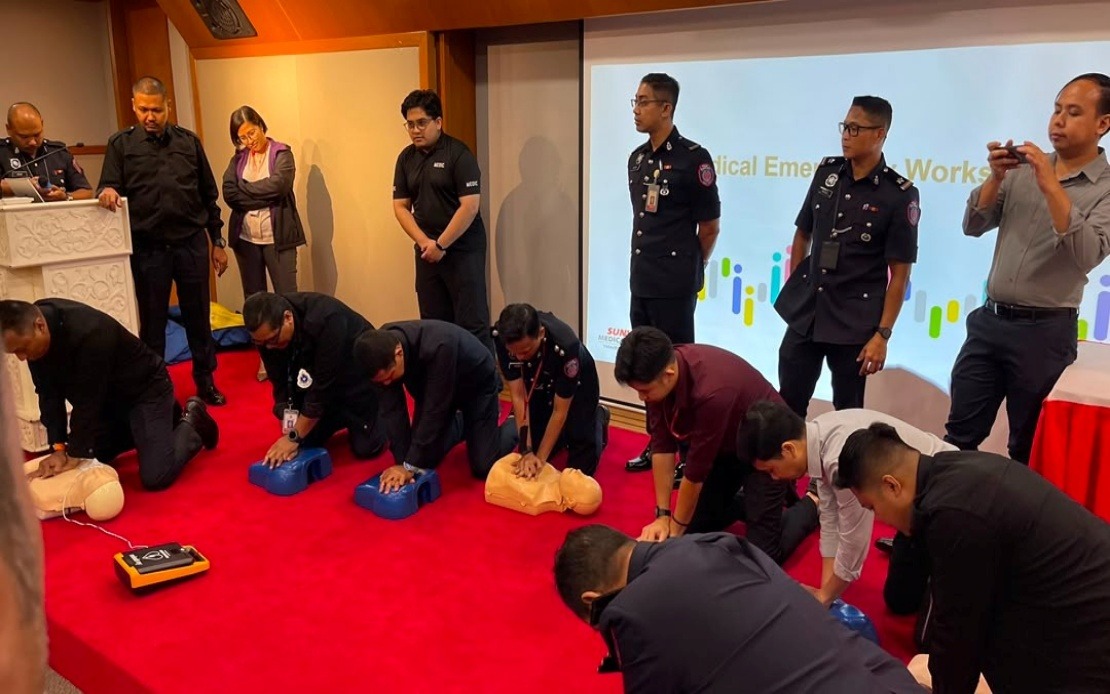
Malaysia faces a silent health crisis, with sudden cardiac arrest claiming lives at alarming rates and survival outcomes among the world's poorest. The nation's cardiac arrest survival rate, hovering between 0.5 and 8.5 per cent, reflects a systemic gap in both emergency infrastructure and public preparedness—a disparity that Sunway Medical Centre Velocity is now working to narrow through an ambitious expansion of life-saving equipment across Kuala Lumpur's busiest corridors. The initiative underscores a hard medical reality: in cardiac emergencies, every second is measurable distance between recovery and tragedy.
The biological window for intervention is brutally unforgiving. When the heart stops without warning, the brain begins dying within minutes, and without cardiopulmonary resuscitation initiated promptly, survival chances plummet catastrophically after eight to ten minutes have elapsed. This explains why Malaysia's survival statistics lag so dramatically behind developed nations—the chain of survival is only as strong as its weakest link, and for too many Malaysians, that link has been missing entirely. The absence of accessible automated external defibrillators in public spaces, combined with widespread uncertainty about how to perform CPR, has created a scenario where rescuers exist but are frequently paralysed by either ignorance or lack of equipment.
Sunway Medical Centre's expansion strategy places AED units at thirteen carefully selected locations, each chosen for high foot traffic and demonstrated cardiac emergency risk. The rollout encompasses major transport interchanges—including MRT stations at Tun Razak Exchange, Bukit Bintang, Ampang Park and Muzium Negara—alongside major commercial landmarks such as Aquaria KLCC and towers within the Menara Public Bank complex. The inclusion of Stadium Merdeka's National Heritage Building within the Merdeka 118 Precinct and the Public Bank-ITTC facility demonstrates recognition that cardiac events do not discriminate by venue; they strike in conference rooms, shopping malls, and cultural spaces with equal indifference. These placements reflect epidemiological logic: position lifesaving tools where the crowds are densest and the odds of sudden collapse highest.
Yet equipment alone is insufficient. Dr Wee Tong Ming, the hospital's Medical Director and Emergency Physician, articulated the crucial insight that delays in response—not the absence of help—claim lives. A defibrillator in a locked cabinet or mounted invisibly on a wall becomes merely symbolic. To address this, each AED unit will be accompanied by distinctive standees designed for immediate visibility and intuitive access. Quick response codes linking to guidance materials will connect bystanders to training resources in real time, bridging the gap between equipment availability and knowledge of how to deploy it. This layered approach—combining physical access, visual clarity, and digital guidance—recognises that infrastructure and information must move together.
The hospital's corporate social responsibility programme extends beyond device placement into systematic public education. On-site training sessions and accident and emergency awareness talks are building a foundation of basic life support competency throughout the community. The initiative targets recognition of cardiac arrest symptoms, hands-on CPR technique, and confidence in operating defibrillators correctly. Without this educational component, AED rollout becomes a collection of dormant machines. With it, ordinary citizens transform into potential rescuers capable of extending survival windows until professional paramedics arrive. Susan Cheow, the centre's Chief Executive Officer, framed the initiative in democratic terms: no one should feel helpless when confronted with medical emergency, whether through lack of knowledge or lack of equipment.
For Malaysia's healthcare ecosystem, this public-private partnership model carries broader significance. Government hospitals and emergency services operate under considerable resource constraints, and supplementary initiatives from private healthcare providers can meaningfully expand capacity in critical domains. The integration of general practitioner clinics into the information distribution network—through QR code stickers connecting to guidance materials—creates redundancy in the system, ensuring that residents across multiple healthcare touchpoints encounter emergency preparedness messaging repeatedly. This reinforces the cultural shift Sunway is attempting: moving emergency readiness from an esoteric speciality into everyday public consciousness.
The initiative also reflects growing recognition that medical emergencies constitute a shared vulnerability, not merely an individual misfortune. When a person collapses from sudden cardiac arrest in a shopping mall, the problem becomes collective: the mall's responsibility to provide tools, the nearby shoppers' responsibility to act, and society's responsibility to ensure everyone possesses baseline competency. This reframing matters politically and socially, suggesting that emergency preparedness belongs alongside occupational safety and food hygiene as standard infrastructure rather than luxury amenity.
Malaysia's demographic trends add urgency to this work. As the population ages, cardiovascular disease prevalence increases inexorably. Non-communicable diseases already dominate mortality statistics, and cardiac events will only become more frequent absent significant preventive advances. The current moment to embed AED access and CPR training represents wise investment in future resilience. For Southeast Asian countries observing Malaysia's approach, the model offers a replicable template: identifying high-traffic public spaces, partnering with healthcare institutions for equipment and training provision, and creating feedback loops where community members become defenders of their own spaces.
The programme's emphasis on infrastructure and education working synchronously is particularly instructive for the Malaysian context. Placement of 13 defibrillator units across central Kuala Lumpur cannot claim to have solved the national survival rate crisis comprehensively—far more is needed across provincial hospitals, secondary cities, and rural areas. Yet the initiative demonstrates how institutional commitment can systematically address preventable gaps. Each person trained in CPR becomes a permanent resource. Each AED correctly used generates community confidence in emergency response. Each successful resuscitation broadcasts powerful evidence that action matters.
Implementation of this scale requires coordination across multiple stakeholders: Sunway Medical Centre itself, property managers of the designated locations, transport authorities overseeing MRT stations, and countless individuals willing to dedicate time to training. The complexity of mobilising such cooperation illustrates why many hospitals never progress beyond aspiration to execution. That Sunway has committed resources to a genuinely expansive rollout rather than token gesture suggests institutional seriousness about impact. The hospital's willingness to fund ongoing training and awareness campaigns, rather than merely installing equipment and declaring victory, further distinguishes genuine commitment from performative corporate responsibility.
For Malaysian patients and families who have suffered sudden cardiac arrests, the expansion carries personal resonance beyond policy abstraction. An AED installed at the Bukit Bintang MRT station might save the life of someone who would previously have collapsed with zero access to defibrillation. A shopper trained through a Sunway awareness session might recognise symptoms and perform CPR on a stranger, extending their survival window sufficiently for ambulances to arrive. These outcomes, invisible in aggregate statistics until sufficient cases accumulate, represent the true measure of the programme's success.
As Sunway Medical Centre extends this initiative and considers future expansion beyond Kuala Lumpur's boundaries, Malaysian healthcare stakeholders should evaluate the model's lessons. The integration of equipment, training, and community engagement offers a pathway toward materially improving survival outcomes in one of the few medical emergencies where seconds determine survival. The hospital's framing—that emergency preparedness should be woven into everyday planning—challenges complacency and positions sudden cardiac arrest as a problem amenable to systematic intervention rather than tragic inevitability. For a nation currently losing far too many people to events that could be survived with proper preparation, this expansion represents meaningful progress against preventable death.

